Industrial emissions
A new study in Proceedings of the National Academy of Sciences shows why aircraft may need to play a much larger role.
The research, led by scientists at the U.S. National Science Foundation National Center for Atmospheric Research, used global airborne CO₂ observations from NASA’s Atmospheric Tomography Mission to test and refine estimates of where carbon dioxide is being emitted and absorbed.
For environmental monitoring professionals, the significance is not only scientific.
It points to a wider monitoring problem: if carbon sinks and sources are poorly constrained, then climate models, carbon budgets, emissions reporting and net-zero assessments all carry greater uncertainty than they appear to.

The concentration of CO₂ in the atmosphere reflects a balance between sources and sinks.
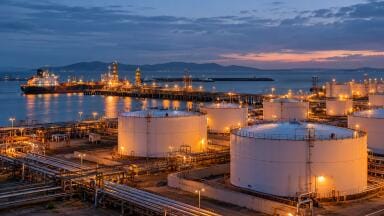
Sources include fossil fuel combustion, land-use change, deforestation and natural releases from land and ocean systems. Sinks include forests, vegetation, soils and oceans that absorb CO₂ from the air.
At the global scale, scientists know that atmospheric CO₂ is rising because human emissions exceed the ability of natural systems to absorb them.
The harder question is where the remaining carbon is going.
That matters because carbon budgets are not only scientific accounting exercises. They influence climate projections, national reporting, land-use policy, carbon removal claims, forestry strategies and assessments of whether natural sinks are weakening under climate pressure.
If models overestimate the ability of tropical forests to absorb CO₂, for example, then future carbon budgets may be too optimistic.
If northern forests are absorbing more CO₂ than expected, or if fossil fuel emissions are being overestimated in some regions, that has different implications for monitoring, modelling and policy.
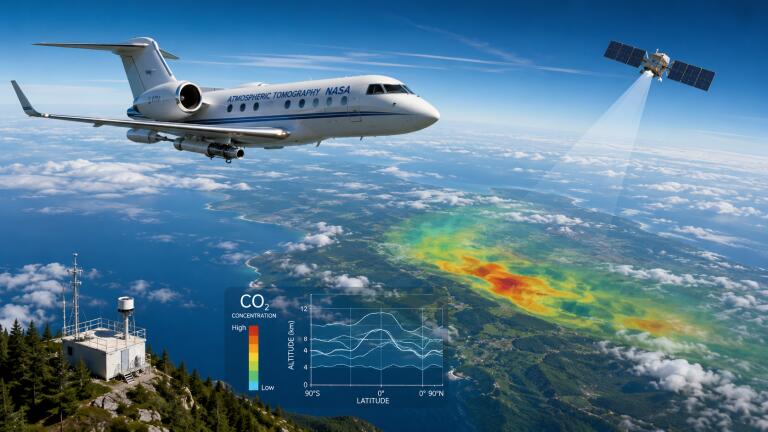
The PNAS study used airborne CO₂ observations from NASA’s ATom mission, which flew research aircraft across large sections of the global atmosphere between 2016 and 2018.
The aircraft sampled air at different altitudes, from near the surface to the upper troposphere, across remote ocean basins and latitude bands.
That vertical information is important.
Surface stations provide highly accurate measurements, but they are sparse and unevenly distributed. Satellites provide broad coverage, but CO₂ retrievals are technically challenging, especially in cloudy regions and high latitudes.
Aircraft sit between those systems.
They can sample large transects of the atmosphere while also capturing vertical mixing, helping researchers test whether atmospheric models are placing sources and sinks in the right places.
Using these airborne data, the researchers reduced uncertainty in latitudinal carbon flux estimates. Their results suggest that tropical forests take up less CO₂ than many Earth system models predict.
The study also found that forests and other land systems outside the tropics may be taking up more CO₂ than some models suggest, or that fossil fuel emissions estimates in those regions may be too high, or both.
In practical terms, the research challenges a simple assumption that the tropics are acting as a large, reliable carbon sink.
Instead, the tropical land system may be closer to neutral, or even a small net source, once emissions, uptake and land-use change are considered together.
For monitoring professionals, the study reinforces a familiar principle: modelled outputs are only as strong as the observations used to constrain them.
Carbon budgets rely on many different evidence streams. These include emissions inventories, atmospheric measurement stations, satellite retrievals, ocean flux estimates, forest inventories, land-use datasets and process-based ecosystem models.
Each has strengths and weaknesses.
The value of airborne monitoring is that it can test the combined result of those systems in the atmosphere itself. Rather than only asking what forests, oceans or industrial sources are expected to do, aircraft measurements help show what the air actually contains after those exchanges have occurred.
That makes airborne campaigns especially useful for validating inverse models.
Inverse modelling works backwards from measured atmospheric CO₂ concentrations to estimate where emissions and removals must have occurred. But different inverse models can produce very different regional results, particularly where observations are sparse or transport modelling is uncertain.
Aircraft data provide an independent check.
The study does not suggest that aircraft should replace satellites.
Instead, it shows why satellite, aircraft and surface measurements need to work together.
Satellites are essential for repeated global coverage and for detecting spatial patterns that would be impossible to observe from the ground alone.
Surface networks provide long-term, high-quality records. Aircraft can fill a different gap by sampling vertical structure and remote atmospheric regions with consistent instrumentation.
For greenhouse gas monitoring, that combination is increasingly important.
As countries, companies and carbon markets make stronger claims about emissions reductions and removals, the demand for defensible atmospheric evidence will grow.
That evidence will need to support both broad climate science and practical MRV systems.

The findings are relevant to suppliers and users of greenhouse gas analysers, airborne sampling systems, calibration gases, telemetry systems, atmospheric modelling platforms and data-assimilation tools.
They also matter for organisations working on satellite validation, carbon accounting, land-use monitoring and climate-risk assessment.
The study suggests that high-quality airborne campaigns can materially reduce uncertainty in carbon budgets. That creates a case for sustained measurement programmes rather than isolated scientific campaigns.
For instrumentation users, the important point is that carbon monitoring is becoming a system-of-systems challenge.
No single platform can provide the full answer. Ground stations, aircraft, satellites, inventories, flux towers, ocean measurements and models all need to be connected into coherent evidence networks.
The study arrives at a time when climate policy is increasingly dependent on assumptions about natural carbon sinks.
Forests, soils and oceans are often built into net-zero pathways as continuing absorbers of CO₂. But if those sinks are weaker, more variable or differently distributed than expected, then emissions cuts may need to be deeper and faster than current carbon accounting implies.
This is why the monitoring detail matters.
An uncertain carbon sink is not just a scientific uncertainty. It affects how governments assess progress, how companies report climate performance and how carbon removal or land-use projects are valued.
The PNAS study shows that better observations can reduce that uncertainty.
For the environmental monitoring sector, the message is clear: carbon accounting will increasingly depend on atmospheric measurement systems that can verify what models and inventories claim.
Aircraft may not be the most visible part of that system, but this research suggests they could be one of the most important.
IET 36.5 Sept/Oct 2026



 Product directory



















.jpg)