Water/wastewater
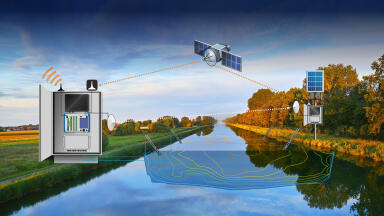
Flow measurement specialists at Nivus have developed a wireless, continuous river monitoring solution to meet the requirements of water managers and regulators such as the Environment Agency (EA) in England. Utilising satellite technology, the new Wireless Transit Time method avoids the requirement for invasive capital works on rivers.
River flow measurements underpin several of the EA’s core functions, including flood warning, modelling, forecasting and planning, as well as the management of water infrastructure and abstraction licenses. Flow monitoring also informs the EA’s work to monitor long-term indicators of change in catchments, and track the effects of climate change.
The EA operates around 7,000 hydrometric monitoring stations across England. This includes high-resolution data (mainly 15 minute) measurements of river flow, river level, groundwater and rainfall, as well as daily data.
"The measurement of river flow in England presents a particular set of challenges,” explains Sam Everitt, National Hydrometry Advisor at the EA. “We monitor everything from slowly responding lowland rivers to catchments that can experience rapid changes in flow during storm events. This means that flow monitoring technology has to be sufficiently robust and versatile to perform reliably across a wide range of river conditions."
The EA operates a variety of flow measurement techniques, and the Transit Time method has been employed for decades to monitor relatively clean rivers. Traditionally, the main drawback of the Transit Time method has been the necessity to install cabling across or under the river.
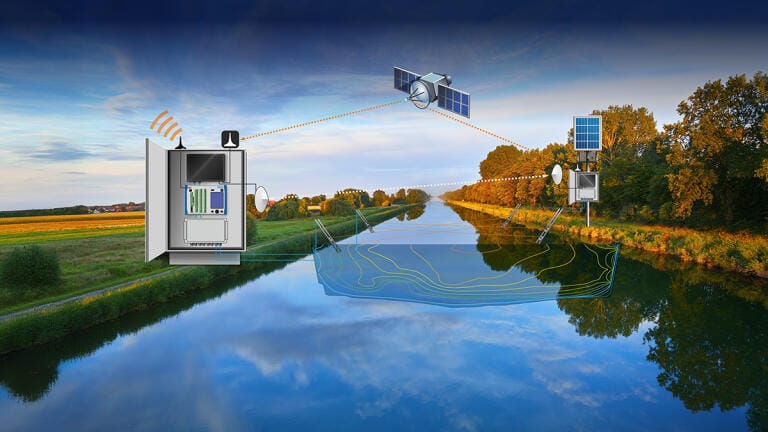
This standard flow measurement method (ISO 6416) relies on the highly accurate measurement of acoustic signals emitted upstream and downstream. Sensors are necessary on both banks of a river so that it is possible to exploit the characteristic of sound waves travelling faster in the direction of the flow than they do when travelling against it. One sensor acts as a transmitter sending a signal downstream, and the sensor (transmitter/receiver) on the opposite bank receives it. The process is then reversed to measure the upstream signal.
Highly accurate flow velocities are determined by calculating the difference between the upstream and downstream signal transmission times. This delivers a full velocity profile of the river, rather than spot velocity measurements that are utilised by some alternative methods.
In comparison with traditional methods like mechanical meters, Acoustic Doppler Current Profilers (ADCP), or tracer injections, the Transit Time method offers a number of important advantages. It provides continuous measurements; has less environmental impact; is not reliant on tracers, particles or bubbles; is less sensitive to localised turbulence and misalignment; offers highly reproducible total discharge volume measurements, and requires very low levels of maintenance.
Explaining the advantages of their Transit Time monitors, Nivus’s Alistair MacKinnon says: “We can apply this method to a wide range of channel sizes, and for rivers up to 200 metres wide. Deep water can also be accommodated with multiple sensors and signal paths. In addition, some of these signal paths can be redundant to account for fault conditions or obstructions.”
The potential disadvantages of the Transit Time method include unsuitability to high levels of suspended solids or weed, and to water with entrained air bubbles.
The Transit Time method involves very fast measurements (nanoseconds) between sensors, so it is necessary for the internal timing of the transmitter/receivers to be synchronised and extremely accurate. For this reason, the sensors on both banks have traditionally been connected by cross-river cabling, which significantly increases the cost of installation. Typically, this involves civil works and the installation of cross-ducting on the river floor – operations that can necessitate the damming or diversion of river flow. The installation of ducting can negatively impact river ecology, and once in place, ducting can present a hazard to human activities. In addition, the duct and cabling could be at risk during severe weather events.
The Nivus WTT solution retains the accuracy of the Transit Time flow measurement method without the associated costs and disadvantages of the cabled version. The WTT sensors communicate across the river by Wi-Fi and maintain time accuracy by communicating with GPS satellites which employ atomic clocks.
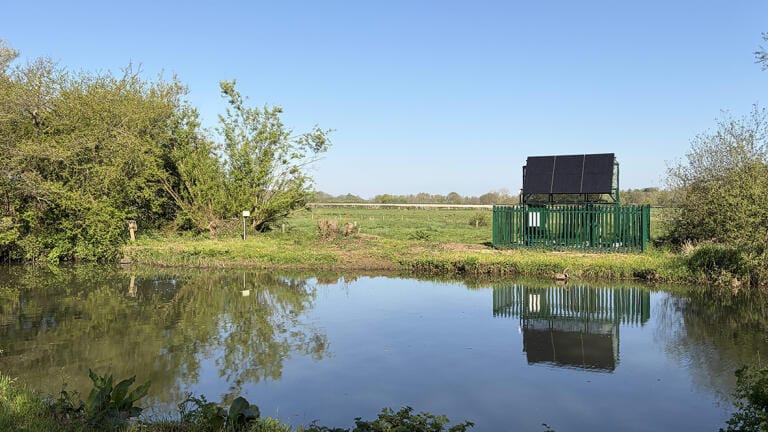
Sustainability has been a key driver in the development of the Nivus WTT solution. The entire system is able to operate on solar power, providing an off-grid solution that can be deployed in any location. In addition, ground screws are used to anchor the bankside equipment, which avoids the need for concrete, and simplifies decommissioning.
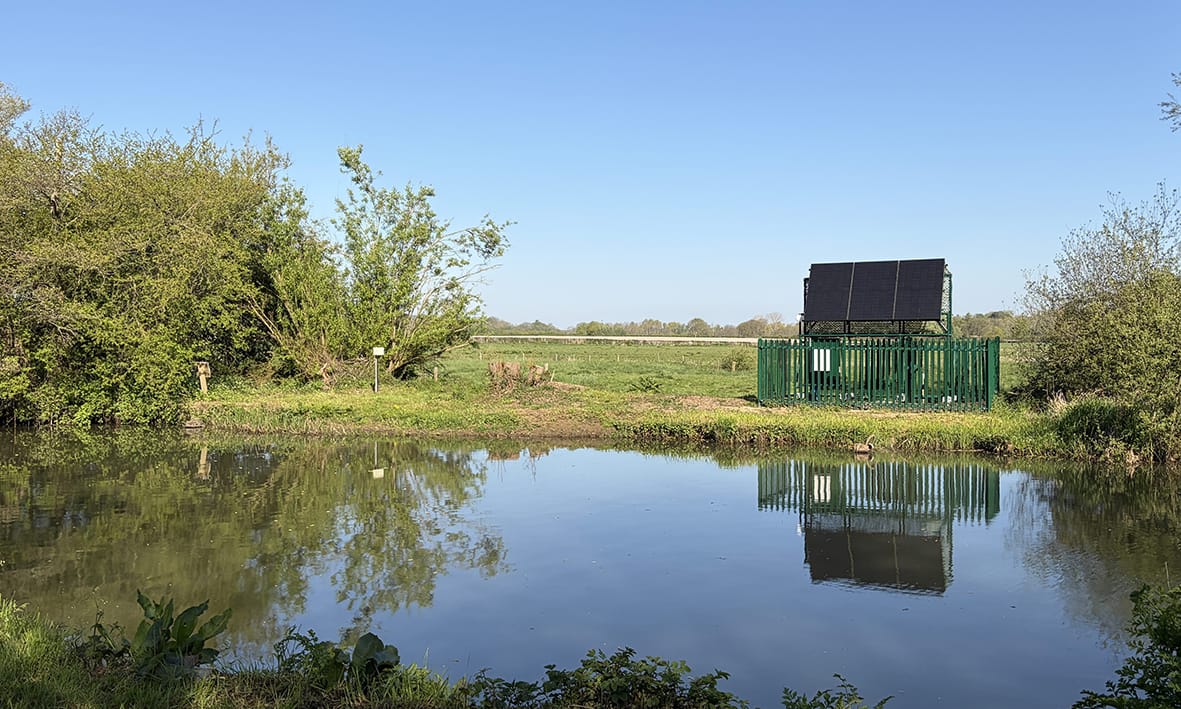
A Nivus WTT system has recently been installed on the River Ouse at Barcombe Mills, close to the Barcombe Reservoir in East Sussex. The new system replaced an older Transit Time monitor that had failed.
The EA and its predecessor, the National Rivers Authority, have been monitoring river flow at the site for over 30 years. The previous system employed a cross-river duct that lay on the riverbed, weighed down by clay chimney pots. Theo Parfitt, from the EA’s regional Hydrometry & Telemetry team, explains the options: “It would be possible to bore a tunnel under the river, but this requires tunnelling to begin at some distance from the river to create the correct angle of bore. However, aside from the high cost, the proximity of the reservoir rendered this option redundant. Similarly, replacement of the cross-river ducting was disregarded because of cost and environmental issues. It was fortuitous therefore that our working partnership with Nivus had developed a beneficial solution.”
The Ouse is approximately 20m wide at Barcombe Mills, and it was estimated that the cost of a Nivus WTT system would be around 25% of the cost of a ducted system.
“The previous system included two sets of sensors in submerged racks on either bank, with 8 signal paths,” Theo explains. “Fortunately, these sensors could be utilised by the new WTT system, which also helped to lower costs.”
The EA already operates two WTT systems on North London and Yorkshire. Both of these Nivus installations are mains powered, so Barcombe Mills is the first to be fully solar powered.
Looking forward, Sam Everitt says: “This is a good example of the ways in which the EA can leverage its size and expertise, working with specialist partners, to develop innovative solutions that save money and enhance environmental protection. Given these advantages, we are looking to switch our existing Transit Time monitors to wireless versions as they come up for renewal. The new technology appears to be working very well, and has prompted interest from our counterparts in North America and Scandinavia.”
IET 36.5 Sept/Oct 2026


 Product directory