Wastewater analysis
A new digital transmitter for fixed water and wastewater monitoring points connects directly to up to four digital sensors, displaying and transmitting readings for parameters ranging from dissolved oxygen to organic load.
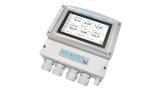
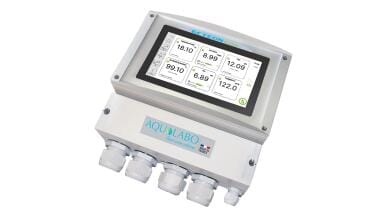
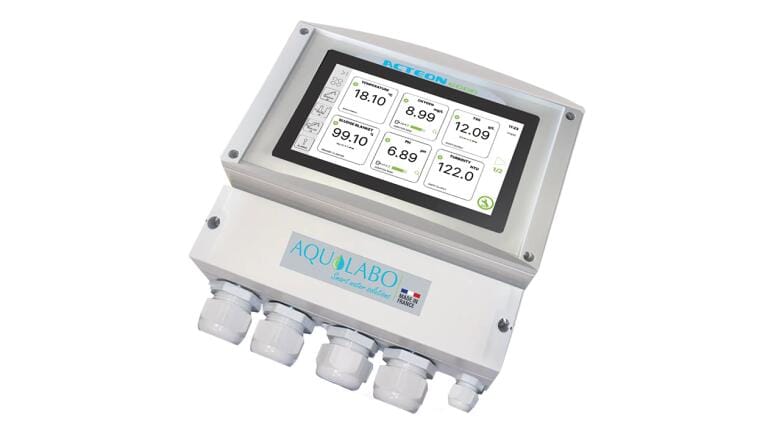
Aqualabo has introduced the ACTEON 6000, a multi-channel digital field transmitter designed for use in wastewater treatment, drinking water, industrial effluent treatment, surface water monitoring and fish farming.
The unit connects directly to up to four digital sensors from the PONSEL range. These measure pH, redox, temperature, optical dissolved oxygen, conductivity, salinity, turbidity, suspended solids and sludge blanket. UV absorption sensors measure the spectral absorption coefficient at 254 nm (SAC254), as well as equivalent values for total organic carbon (TOC), chemical oxygen demand (COD) and biochemical oxygen demand (BOD). Sensors for nitrate, ammonium, chlorine and hydrocarbons are also supported.
Each PONSEL sensor stores its calibration data, including factory coefficients, offset and slope, within the probe. Digital communication between the sensor and transmitter helps protect measurements against interference.
The transmitter runs two Modbus RTU networks. One handles the four DIGISENS digital sensor inputs, while the other provides a configurable input. Two analogue inputs and two digital inputs are also available, allowing additional sensors to be connected via Modbus, 0–10 V or 4–20 mA. These can measure parameters such as level or chlorophyll.
Readings can be transmitted via four 4–20 mA analogue outputs, Modbus RTU or Ethernet TCP/IP. Four programmable relays and three digital outputs provide control options for applications such as regulating nitrification and denitrification in aeration tanks or timing an external cleaning system.
A 7-inch backlit touchscreen displays up to 12 parameters and relay status on the main screen. Data can be logged and exported in CSV format via USB. The polycarbonate housing is rated IP65, and the unit operates at temperatures from –15°C to +50°C.
IET 36.5 Sept/Oct 2026


 Product directory