Wastewater analysis
Wastewater is increasingly being recognised for something it was never originally designed to do: provide early insight into public health trends. By analysing what is present in municipal sewage, scientists can detect the presence and spread of infectious diseases across entire communities, often before cases are formally diagnosed.
This approach, known as wastewater-based epidemiology, is now moving from research into regulation. Under EU Directive 2024/3019, EU Member States will be required to put in place robust systems for epidemiological wastewater monitoring by 2027. In practice, this means turning a complex scientific concept into a reliable, routine monitoring tool.
Wastewater is an extremely challenging sample type, so that is easier said than done. Its composition changes constantly and contains a mixture of biological and chemical material that can make accurate pathogen detection difficult. To be effective, monitoring systems must therefore be both highly sensitive and highly robust.
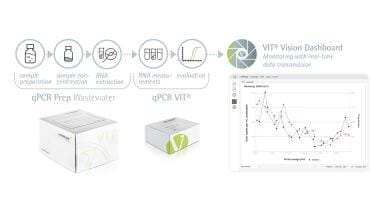
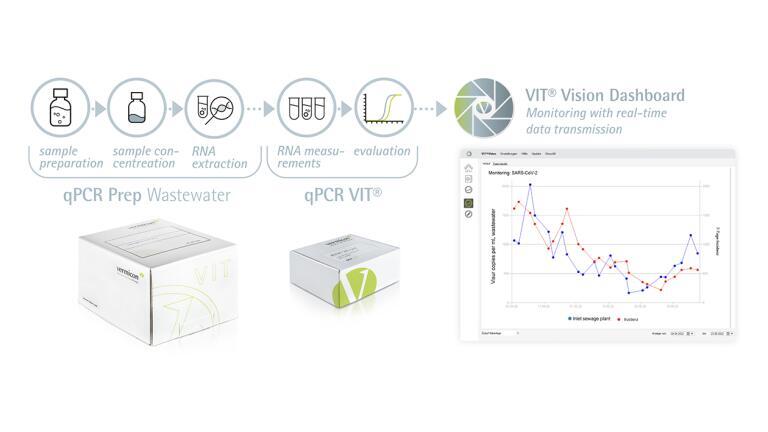
One technology developed specifically for this environment is the qPCR VIT® Test Kit from vermicon AG. Built on more than 30 years of microbiological expertise, the kits are designed to work within the realities of wastewater analysis rather than ideal laboratory conditions.
Using the established RT-qPCR method—recommended by the EU Commission and ESI-CorA for epidemiological applications—the system enables the detection and quantification of RNA virus particles with a high degree of sensitivity. Just as importantly, it includes tailored sample preparation steps that help ensure reliable results even in difficult wastewater matrices.
In practical terms, this allows operators and laboratories to monitor viral loads in wastewater on an ongoing basis, rather than relying on occasional snapshots. Over time, this creates a clearer picture of how infection levels are changing within a population.
As wastewater monitoring becomes more embedded in public health strategy, the focus is shifting towards tools that are not just scientifically sound, but also practical and repeatable in real-world conditions.
The qPCR VIT® Test Kits will be showcased at IFAT Munich 2026, where the latest developments in water and environmental monitoring will be on display.
More broadly, this field marks a quiet but important shift in public health: using existing infrastructure not just to manage sanitation, but to understand and anticipate disease trends before they escalate.
IET 36.5 Sept/Oct 2026




 Product directory