Business news
Regulatory activity on per- and polyfluoroalkyl substances (PFAS), widely known as forever chemicals, is intensifying across the United States, the European Union and Japan, with implications for testing, monitoring and remediation markets.
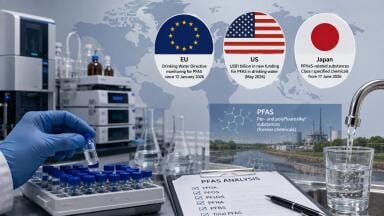
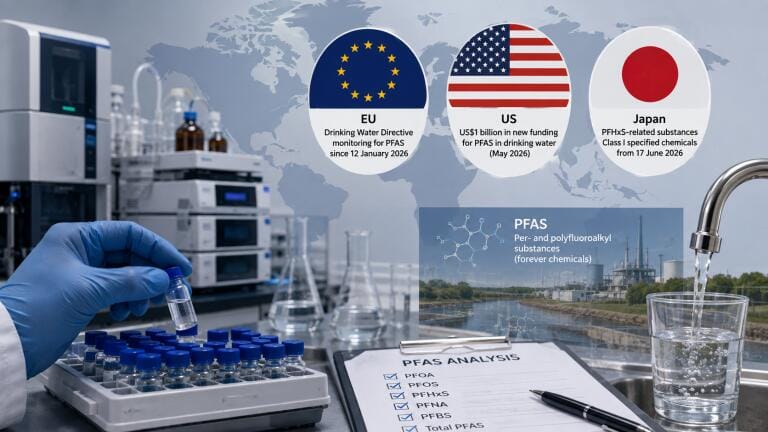
Since 12 January 2026, EU member states have been required to monitor PFAS in drinking water under the recast Drinking Water Directive, applying harmonised methods and binding limits for total and summed PFAS. In the US, the Environmental Protection Agency announced nearly US$1 billion in new funding in May 2026 to help states address PFAS in drinking water, alongside proposed changes to existing PFOA and PFOS standards. Japan has designated PFHxS-related substances as Class I specified chemicals under its Chemical Substances Control Law, prohibiting their manufacture, import and use from 17 June 2026.
Market researcher DataM Intelligence forecasts the global PFAS testing market will exceed US$1.8 trillion by 2035 – a vendor projection rather than an independently verified figure. The European Commission has separately estimated legacy PFAS remediation across the EU-27 could cost around US$42 billion over 20 years.
For laboratories and instrument suppliers, expanding analyte lists and tightening limits point to sustained compliance-driven demand across all three markets.
IET 36.5 Sept/Oct 2026




 Product directory