Water monitoring
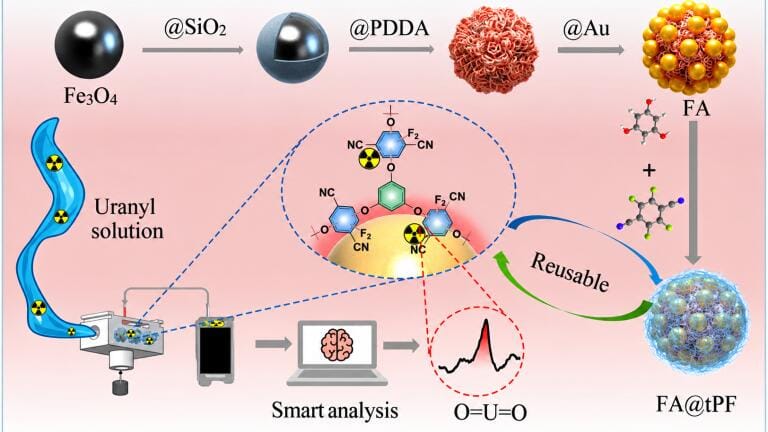
Polymer-coated magnetic particles concentrate uranyl ions for surface-enhanced Raman measurement and can be regenerated for repeat use.
A magnetic sensor that captures uranyl ions for Raman analysis has detected the mobile form of uranium at concentrations down to 1×10⁻⁷ moles per litre in water, and can be cleaned and reused.
The work, by Zhenli Sun’s team at North China Electric Power University, is published in Sustainable Carbon Materials.
Established methods for uranium monitoring are accurate but often require costly instruments, extensive sample preparation and trained operators. Surface-enhanced Raman scattering (SERS) can identify substances from their molecular fingerprints using potentially portable equipment. Its performance, however, depends on the sensing surface capturing sparse target ions and producing a strong signal in the presence of other substances.
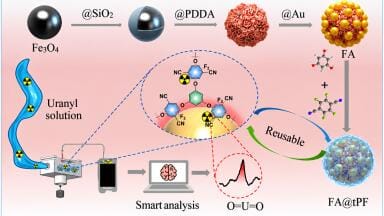
The sensor, FA@tPF, is built from magnetic iron oxide particles coated with silica, decorated with gold nanoparticles and finished with a covalent organic polymer layer. The magnetic core allows the particles to be recovered with a magnet, the polymer captures uranyl and the gold nanoparticles amplify Raman signals from nearby material.
In tests on standard uranyl solutions, the particles were mixed with water, collected magnetically and measured with a portable Raman instrument. A characteristic peak near 850 inverse centimetres remained detectable at 1×10⁻⁷ moles per litre after 20 minutes of enrichment. The signal tracked concentration across the tested range of 1×10⁻⁷ to 1×10⁻⁴ moles per litre.
Particles without the polymer layer produced no identifiable uranyl peak, even at 1×10⁻⁴ moles per litre. A flow-cell experiment reached the same detection limit after 20 minutes, and common coexisting ions had little effect on the uranyl signal.
Captured uranyl was released with a sodium carbonate solution. The characteristic peak remained detectable through six capture-and-release cycles, though its intensity declined slightly.
The team also analysed the spectra using principal component analysis and a convolutional neural network. The model classified the reported dataset with 100 per cent accuracy, basing its decisions mainly on the uranyl peak near 850 inverse centimetres.
The authors note that performance across a wider range of real environmental samples has yet to be established. The research was supported by the National Natural Science Foundation of China.
IET 36.5 Sept/Oct 2026


 Product directory