Water/wastewater
A computational study has mapped out a multilayer surface plasmon resonance design that swaps the usual gold film for aluminium, although the device has yet to be built or tested on real water samples.
Researchers in Ecuador and Italy have used numerical modelling to design a thin-film optical sensor that could, in principle, register the small refractive index changes in water associated with dissolved mercury, lead and zinc ions.
Published in Electron, the study sets out an optimised four-layer architecture based on surface plasmon resonance (SPR). Gold is the metal most often associated with SPR sensing because of its chemical stability. The team instead modelled aluminium, which is more abundant and comparatively cheap.
The design exists only as a simulation. It has not been fabricated or exposed to environmental samples, and the authors present it as a basis for future experiments rather than a working device.
Detecting metal ions at low concentrations typically depends on specialised analytical instruments and trained staff. Optical approaches such as this are being investigated as a way to make water monitoring faster, simpler and more accessible.
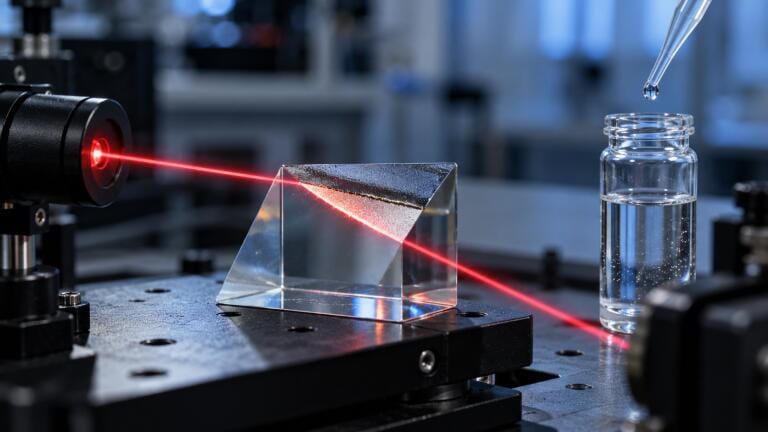
In SPR, the angle at which incoming light couples into a thin metal film depends on the refractive index immediately next to the sensing surface. When that local environment changes, the resonance angle shifts – converting an otherwise invisible change in the water into a measurable optical signal.
The optimised stack comprises a borosilicate glass prism, a 60nm aluminium film, a 32nm aluminium oxide (Al₂O₃) layer and a graphene oxide sensing layer. Borosilicate was chosen after comparison with other prism materials, offering the best trade-off between optical response and resonance sharpness under the modelled conditions.
Because aluminium oxidises readily, the Al₂O₃ layer serves a dual purpose. It passivates the metal and also forms an integral part of the optical design.
For the outermost layer, the team compared four carbon nanomaterials: graphene oxide, reduced graphene oxide, graphene and semiconducting single-walled carbon nanotubes. The nanotubes produced a particularly large angular shift but broadened the resonance so severely that it would be difficult to measure precisely. Reduced graphene oxide and graphene each involved different compromises between signal shift and resonance width.
Graphene oxide gave the most balanced result, combining a measurable shift with a comparatively narrow resonance. The finding underlines a basic point in sensor design: the material with the largest response is not necessarily the most useful one.
Simulations covered aqueous conditions corresponding to Hg(II), Pb(II) and Zn(II), plus two binary mixtures containing mercury. Among the single-ion cases, Zn(II) gave the highest modelled angular sensitivity and Hg(II) the lowest. Both mixtures retained sensitivities above 333 °/RIU, where RIU denotes refractive index units.
The modelled optical limits of detection were on the order of 10⁻⁵ RIU. This is not a concentration. It represents the smallest refractive index change the system could theoretically resolve, and relating it to actual mercury, lead or zinc levels will require calibration against experimentally prepared samples.
The authors are also clear that the model distinguishes conditions through refractive index alone. It does not show that unmodified graphene oxide is selective for any particular metal. In real water, sodium, calcium and magnesium ions, pH, temperature, ionic strength and dissolved organic matter could all affect the signal. Competition between ions and adsorption kinetics were outside the scope of the model.
Demonstrating chemical selectivity would therefore require selective surface functionalisation – adding recognition elements that preferentially bind target ions – along with experimental validation and interference studies.
Fabricated films will also depart from the idealised model. Surface roughness, small variations in layer thickness, continued oxidation of the aluminium and uneven graphene oxide coatings could all alter the observed resonance.
The next stages set out in the study include fabrication-tolerance analysis, production of the multilayer structure, surface functionalisation, long-term stability testing and trials with real water samples. The authors suggest conventional thin-film deposition for the aluminium, controlled growth of the oxide layer and solution-based deposition of graphene oxide. Compact optical or microfluidic components could later be explored for portable formats.
IET 36.5 Sept/Oct 2026


 Product directory