River water monitoring
Two decades of tribal water quality data gave the Klamath dam removal its evidence base. England is moving towards a formal role for citizen science river monitoring, but the funding, standards and authority that made Klamath work are not yet in place.
When the last of four dams on the Klamath River came down in 2024, the monitoring networks that recorded the river’s response were already in place.
Many had been running for years, operated partly by the tribes whose fisheries the dams had cut off.
That long record is what makes Klamath instructive for the UK. England’s river monitoring is changing. Volunteer networks have grown rapidly, and government has committed to ending water companies’ self-monitoring.
The question is whether community data can become part of the regulatory record, rather than a parallel campaign resource.
The four dams – J.C. Boyle, Copco No. 1, Copco No. 2 and Iron Gate – were removed between 2023 and 2024. The river ran free from Wednesday, 28 August 2024.
The Klamath River Renewal Corporation (KRRC), which carried out the work, describes it as the largest dam removal in US history.
Early results have been striking. On Tuesday, 15 October 2024, the California Department of Fish and Wildlife (CDFW) recorded Chinook salmon spawning in Jenny Creek, above the former Iron Gate Dam.
It was the first time anadromous fish had reached those tributaries since 1961.
By Tuesday, 18 November 2025, CDFW had counted 208 adult Chinook in Jenny Creek and 260 in Shovel Creek. Around 65,000 wild juvenile Chinook were counted in Fall Creek.
Water quality has changed too. On Tuesday, 24 February 2026, the Yurok Tribe reported reductions in microcystin, mercury, aluminium, total nitrogen, total phosphorus and turbidity since removal.
It could make that comparison because it held 20 years of pre-removal baseline data.
Josh Cahill, Water Program Manager at the Yurok Tribe Environmental Department, said: “We’ve seen a significant decrease in the levels of microcystin throughout the Reservation since dam removal. That directly affects human health.”
Klamath’s co-monitoring was not ad hoc. The Yurok and Karuk tribes run water quality programmes funded through US Environmental Protection Agency (EPA) grant schemes, which began in 1998 [unverified – single source, EPA regional presentation].
The Klamath Tribes have monitored Upper Klamath Lake since 1990.
Under the 2010 Klamath Hydroelectric Settlement Agreement, dam owner PacifiCorp funded basin-wide monitoring from 2009.
Tribes, agencies and other parties collected data within their own areas of responsibility, under a common quality assurance framework that included inter-laboratory comparisons. Final datasets are published annually through the Klamath Basin Monitoring Program.
Governance mattered as much as method. The Karuk and Yurok tribes each appoint a member of the KRRC board.
The Hoopa Valley Tribe holds EPA “treatment as a state” status and sets its own federally approved water quality standards.
Some of this has no UK equivalent. Tribal treaty rights, regulatory authority and settlement board seats rest on a legal relationship between sovereign nations and the US federal government.
UK communities have nothing comparable.
The closest UK analogue for local statutory standing is probably Scotland’s district salmon fishery boards.
Funded by a levy on fishery owners, they can appoint bailiffs, but they represent owners and have no formal monitoring remit.
Other elements could transfer. These include long-running baseline datasets held by communities and a shared quality assurance framework.
Data held by several organisations but shared on agreed terms, and a coordinating hub, would also carry over.
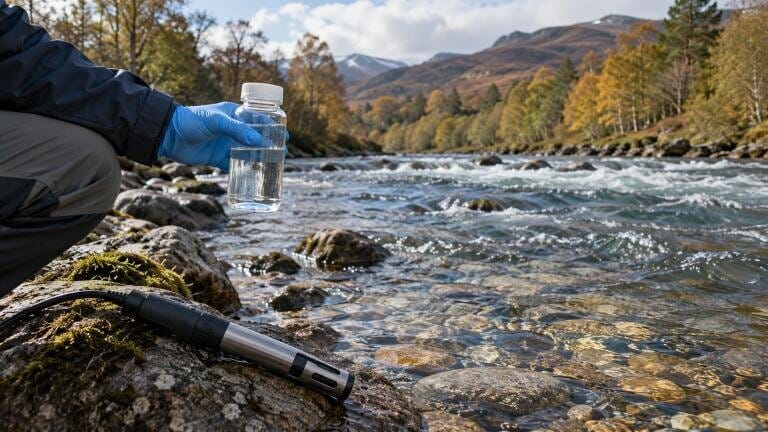
England already has partial versions of each. Friends of the River Wye reported in January 2026 that volunteers had taken more than 50,000 samples since 2020.
The Angling Trust’s Water Quality Monitoring Network, launched in 2022, involves more than 500 angling clubs.
The Catchment Systems Thinking Cooperative (CaSTCo), led by United Utilities and The Rivers Trust with Ofwat innovation funding, is building national catchment data standards.
In July 2026, Ofwat approved a one-year extension. Its plans include a National Citizen Science Accreditation Scheme, national catchment data standards and a National Catchment Coordination Council.
The Environment Agency (EA) published a Citizen Science Technical Advisory Framework on Tuesday, 18 March 2025.
It sets out principles on quality assurance, training, calibration and validation. It commits to increasing the use of third-party data while retaining the EA’s statutory monitoring responsibilities.
The policy direction points the same way. The Independent Water Commission’s final report, published on Monday, 21 July 2025, called for future monitoring programmes to be reviewed and adequately resourced.
Surfers Against Sewage has read that recommendation as embedding citizen science in official testing [unverified – confirm wording in the report itself].
The Water White Paper, published on Tuesday, 20 January 2026, commits to ending operator self-monitoring.
The weakness in the UK model is not enthusiasm, but standing and funding. Klamath’s monitors had authority, settlement money and a formal place in decision-making.
UK volunteers have an advisory framework and a data standards project extended one year at a time. The Rivers Trust says catchment partnerships have faced real-terms funding cuts.
Klamath also shows how fragile such arrangements can be. The Klamath Basin Monitoring Program’s funding lapsed in 2024, and it relied on the Pacific States Marine Fisheries Commission in 2025.
There is a risk in the opposite direction too. EA sampling fell by around 45 per cent between 2013 and 2018, according to freedom of information data obtained by Unearthed.
In 2025, staff shortages at the EA’s Starcross laboratory led to around 10,000 tests being dropped between May and July. [Human review: criticism of a named regulator – check both figures against EA responses.]
Co-monitoring that replaces regulator capacity, rather than adding to it, would repeat the problem it is meant to solve.
A Klamath-style scheme in England would need three things the current landscape lacks.
The first is an accreditation route that lets volunteer and community data meet a defined evidential standard. The second is multi-year funding that does not depend on innovation grants.
The third is a formal role for community monitors in catchment decisions, alongside the EA and water companies.
The Wye, the Wharfe at Ilkley and other catchments already hold the kind of baseline data Klamath’s tribes spent decades building.
Whether it counts when decisions are made depends on choices the government has yet to make.
IET 36.5 Sept/Oct 2026

 Product directory