Water monitoring
When Hurricane Melissa struck Jamaica on 28 October 2025, it made landfall as one of the strongest Atlantic hurricanes on record, having intensified from a tropical storm to a category 5 system in around 39 hours.
Ravi Pappu, founder of ocean sensing company Apeiron Labs, attributes some of that surprise intensification to a gap in ocean monitoring.
"The storm intensified because of a small pool of hot water in the Caribbean Ocean that fed it energy," Pappu said.
"These pools are everywhere. They can be hundreds of kilometres wide and are literally invisible to us. If we knew about that pool, we could say very precisely how the hurricane would intensify and better deal with it."

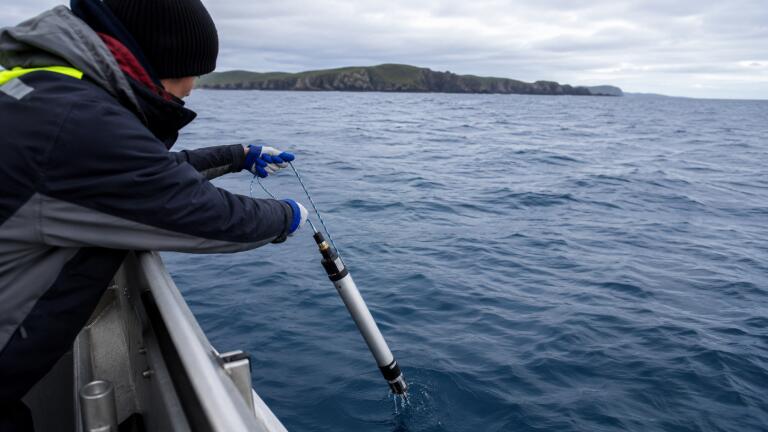
Apeiron Labs, founded by Pappu in 2022, deploys low-cost autonomous ocean sensors designed to gather data at a scale that has not previously been attempted.
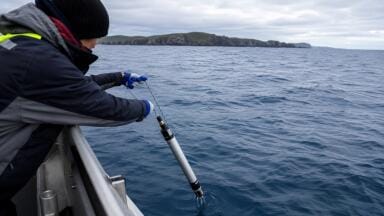
The company's devices roam the ocean to a depth of around 400 metres, continuously recording temperature, acoustics, salinity and other variables.
Each sensor is about three feet long and weighs around 20 pounds.
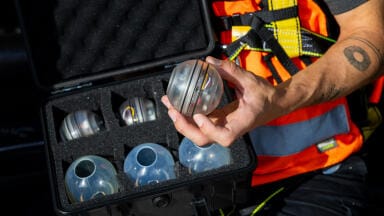
They are dropped from a boat or aircraft with biodegradable parachutes, remain in the ocean for up to six months, and send data continuously to the cloud, where it can be accessed through a mobile app.
Trackers make it easier to recover the devices from the surface once they need recharging.
Pappu compares the approach to the effect small, modular CubeSat satellites had on Earth observation from space.
"Humanity needs ocean measurements, and we need them at a scale that has never been attempted before," Pappu said.
"In the past century, oceanographers resigned themselves to calling it the century of undersampling. If we are successful, we will have a much more fine-grained understanding of our oceans and how they impact humans."
Conventional ocean sensing has typically relied on expensive, long-lived instruments deployed from crewed research vessels. Pappu argues that model is a barrier to the scale of monitoring that is needed.
"All of the ocean sensing up to that point, and even today, was about making a really expensive thing that cost US$20m, goes to the bottom of the ocean, and stays there for five years," Pappu said.
"We needed things that are cheap and scalable to deploy wherever you need them for as long as you want."
A fully crewed research ship can cost US$100,000 a day to operate, on top of the millions of dollars typically spent on the sensors themselves.
Apeiron's autonomous devices are intended to remove that overhead, lowering both the cost and the carbon footprint of gathering ocean data.

The company's sensors currently carry two types of instruments: one measuring salinity, temperature and depth, and another using a hydrophone to passively listen for underwater sound, including vessels and marine mammals.
That listening capability could support detection of the low-frequency calls of endangered whale species, work that today largely depends on human spotters on ships or aircraft.
The data could also feed into improved weather forecasting, monitoring of noise from offshore energy projects, and tracking of ocean currents.
"Currents are determined by temperature and salinity, so if there's an oil spill, our data could help determine where that spill is going," Pappu said.
"Or if you're a fisherman, knowing where the water changes from warm to cold, which is where the fish hang out, is very useful."
Apeiron Labs has worked with government defence agencies, including the US Navy, over the past two years, and has tested its devices off the coast of California and in Boston Harbor.
"The most important thing is, when we show people our approach and what we've demonstrated so far, they are no longer asking, 'Can it be done?' they're asking, 'What can we do with it?'" Pappu said.
Improved storm forecasting remains the application Pappu is most focused on. "The ocean is a huge determinant of weather, climate, and short-term forecasting," he said.
"Despite our best efforts to predict the intensity of storms, sudden changes are still the norm, and much of that comes down to a lack of understanding of our oceans."
IET 36.5 Sept/Oct 2026

 Product directory


.jpg)