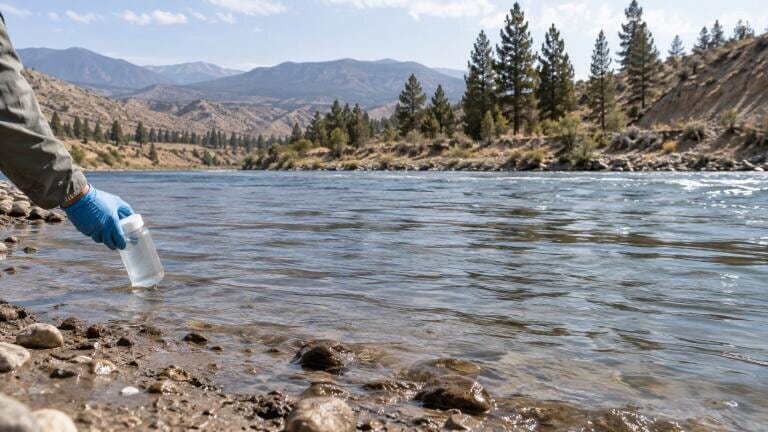
Microplastics analysis
The findings point to spring runoff as the dominant driver of contamination levels, rather than any single pollution source.
The research, led by Hannah Lukasik during her master's studies at the Desert Research Institute (DRI) and the University of Nevada, Reno, was published in ACS ES&T Water.
It was supervised by Monica Arienzo, director of DRI's Microplastics and Environmental Chemistry Lab.

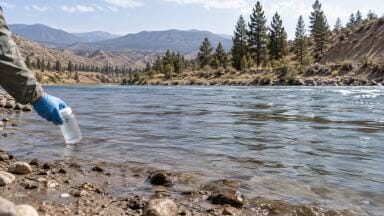
The Truckee River runs from Lake Tahoe through Reno and Sparks, Nevada, to Pyramid Lake, and supplies drinking water to close to half a million people.
The team sampled nine sites upstream and downstream of the Reno-Sparks metropolitan area, selected to bracket major population centres, wastewater treatment plants and river confluences.
Fourteen water samples were collected in total: six in fall 2022 and eight in spring 2023.
Mean concentrations rose from 0.4 microplastics per litre in fall to 3.7 microplastics per litre in spring.
The researchers attribute the increase to higher spring flows flushing accumulated particles from the surrounding landscape and the riverbed. Polyethylene and polypropylene were the dominant polymer types identified.
Sample-level concentrations ranged from 0.1 to 1.0 microplastics per litre in fall and from 1.0 to 10 microplastics per litre in spring.
The highest readings came from sites within Reno and Sparks. The lowest were recorded upstream of the metropolitan area and downstream of a river restoration site.
The researchers suggest a meandering restored channel may be retaining particles rather than transporting them further downstream.
Samples were filtered through stainless steel mesh capable of capturing particles as small as 50 micrometres, then analysed by Fourier Transform Infrared spectroscopy to confirm polymer composition.
The study also compared concentrations in the river to those measured at its source.
Microplastic levels in the Truckee River were three to four orders of magnitude higher than those recorded in Lake Tahoe.
This indicates that the bulk of the contamination is drawn from the surrounding urban and developed landscape rather than carried down from the headwaters.
Truckee River concentrations were broadly comparable to those reported in other rivers across the western United States.
"The Truckee River is such a critical artery for northern Nevada," Lukasik said.
"It not only supplies drinking water to around half a million people in the Reno–Sparks area, it is also a main water source for wildlife and is central to recreation in the region."
For laboratories and monitoring networks running seasonal sampling programmes, the findings reinforce a point increasingly made elsewhere in microplastics research.
Single-point or single-season sampling risks substantially understating contamination levels. A river judged clean on a fall sample could show markedly different results a few months later under high-flow conditions.
 This has implications for how monitoring programmes on comparable snowmelt-fed or seasonally variable rivers are designed and scheduled.
The researchers note that the interplay of seasonal flow, land use and infrastructure identified in the Truckee is likely to generalise to other rivers with similar hydrology.
They stop short of proposing a standardised sampling protocol based on this single study.
IET 36.5 Sept/Oct 2026


 Product directory