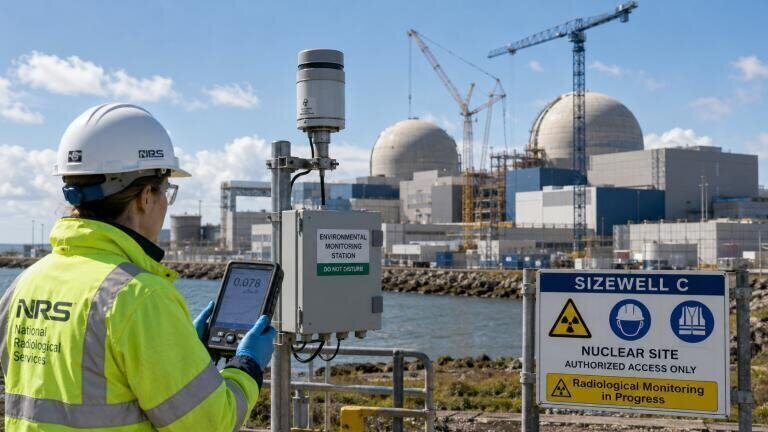
Portable & field testing
The Final Investment Decision for Sizewell C was formally approved in July 2025. Rolls-Royce SMR has begun the UK reactor design process under its GBE-N contract, with Wylfa confirmed as the site for the first three small modular reactors and a grid connection target in the mid-2030s.
Hinkley Point C is under construction. Advanced modular reactor development is moving through feasibility stages. The regulatory system that governs all of this activity was, by the government's own assessment, not fit for the pace now required.
The Nuclear Regulatory Review – published in 2025 – made that diagnosis explicit. It found a system characterised by overlapping responsibilities, multiple regulators with no single designated lead, separate statutory duties that could pull in different directions, and no clear mechanism for resolving conflicts quickly.
In some defence nuclear projects, a single development faces as many as eight regulatory bodies. The government accepted all 47 recommendations of the review in principle and has committed to implementation by the end of 2027.
The Nuclear Regulation Bill provides the legislative vehicle for the most significant of those changes.
The most immediate structural change is already in effect. From March 2026, the Office for Nuclear Regulation has been designated as lead regulator for significant multi-regulator nuclear projects.
This gives developers a single regulatory point of contact – a change that sounds administrative but has real practical consequences for how evidence, consents and monitoring obligations are coordinated across what were previously separate regulatory tracks.
_*]:min-w-0 gap-3">A Nuclear Commission is being established to act as a single collective decision-making body for unresolved regulatory disputes – what the review described as a final arbiter that would listen to regulators, industry and other stakeholders in public.
It is expected to be fully functioning by summer 2028. The ONR is also being merged with the Defence Nuclear Safety Regulator, with initial changes by autumn 2026 and full merger by end of 2028.
_*]:min-w-0 gap-3">On environmental assessment, the government has committed to replacing Environmental Impact Assessment with Environmental Outcomes Reports by December 2027.
This is a broader planning reform with specific application to nuclear projects. The stated intent is to shift from a process that documents anticipated impacts to one that sets required environmental outcomes and verifies delivery.
For monitoring professionals, the distinction matters: EORs are expected to place more weight on post-permission monitoring than EIA currently does.
The baseline requirement is retained – the government has confirmed that an environmental baseline will remain part of the process of demonstrating how a project supports delivery of outcomes – but the emphasis shifts toward proving that promised outcomes are actually achieved.
_*]:min-w-0 gap-3">Regulatory reform premised on speed and proportionality does not reduce the monitoring burden. It changes what the monitoring is for.
If the system is moving from process compliance toward outcomes verification, the data produced by monitoring programmes becomes the primary mechanism by which that verification happens.
A lead regulator model with faster decision-making works only if the underlying evidence is trusted. When the ONR needs to make a binding determination on a multi-regulator dispute, it will do so on the basis of the radiological and environmental data available.
The quality of that data directly affects the credibility of the decision.
_*]:min-w-0 gap-3">The specific monitoring requirements for nuclear sites are substantial. Under the existing Environmental Agency and Natural Resources Wales framework – which the regulatory reform does not replace – operators of nuclear sites must design and implement environmental radiological monitoring programmes as a condition of their radioactive substances activity permit.
Higher-impact sites, where dose to the representative person exceeds 0.01 millisievert per year or where abnormal releases are possible, require comprehensive programmes covering all relevant pathways.
Routine requirements include discharge monitoring, groundwater surveillance, marine sample collection, sediment analysis, biota monitoring, atmospheric measurements and dose-rate surveys.
Annual discharge reports to the UK authorities cover radionuclides reaching the north-east Atlantic marine environment – a reporting obligation that feeds into international frameworks as well as domestic compliance.
_*]:min-w-0 gap-3">A construction phase at Sizewell C, progressing in parallel with SMR development at Wylfa, creates a specific monitoring demand that sits upstream of operational requirements.
Baseline characterisation before first concrete is poured establishes the reference against which any future impact must be measured. Construction itself generates hydrology disruption, potential groundwater pathway changes, coastal and marine disturbance and ecological pressure.
The monitoring programmes that document those impacts during construction are the evidence on which post-construction assessments – and eventually operational permit conditions – will depend.
_*]:min-w-0 gap-3">One of the central arguments for the SMR programme is that a standardised, replicable reactor design reduces regulatory and construction uncertainty.
Once a design has gone through Generic Design Assessment – Step 3 of the Rolls-Royce SMR GDA is planned for completion by December 2026, requiring detailed hazard registers, quantitative risk assessments and full radiological safety demonstration – subsequent site-specific licensing should in principle be faster.
_*]:min-w-0 gap-3">The monitoring implication is that standardisation of reactor design does not translate to standardisation of environmental context. Wylfa is a coastal site in the Irish Sea with specific marine and tidal characteristics.
Future SMR sites – the government has also announced a site selection process for new large-scale nuclear plants – will have different hydrogeological profiles, different receptor communities, different groundwater behaviours and different distances to sensitive ecological designations.
A standard CEMS approach, a standard discharge monitoring protocol or a standard marine surveillance programme cannot be lifted from one site and applied without site-specific calibration and validation.
The proportionality argument for faster regulation depends on having high-quality site-specific evidence to justify proportionate decisions. That is not a reduced requirement. It is a better-targeted one.
_*]:min-w-0 gap-3">The briefing notes for the Nuclear Regulation Bill identify a potential cliff-edge loss of regulatory and technical capability due to specialist retirements.
The data behind that warning is stark. More than half of the UK's nuclear engineers are over 45.
Around 20% are under 34. Health physicists, reactor physicists, experienced radiation protection advisers and senior safety engineers are the disciplines under greatest pressure – not because the total workforce is shrinking but because the specialist roles are thinning faster than they can be replaced.
UK civil nuclear employment reached just under 100,000 roles by late 2025, a record high, but overall employment figures obscure the specific pinch points.
_*]:min-w-0 gap-3">Radiation Protection Advisers are particularly exposed. Legacy decommissioning work – complex, technically demanding, requiring continuous radiation protection expertise across decades-long site programmes – is proceeding at the same time as new build activity is accelerating.
The supply of qualified RPAs cannot scale quickly. ONR's SQEP requirements mean that operators who cannot demonstrate sufficient numbers of suitably qualified and experienced personnel in a given discipline face operational restrictions. It has already occurred at sites where retirement patterns outpaced succession planning.
_*]:min-w-0 gap-3">For the monitoring market, the workforce constraint cuts in two directions.
First, it creates direct demand for specialist radiation monitoring contractors and laboratory services that site operators and regulators cannot fully provide internally.
Second, it increases the importance of instrumentation and data systems that can extend the reach of a smaller number of qualified people – automated monitoring networks, remote telemetry, digital audit trails, integrated dose-rate surveillance systems and laboratory information management systems that can process environmental radiological results without requiring manual handling at every stage.

The pipeline of monitoring work associated with UK nuclear development over the next decade is larger than at any point since the original build programme.
Sizewell C alone represents a multi-decade project requiring baseline characterisation, construction monitoring, pre-operational surveys, operational discharge monitoring, marine surveillance, groundwater programmes, emergency preparedness systems and long-term records management.
Add Wylfa SMR, future SMR sites, ongoing Hinkley Point C, Sellafield decommissioning and legacy site programmes, and the picture is of sustained demand across a range of technical disciplines.
The reform does not make that demand disappear. It reshapes the context in which it must be met. Faster regulation means decisions will be made on tighter timeframes, which means monitoring evidence must be available, current and defensible when it is needed – not months later.
The shift from EIA to Environmental Outcomes Reports means monitoring programmes need to be designed for verification and audit, not just for impact prediction.
The lead regulator model means monitoring evidence will increasingly flow through a single coordination point, which increases the premium on consistency, comparability and traceability.
For suppliers and laboratories serving the nuclear sector, the message is straightforward. The regulatory reform is real and the delivery pipeline is real.
The organisations that will be most valuable in this market are those that can design monitoring programmes suited to outcomes-based regulation, provide data of sufficient quality for a faster-moving regulatory process, and help address the capability gap that the UK nuclear sector is already navigating.
IET 36.5 Sept/Oct 2026




 Product directory






























.jpg)