Environmental laboratory
Whether the evidence systems behind long-term waste management are fit for what comes next.
The European Commission's evaluation of the Radioactive Waste Directive and the Shipments Directive should interest environmental monitoring professionals because it deals with one of the longest time horizons in environmental protection.
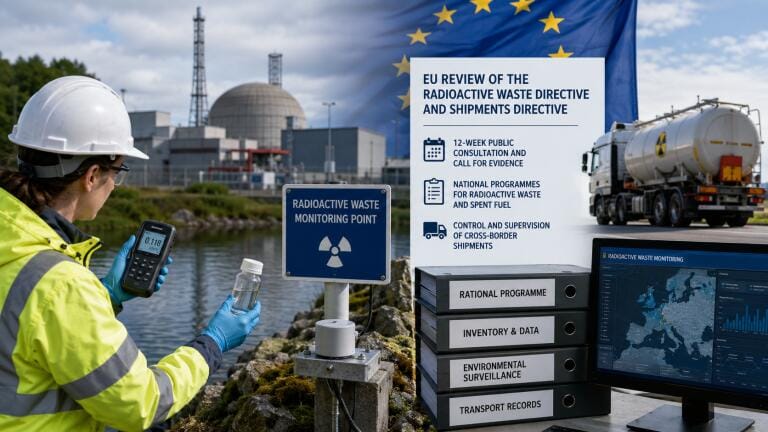
On 27 March 2026, the Commission launched a 12-week open public consultation, alongside a separate four-week call for evidence, to assess how the EU's radioactive waste and spent fuel rules are performing.
Both exercises close on 19 June 2026. The Radioactive Waste Directive (2011/70/Euratom), adopted in 2011, requires Member States to establish national programmes covering the full lifecycle of radioactive waste and spent fuel, from generation to disposal.
The Shipments Directive (2006/117/Euratom), adopted in 2006, governs the supervision and control of cross-border shipments through a system of prior authorisation.

This is not limited to countries operating nuclear power stations.
The Commission notes that radioactive waste is also generated through medical, industrial, agricultural, research and educational uses of radioactive materials.
Every Member State therefore has some form of radioactive waste to manage, whether or not it runs a nuclear plant.
The review follows concerns identified in the Commission's third implementation report on the Radioactive Waste Directive, published as COM(2024)197.
That report set out four persisting issues: several Member States still lack defined long-term national policies for managing all their radioactive waste; some national programme targets are not sufficiently ambitious; there are weaknesses in programme control and funding; and some cost assessments are outdated or incomplete.
For monitoring professionals, the central issue is evidence over time.
Radioactive waste management depends on containment, isolation, site monitoring, transport controls, regulatory reporting, inventories, environmental surveillance and institutional memory that has to survive far longer than a normal industrial planning cycle.
The Shipments Directive creates a specific monitoring and documentation challenge of its own.
Cross-border movement of radioactive waste and spent fuel requires prior authorisation, notification to national authorities, and controls on shipments entering, leaving or transiting the EU.
Operators must be able to demonstrate compliance at every stage of a shipment's route, not just at origin and destination.
The timing of the review is not incidental.
Nuclear energy is receiving renewed political attention in parts of Europe: the Commission published its Unleashing the Power of Nuclear: A Plan for Action in March 2026, and small modular reactor deployment has been under active discussion at EU level since late 2025.
New nuclear projects, decommissioning activity, medical isotope use and legacy waste management all require credible data systems capable of outlasting the political and industrial cycles around them.
The practical relevance for the monitoring sector follows from this.
Regulators and operators will need accurate radiation detection, environmental sampling, inventory systems, transport records, groundwater and air surveillance, and independent verification capability, all of it structured to produce evidence that remains usable and auditable decades after it is collected.

Given the scale of the issues the Commission's own implementation report identified, and the renewed political weight behind nuclear energy in several Member States, this evaluation looks unlikely to be simply a legal tidying-up exercise.
It raises a larger question: whether Europe's radioactive waste framework is currently supported by monitoring systems robust enough for the next phase of nuclear policy, or whether the consultation will surface gaps that require new obligations on data quality, retention and independent verification.
For instrumentation suppliers, laboratories and environmental data providers working in radiation monitoring, the consultation period is worth watching closely.
Findings will feed into future Commission and Member State policy, and the same gaps in long-term evidence systems identified in the third implementation report are likely to shape what regulators specify next.
IET Guide 2026

 Product directory