Environmental laboratory
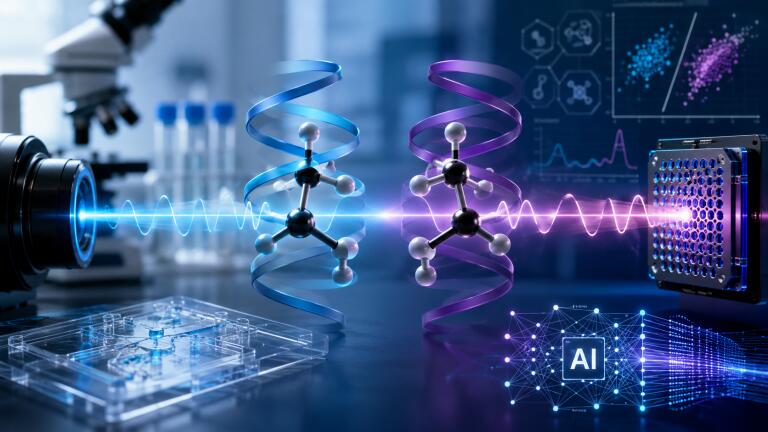
Two enantiomers can share the same chemical composition but behave differently because of their three-dimensional structure.
In pharmaceuticals, food safety, clinical diagnostics and materials science, those differences can matter greatly.
For environmental and analytical monitoring professionals, chirality is not yet a routine front-line issue in the same way as PFAS, nutrients, heavy metals or particulates.
But it is a useful example of where analytical instrumentation may be heading: towards methods that can extract more information from smaller samples, with less destructive preparation and stronger links between optics, nanophotonics, microfluidics and machine learning.
A new review published in Opto-Electronic Advances examines recent progress in the optical sorting and detection of chiral particles.
The review focuses on how engineered light fields, resonant photonic structures, spectroscopy and AI-assisted analysis could improve the sensitivity and selectivity of chiral analysis.
The significance for monitoring users is not that a new field-ready instrument is ready for deployment.
It is that optical methods are being developed to address some of the practical limitations associated with conventional chiral analysis, including complex procedures, relatively high sample consumption and limited real-time capability.

Chirality describes structures that cannot be superimposed on their mirror image.
In chemistry, that means two molecules can contain the same atoms in the same order but still interact differently with biological systems, materials or other chemicals.
That distinction is already central in pharmaceutical development, where one enantiomer may deliver a desired therapeutic effect while another may behave differently. Similar issues can arise in food safety, clinical diagnostics and advanced materials.
For environmental laboratories, the long-term relevance is that some contaminants, residues or transformation products may need to be understood not only by concentration, but also by molecular form.
That raises a familiar instrumentation question: can the method distinguish what actually matters, or is it only measuring a broader chemical category?
Established chiral analysis often relies on chromatographic separation, chemical derivatisation or biochemical reactions.
These methods are powerful and well understood, but they can also involve complex sample preparation, specialist consumables and relatively slow workflows.
That matters when laboratories are under pressure to process more samples, detect lower concentrations and generate defensible evidence faster.
Optical methods offer a different route.
Because they are based on light–matter interactions, they can potentially support non-contact, non-destructive probing and easier integration into compact analytical platforms.
In practical terms, that could make them useful for future instruments where laboratories need sensitive detection but also want reduced sample preparation, smaller sample volumes or more automated workflows.
The challenge is that chiral optical effects are usually weak.
The review notes that chiral light–matter interactions often originate from weak electric and magnetic dipole-level coupling. In detection terms, this makes it difficult to distinguish small chiral signatures from background noise, particularly at low concentrations.
This is the central instrumentation problem.
A method may be theoretically capable of detecting a chiral difference but still struggle to deliver robust, repeatable and sensitive performance in a practical sample.
That is where recent work in nanophotonics becomes important.
The review highlights several approaches designed to strengthen the interaction between light and chiral matter.
These include structured light fields, vector beams, plasmonic structures, optical microcavities, metasurfaces and photonic crystals.
For monitoring professionals, the key point is not the physics terminology itself.
The point is that these platforms are being used to shape light more precisely, confine it more effectively and amplify weak optical responses. That could make it easier to detect subtle molecular differences that would otherwise be lost in background signal.
Metasurfaces and other micro- and nano-optical elements are especially interesting because they can be engineered to control light at very small scales. In future analytical instruments, that could support compact optical components with stronger sensitivity and more selective detection.
The review also points to artificial intelligence and machine learning as emerging tools for chiral detection.
This is relevant because optical systems can generate complex signal patterns, particularly when multiple components are present in a sample.
Machine learning could help classify those signals, identify multiple chiral components and support high-throughput analysis.
For laboratories, the practical question will be whether AI improves interpretation without weakening traceability, validation or user confidence.
A model that helps identify a chiral signature may be valuable, but regulated and professional users will still need to understand calibration, uncertainty, method validation, false positives and the conditions under which the model fails.
In that sense, AI-assisted chiral spectroscopy fits a broader trend across environmental and analytical monitoring: smarter instruments are useful only if their outputs remain defensible.
The review is clear that challenges remain.
High fabrication costs, limited system stability and constrained throughput still need to be addressed before optical chiral technologies can become widely practical.
That is an important caveat.
This is not yet a replacement for routine laboratory methods, nor is it an immediate field monitoring solution for environmental compliance.
Instead, it should be seen as enabling research that may influence future spectroscopy platforms, lab-on-chip systems, high-throughput analytical workflows and specialist detection methods.
For manufacturers and advanced laboratory users, the direction is worth watching.
Chiral analysis sits at the intersection of optical engineering, sample handling, data interpretation and molecular selectivity. Improvements in that area could eventually influence how laboratories approach difficult samples where chemical identity alone is not enough.

The most useful lesson from this review is that optical spectroscopy is continuing to move beyond simple detection towards more selective molecular discrimination.
For environmental monitoring, that matters because the next generation of analytical challenges is unlikely to be solved only by measuring more parameters.
It will also require better ways of distinguishing closely related chemical forms, understanding biological relevance and interpreting complex samples with greater confidence.
Optical chiral detection is still a specialised research field.
But its development points towards a wider future for analytical instrumentation: smaller samples, less destructive testing, stronger optical enhancement, integrated data analysis and more selective detection of difficult compounds.
For laboratories and instrument developers, that is the real story.
IET 36.5 Sept/Oct 2026




 Product directory