Food safety testing
Member States are asked to submit monitoring results to the European Food Safety Authority (EFSA) by 30 June 2029.
The recommendation also asks that, where high PFAS levels are found in food of animal origin, follow-up investigation should extend to the soil where food-producing animals forage and to their drinking water, tracing contamination back through the exposure pathway rather than treating an elevated result as an isolated finding.

The feed recommendation sits apart from the EU's approach to PFAS in drinking water.
The recast Drinking Water Directive (2020/2184) entered into force on 12 January 2026 and sets binding parametric values for PFAS in drinking water, backed by mandatory Member State monitoring and reporting to the Commission on exceedances.
Water suppliers face compliance obligations with legal consequences for breaching those limits.
The feed recommendation is a different kind of instrument.
It is non-binding, asking Member States to gather monitoring data over a defined period rather than imposing threshold limits or penalties.
No numeric limits for PFAS in feed were set alongside the recommendation; the exercise is framed as building an evidence base rather than enforcing compliance.
For laboratories working across the agri-food supply chain, feed monitoring adds a distinct analytical requirement to an already crowded PFAS testing landscape.
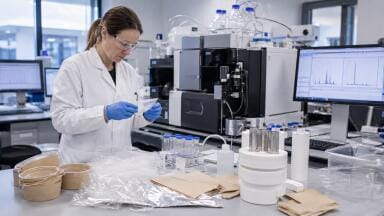
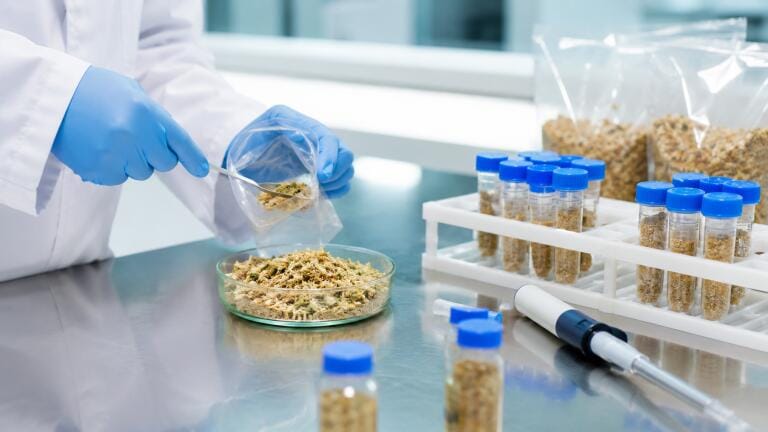
Feed matrices differ from water samples in composition and require their own approach to extraction, clean-up and interference management before analysis, typically by liquid chromatography-mass spectrometry (LC-MS), to reach the low detection limits needed for PFAS work.
 The soil and drinking-water follow-up requirement also implies a wider sampling scope than feed testing alone.
Where a feed result is elevated, laboratories may be asked to trace the source through soil and water testing on the same holding, requiring capacity across multiple matrices rather than a single analytical stream.
Because the recommendation is voluntary rather than backed by set thresholds, laboratories should expect variation in how rigorously individual Member States implement the monitoring programme, in contrast with the more uniform compliance testing driven by the binding drinking water limits.
IET Guide 2026

 Product directory