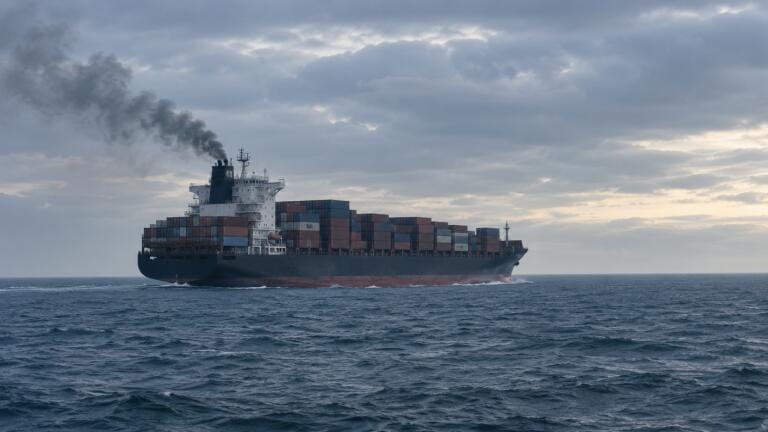
Industrial emissions
If adopted, it would introduce the first global price on shipping’s greenhouse gas emissions.

The Framework comprises a Global Fuel Standard to reduce the greenhouse gas intensity of marine fuels, alongside a carbon pricing and reward mechanism.
It was approved in principle at MEPC 83 in April 2025, after roughly a decade of negotiation. Formal adoption was expected at an extraordinary session in October 2025.
That session ended instead in a vote to adjourn for 12 months, called by Saudi Arabia and passed 57 votes to 49, with 21 abstentions and eight delegations absent.
Major oil-exporting states, including Russia, China and the United States, backed the delay, alongside flag states Panama and Liberia. The EU and UK were among those voting to proceed.
The adjournment followed sustained opposition from the Trump administration, which had submitted an impact assessment to the MEPC arguing the pricing mechanism would impose a disproportionate economic burden on the industry.
Since then, the picture has shifted, though not decisively. MEPC 84 was held in London from 27 April to 1 May 2026.
Analysis by University College London’s Shipping and Oceans Research group found that a majority of member states had returned to backing the Framework broadly as it stood when approved in 2025.
That reversed the narrow majority that voted to delay it the previous October. Alternative proposals put forward at the session failed to gather significant support.
The Clean Shipping Coalition, an environmental group, said the meeting closed with majority member state backing for the Framework, despite continued opposition from the United States, Saudi Arabia, the UAE, Panama and Liberia.
The United States remained the most vocal opponent heading into MEPC 84. Its IMO delegation lead told a pre-meeting briefing there was a clear and sizable bloc opposed, with no prospect of consensus.
Oil-producing states including Saudi Arabia, Russia, Algeria, Bahrain, Iraq, Kuwait and the UAE have separately argued that any framework must be consensus-based and reflect concerns they say the current draft does not address.
Whether the shift in sentiment translates into the two-thirds majority required for formal adoption remains uncertain.
An intersessional working group has continued technical work on implementation guidelines between the April and October sessions, aimed at narrowing outstanding disagreements before member states vote.

For fuel suppliers and compliance testing providers, the practical stakes of the vote centre on certainty rather than direction of travel.
Adoption in October would set an implementation and enforcement timetable running alongside the EU’s existing Emissions Trading System coverage of shipping and the FuelEU Maritime Regulation.
Both of those already factor IMO-level adoption into their own frameworks. A further deferral would extend the period in which fuel pricing and compliance testing investment decisions must be made without a confirmed global baseline.
IET Guide 2026

 Product directory




















.jpg)





.jpg)




.jpg)
