.jpg)
Industrial emissions
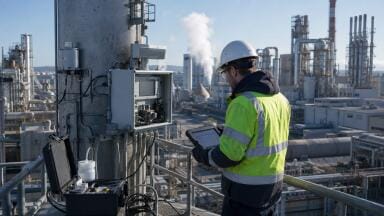
Methane monitoring in the European Union is entering a new phase.
The focus is no longer limited to whether operators can identify and quantify emissions at individual facilities.
Increasingly, the data generated by monitoring programmes will feed into public reporting and wider assessments of methane performance.
Regulation (EU) 2024/1787 requires the European Commission to establish a global methane monitoring tool based on satellite data by 5 August 2026.
The tool is intended to provide regular information on the occurrence, magnitude and location of high methane-emitting events from energy sources both inside and outside the EU.
At the same time, the regulation requires the Commission to publish methane performance profiles for Member States, EU producers and importers placing crude oil, natural gas or coal on the EU market, and relevant third-country producers and exporters.
The result is a monitoring framework that increasingly connects measurements made at source with information visible beyond the operator and regulator.

It is important to distinguish the different deadlines in the regulation. The 5 August 2026 milestone is not a new universal reporting deadline for all oil and gas operators.
For operated oil and gas assets, source-level methane emissions reporting began with a deadline of 5 February 2026. Site-level measurements and associated reporting for operated assets begin from 5 February 2027, followed by annual reporting. Closed and abandoned underground coal mines have a separate requirement for annual source-level emissions reports, with the first reports due by 5 August 2026.
This distinction matters for monitoring teams because the regulatory burden is developing through several stages rather than arriving as one single reporting requirement.
The underlying direction is nevertheless clear. The regulation expects source-level quantification, measurement where possible and verification of reported data. Operators must also provide information on the standards and methodologies used.
Satellite data cannot replace every form of site-level measurement. A satellite observation can identify and characterise significant methane-emitting events over large areas, but it does not provide the same information as a measurement programme designed around individual equipment or emission sources.
The value of the EU tool is therefore partly complementary.
A large methane event identified remotely could provide a signal that prompts investigation on the ground. Conversely, detailed source-level measurements can provide the evidence needed to interpret what remote observations are showing.
This creates a monitoring chain involving different spatial and temporal scales: source-level measurements, site-level measurements, aerial or drone surveys and satellite observations.
For environmental monitoring providers, the opportunity is not simply to replace one technology with another. The challenge is to ensure that measurements produced by different systems can be compared, quality-assured and interpreted together.
The regulation places considerable emphasis on the quality of methane data. Source-level measurements and site-level measurements are expected to be compared, with significant discrepancies triggering further investigation and action.
That makes calibration, measurement uncertainty, methodology selection and data management increasingly important.
A methane figure without information about how it was produced may be less useful than a figure accompanied by clear evidence of its measurement basis.
This is particularly relevant as methane data moves into public-facing systems. The Commission’s methane transparency database is intended to be publicly available and to indicate where submitted information has been independently verified. The performance profiles will include methane emissions information and assessments of data quality where applicable.

The significance of the 2026 milestone is therefore less about a single satellite platform than about the changing role of methane measurement.
Monitoring data is becoming part of a wider evidence system in which operators, regulators, importers and the public can potentially compare emissions information across assets and regions.
For laboratories and monitoring providers, that puts greater emphasis on traceability and defensible measurement. For operators, it means that methane monitoring is increasingly connected to regulatory reporting rather than being treated as a standalone leak-detection exercise.
The EU’s approach also points towards a future in which ground measurements and remote observations increasingly work together. The practical question for monitoring professionals is how those systems will be integrated while maintaining consistent data quality.
IET 36.5 Sept/Oct 2026


 Product directory















.jpg)