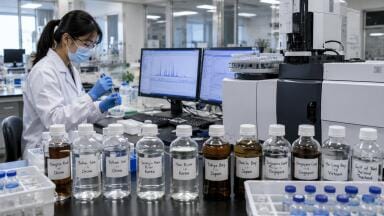
PFAS analysis
Both of ECHA’s scientific committees are now on record backing a broad restriction, subject to targeted exemptions.

The restriction proposal covers an estimated 14,000 PFAS substances across virtually every industrial sector.
It was submitted to the European Chemicals Agency (ECHA) in January 2023 by authorities in Denmark, Germany, the Netherlands, Norway and Sweden.
It has since moved through an initial public consultation, which drew more than 5,000 submissions, and two rounds of scientific committee review.
ECHA’s Risk Assessment Committee (RAC) adopted its opinion on the proposal on 3 March 2026.
The opinion drew on RAC’s evaluation of the hazards, volumes, emissions and risks associated with PFAS use, alongside the practicality and enforceability of the proposed restriction measures.
The Committee for Socio-Economic Analysis (SEAC) published its draft opinion on 26 March, opening a 60-day public consultation that ran until 25 May 2026.
According to ECHA, 61.6 per cent of the consultation responses came from individual companies, with a further 25.9 per cent from industry and trade associations.
Both committees have indicated support for an EU-wide restriction with targeted derogations rather than a blanket ban.
The RAC’s opinion also highlighted the need for a harmonised enforcement strategy, including standardised analytical methods, given the difficulty of consistently identifying PFAS across such a broad substance group.
SEAC is expected to adopt its final opinion, incorporating consultation feedback, by the end of 2026.
Once both committees have finalised their opinions, ECHA will transmit them to the European Commission, along with the original restriction dossier and all comments received.
The Commission will then draft a formal restriction proposal amending Annex XVII of the REACH Regulation.
That proposal goes to the REACH Committee, made up of representatives from EU member states, for deliberation and vote, with further scrutiny by the European Parliament and Council to follow.
There is no further mandatory public consultation at that stage. The SEAC consultation that closed in May was the last formal opportunity for stakeholder input before the Commission’s proposal is drafted.
Estimates for the timeline beyond this point vary. Law firms and regulatory consultancies tracking the process expect the Commission’s draft text in 2027 at the earliest.
Entry into force is considered unlikely before 2028 to 2029, though these remain informed projections rather than a confirmed schedule.

For laboratories and monitoring providers, the RAC’s emphasis on enforcement and standardised analytical methods is the more immediate signal.
Any eventual restriction will depend on reliable, harmonised PFAS detection and quantification across an unusually wide range of matrices and applications.
IET Guide 2026

 Product directory