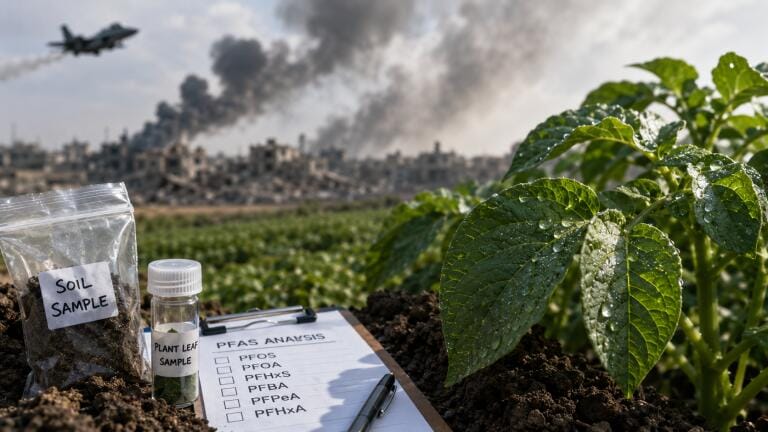
PFAS analysis
The findings raise important questions for environmental monitoring professionals working in conflict-affected regions.
For environmental monitoring professionals, PFAS contamination is usually associated with industrial facilities, airports, military firefighting activities, wastewater treatment plants and biosolids application.
A new study published in the Journal of Hazardous Materials suggests another potential source may deserve greater attention: active war zones.
Researchers from the Hebrew University of Jerusalem and partner organisations investigated PFAS contamination in agricultural land surrounding the Gaza conflict zone. Their goal was straightforward but novel. Could military activity leave a detectable PFAS signature in nearby agricultural systems?
The answer turned out to be more complicated than expected.
Rather than finding a clear contamination footprint in soils, the researchers discovered evidence suggesting that vegetation may be a more sensitive indicator of recent airborne PFAS contamination than soil itself.
The findings highlight both the challenges and opportunities facing environmental monitoring programmes in conflict-affected regions.

The possibility that warfare could contribute to PFAS contamination has received relatively little attention compared with industrial pollution.
However, military activities involve several potential PFAS sources. Firefighting foams remain a well-known contributor, particularly around military bases and airfields. Less widely discussed is the use of fluoropolymers within munitions and explosives.
Materials such as Viton, Kel-F and Teflon are used in some ammunition systems and may generate PFAS-related compounds during combustion or detonation.
Previous studies have shown severe PFAS contamination around military training facilities and firefighting sites but little research has examined whether active warfare creates wider environmental contamination beyond the immediate area of military operations.
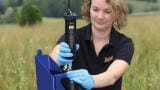
To investigate this question, the research team collected soil, potato leaf and potato tuber samples from 34 agricultural fields located at varying distances from the Gaza border. They also sampled uncultivated soils to help distinguish agricultural contamination from potential military-derived inputs.
PFAS were detected in every agricultural soil sample analysed. However, the contamination profile looked familiar.
The dominant compounds were PFOS, PFOA and PFHxS, substances commonly associated with wastewater irrigation, biosolids application and historical agricultural contamination. PFOS alone accounted for more than half of the PFAS burden measured in agricultural soils.
The researchers found that agricultural soils contained significantly higher concentrations of sulfonate PFAS than nearby uncultivated soils, a pattern consistent with long-term inputs from treated wastewater and organic amendments.
Most importantly, they found no meaningful decrease in PFAS concentrations with increasing distance from the conflict zone. If military emissions were creating a large regional contamination plume, concentrations would be expected to fall as distance increased. That pattern was absent.
For environmental monitoring professionals, this result is significant because it demonstrates how difficult it can be to identify new contamination sources against an already contaminated environmental background.
Agricultural soils often act as long-term repositories for contaminants accumulated over decades. In such environments, recent contamination events can become effectively hidden within historical pollution signals.
While the soil results appeared unremarkable, the potato leaves produced a much more intriguing picture.
PFAS were detected in every leaf sample collected. Total PFAS concentrations in leaves were dramatically higher than those found in edible potato tubers, and were dominated by short-chain compounds such as PFBA, PFPeA and PFHxA. PFBA alone accounted for roughly three-quarters of the PFAS detected in leaves.
The researchers found exceptionally high leaf-to-soil concentration ratios for these compounds. PFBA concentrations in leaves were on average 266 times higher than concentrations measured in soil, with some locations showing ratios exceeding 1,200.
Equally important, leaf concentrations showed little relationship to soil concentrations. This suggests the compounds were not entering the plants primarily through root uptake. Instead, the evidence points towards atmospheric deposition and foliar absorption as the dominant pathway.
The researchers note that the Gaza Envelope is predominantly rural, that fluorinated pesticides were not used on the sampled fields, and that prevailing winds arrive from the Mediterranean and Sinai regions.
Taken together, these observations suggest conflict-related emissions may represent a plausible source of the contamination observed in leaves.
The study's most important contribution may not be what it discovered about Gaza specifically, but what it reveals about environmental monitoring strategies in conflict zones.
Traditional contamination investigations often focus heavily on soil sampling. This research suggests that approach may miss important atmospheric contamination signals.
According to the authors, soils primarily record long-term contaminant accumulation and therefore may mask recent inputs. Vegetation, by contrast, can function as a more immediate indicator of airborne contamination events.
This distinction could prove increasingly important as environmental monitoring expands into regions affected by armed conflict, military training exercises or post-conflict reconstruction.
The findings also highlight the importance of multi-matrix monitoring programmes. Soil alone may not provide a complete picture. Combining soil monitoring with vegetation sampling, atmospheric measurements and non-target PFAS screening could provide a much more comprehensive understanding of contamination pathways.
The study ultimately concludes that active war zones may introduce airborne PFAS contamination that is difficult to detect through conventional soil monitoring approaches. While agricultural contamination from wastewater and biosolids dominated the soil signal, vegetation revealed evidence of a potentially different contamination pathway.
For environmental monitoring professionals, the message is clear. As monitoring programmes increasingly address PFAS contamination across landscapes influenced by industry, agriculture, climate pressures and geopolitical conflict, selecting the right matrix may be just as important as selecting the right analytical method.
In some cases, the most revealing sample may not come from the soil beneath our feet, but from the leaves growing above it.
IET Guide 2026

 Product directory