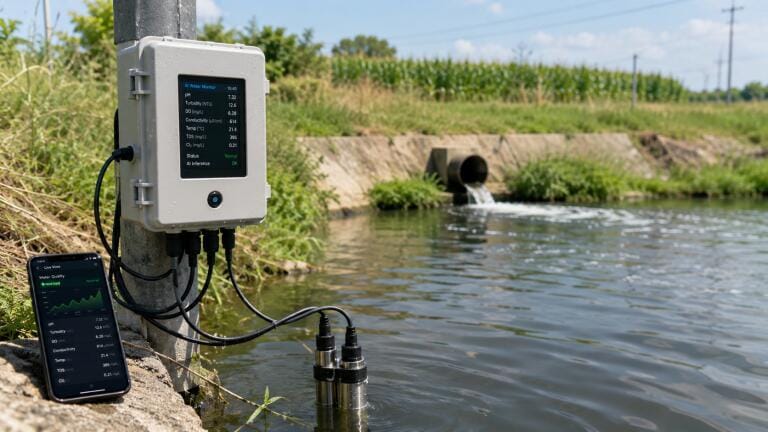
Water quality monitoring
It points to a future in which intelligent, autonomous sensor networks could replace or substantially supplement routine laboratory testing in field monitoring applications.
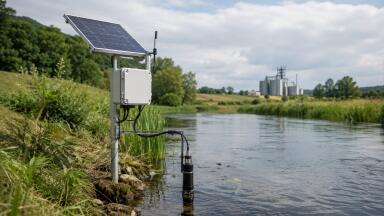
The system, developed by researchers at Vellore Institute of Technology and published in February 2026, integrates a suite of standard electrochemical sensors – measuring pH, turbidity, dissolved oxygen, conductivity, temperature, total dissolved solids (TDS) and residual chlorine – with an embedded artificial intelligence model based on the TinyML framework.
 Unlike conventional approaches, in which sensor data is transmitted to the cloud for analysis, the system performs classification directly on the sensor device itself, reducing latency, improving resilience in low-connectivity environments and cutting the bandwidth and energy requirements associated with continuous data upload.
The neural network at the heart of the system was trained on a custom dataset of 6,000 data points and deployed using TensorFlow Lite for Microcontrollers.
In testing, it achieved 99.28% accuracy in classifying water conditions into three categories: normal, rainwater runoff and chemical contamination 2 providing not just a continuous readout of individual parameters but an interpreted assessment of the likely cause and severity of any deviation from baseline conditions.
The system also incorporates cloud integration for longer-term data logging, trend analysis and remote alert generation – enabling monitoring staff to be notified automatically when the on-device model flags a contamination event, without requiring continuous human oversight of raw sensor feeds.
The cost profile of the system is notably accessible.
By combining off-the-shelf sensor components with open-source machine learning tools, the researchers were able to build a functional multi-parameter monitoring unit at a fraction of the cost of conventional instrumentation, making continuous deployment across multiple monitoring points economically feasible even for smaller operators, local authorities or environmental agencies working with constrained budgets.
The development comes at a time when both regulatory requirements and practical expectations around water quality monitoring are intensifying.
Increasing pressure on catchments from agriculture, urban runoff and climate-driven extreme weather events is making the limitations of periodic manual sampling more apparent – while advances in sensor miniaturisation, battery technology and embedded computing are progressively removing the technical and economic barriers to continuous, intelligent field monitoring.
IET 36.5 Sept/Oct 2026



 Product directory















.jpg)