Water quality monitoring
For decades, water quality programmes have focused heavily on nutrients, metals, organic contaminants, turbidity, dissolved oxygen and standard microbial indicators such as E. coli.
Those measurements remain essential but a new study from Japan highlights why future monitoring strategies may need to pay closer attention to emerging pathogens moving between wildlife, surface water, agriculture and people.
Researchers at Osaka Metropolitan University investigated the presence of Escherichia albertii in environmental water and wild raccoons in Osaka Prefecture. The bacterium is an emerging foodborne pathogen associated with diarrhoeal disease and outbreaks of food poisoning.
Although E. albertii is less familiar than E. coli or Salmonella, the study is relevant to environmental monitoring professionals because it shows how rivers can act as a connecting route between wildlife reservoirs and potential human exposure.

The researchers sampled environmental waters across eight river systems in Osaka Prefecture between August 2022 and October 2023. They detected E. albertii in 49 of 64 water samples, equal to around 77%.
The bacterium was found in six of the eight river systems tested.
That alone would make the study significant. However, the spatial pattern was especially important. The researchers did not only find the bacterium downstream, where pollution from settlements, farms or recreational areas might be expected to accumulate. It was also detected upstream and close to water sources, including areas with little obvious human activity.
For monitoring professionals, this is the key point. Not all microbial contamination in surface waters can be understood through human wastewater, sewer overflows or agricultural run-off alone. Wildlife can be an active and persistent source of microbial risk, particularly where animals move between rivers, farmland, urban edges and food production areas.
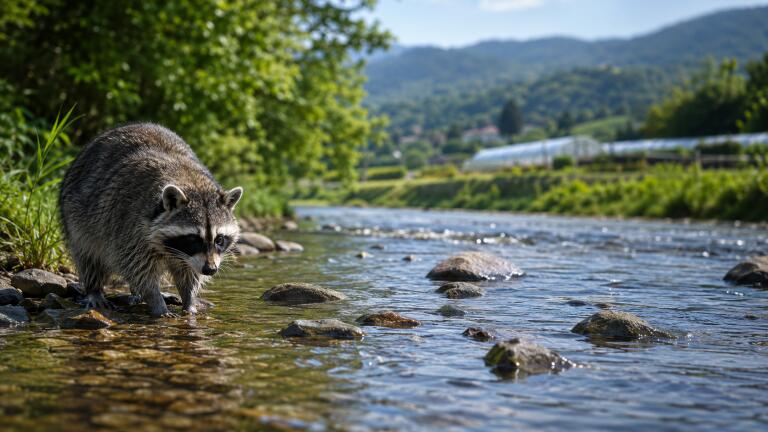
The study also examined 122 wild raccoons captured in Osaka Prefecture between November 2021 and March 2023. E. albertii was detected in 68 animals, or around 56%.
Raccoons are invasive in Japan and are well suited to spreading pathogens through mixed landscapes. They move through forests, riverbanks, farms and urban areas, and they are strongly associated with water sources. If infected animals shed bacteria in faeces, rivers and irrigation channels can become part of the transmission pathway.
The researchers’ findings suggest that wild raccoons may be contaminating environmental waters with E. albertii. This does not mean raccoons are the only source, or that every contaminated river represents a direct human health threat. However, it does show how wildlife reservoirs can complicate water quality assessment.
For environmental laboratories, catchment managers and public health agencies, this points to a broader monitoring challenge. A river can meet expectations against some conventional indicators while still carrying emerging biological risks that are not being specifically targeted.
One of the most important aspects of the study was the use of whole-genome sequencing.
The researchers did not simply ask whether E. albertii was present. They compared isolates from water and raccoons at high genetic resolution. This allowed them to examine whether strains from different sources were closely related.
The analysis found substantial overlap between water-derived and raccoon-derived strains. In some cases, strains isolated from river water and raccoons in the same area and period were almost identical.
This is where the study becomes especially relevant to modern monitoring. Traditional microbial testing can identify the presence of an organism. Genomic methods can begin to show where it may have come from, how it is moving through the environment, and whether environmental strains are related to those associated with human illness.
That distinction matters. Environmental monitoring is moving from detection toward attribution. Regulators and operators increasingly need to know not just that contamination exists, but whether it is linked to wastewater, livestock, wildlife, industrial activity, stormwater, failing infrastructure or diffuse catchment pressures.
The immediate public health concern is foodborne disease. If contaminated environmental water reaches crops, animal feed, livestock, poultry or food handling environments, it can become part of a wider exposure chain.
However, the implications extend into water monitoring.
Surface waters used for irrigation, recreation or drinking water abstraction are not isolated from wildlife ecology. Climate pressure, land-use change, urban expansion and biodiversity shifts can all affect how pathogens move through catchments. At the same time, global trade and urbanisation can bring people, food systems and wildlife into closer contact.
This makes the study a useful example of One Health monitoring in practice. Human health, animal health and environmental quality cannot always be separated. A pathogen detected in river water may reflect wildlife ecology, land management, agricultural practice and public health risk at the same time.
For monitoring professionals, this raises practical questions. Which pathogens should be added to surveillance programmes? When are standard faecal indicators enough? Where does targeted PCR or sequencing add value? How should environmental laboratories validate methods for organisms that are not yet part of routine regulatory testing?
The study does not suggest that every water monitoring programme should immediately begin routine testing for E. albertii. The findings are specific to Osaka Prefecture, and the researchers note that more quantitative work is needed to understand the level of infection risk from contaminated environmental waters.
That caveat is important.
Detection is not the same as exposure, and exposure is not the same as disease. Concentration, viability, persistence, seasonality, land use, treatment barriers and human behaviour all affect real-world risk.
Even so, the study shows where targeted surveillance may be useful. Catchments with known wildlife reservoirs, high recreational use, irrigation abstraction, fresh produce production or repeated unexplained foodborne outbreaks may benefit from more detailed microbial source tracking.
In those contexts, environmental DNA methods, species-specific PCR, selective enrichment, culture-based confirmation and whole-genome sequencing can provide a much richer picture than conventional indicator testing alone.
The central message is not that raccoons are uniquely dangerous. It is that wildlife-linked pathogens can enter water systems in ways that may be missed if monitoring is too narrowly designed.
For laboratories, the study reinforces the growing importance of molecular methods and genomic analysis in environmental microbiology. For catchment managers, it shows why sampling location, seasonality and wildlife activity need to be considered when interpreting results. For regulators, it adds weight to the argument that water quality frameworks may need to become more flexible as emerging pathogens are identified.
The next stage will be quantitative risk assessment. Monitoring programmes need to know how much pathogen is present, whether it remains viable, how long it persists, and whether it can reach humans through water, crops, livestock or food processing pathways.
Until then, this study offers a clear signal. Environmental water is not just a passive recipient of contamination. It can be an active pathway through which zoonotic pathogens move across the boundaries between wildlife, agriculture and public health.
IET Guide 2026

 Product directory