Environmental laboratory
Large datasets, repetitive analytical tasks, quality assurance demands, multi-parameter complexity, regulatory reporting burdens – these are exactly the conditions under which machine learning tools are supposed to deliver.
The published literature is enthusiastic: a bibliometric analysis of AI and machine learning applications in environmental monitoring, covering 4,762 publications from 1991 to 2024, shows a sharp acceleration in output since 2010, with China, the US and India among the leading contributors.
Research claims are frequently impressive – ML models applied to water quality prediction, including XGBoost, LSTM networks and random forest approaches, report accuracy metrics as high as R² = 0.99 in some classification and regression tasks.
But the gap between research performance and operational deployment is where the honest assessment becomes more complicated.
For environmental monitoring laboratories specifically, the picture is one of genuine but uneven progress – with the most credible advances concentrated in a few specific application areas and several structural obstacles still limiting broader adoption.

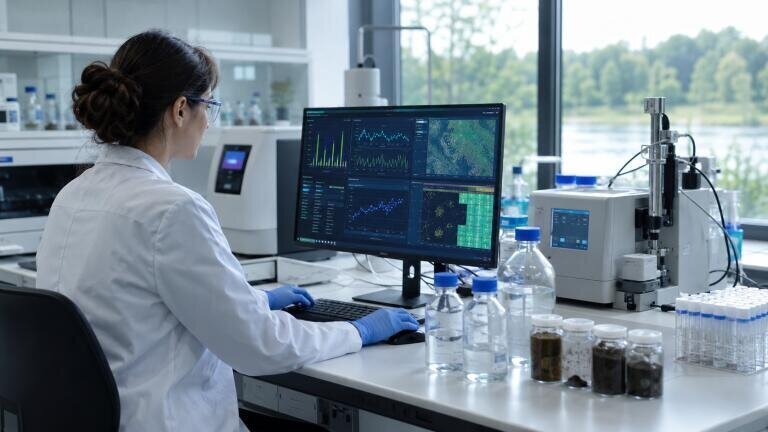
The area where AI has delivered the most demonstrable practical value in environmental labs is data management and laboratory information management systems (LIMS).
AI-enhanced LIMS now offer real-time anomaly detection, comparing incoming instrument results against historical patterns to flag outliers before they enter a validated dataset.
Automated report generation, audit trail management and chain-of-custody documentation have reduced manual administrative burden in labs running high sample volumes.
For accredited environmental laboratories, where QA documentation is a regulatory requirement rather than an option, these tools address a genuine operational pain point. The value is not glamorous, but it is real and measurable in time saved and error rates reduced.
Spectroscopy has emerged as a second area of genuine progress.
In 2025, the convergence of deep learning with miniaturised and portable instrumentation produced practical applications that go beyond laboratory research settings.
Deep-learning Raman microplastic detection in environmental samples and mid-infrared convolutional neural networks for soil carbon quantification, have both moved toward operational deployment.
For environmental monitoring professionals working on microplastics, soil health indicators or contaminated land characterisation, these represent tools that are beginning to deliver results at analytical speeds and costs that would not have been possible using conventional approaches.
Continuous water quality monitoring is a third application with real-world traction.
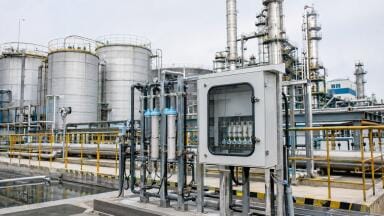
AI models trained on sensor arrays – monitoring turbidity, dissolved oxygen, temperature, pH, conductivity and specific ions – have been used to flag anomalies in real time, identify likely pollution events and reduce the need for laboratory confirmation testing of every anomaly.
When the system is working well, it functions as a first-pass filter: directing laboratory resources toward genuine events rather than sensor noise.
The accuracy figures reported in academic literature need to be read carefully.
An ML model achieving R² = 0.99 for water quality prediction has typically been trained and tested on a curated dataset from a specific geographic location, a defined monitoring period, and a manageable number of input parameters.
Transfer that model to a different catchment, a different season, or a water body with different hydrochemical characteristics, and performance frequently degrades significantly.
A review published in the IWA Water Quality Research Journal was explicit on this point: there is no one-size-fits-all AI solution for water quality monitoring, and the requirement for large, locally relevant training datasets remains a fundamental constraint.
This matters practically for environmental monitoring laboratories because regulatory compliance work requires defensible, reproducible results across diverse matrices and sites.
A model trained on a chalk catchment in the south of England does not necessarily perform reliably on a flashy upland catchment in Wales.
Retraining requirements, dataset assembly and ongoing validation are real operational costs that the research literature tends to understate.
The interpretability problem is another genuine obstacle. Many high-performing ML models – deep neural networks, gradient-boosted ensembles – are effectively black boxes.
They produce outputs without transparent mechanistic explanations. For environmental compliance purposes, where a laboratory result may need to withstand regulatory scrutiny, third-party verification or legal challenge, the inability to explain why a model produced a particular output is a significant liability.
Regulators have not yet developed frameworks for accepting AI-generated results in the same way they accept results from validated analytical methods with documented uncertainty budgets.
A recurring finding across multiple sources is that data quality, not algorithmic sophistication, is the limiting factor for most operational AI deployments. A LabWare analysis made the point directly: AI's effectiveness within a LIMS ultimately hinges on data quality.
Environmental monitoring laboratories that have inconsistent sample coding, manual transcription steps, poor instrument integration, or fragmented legacy databases are not ready for AI tools that depend on clean, structured, continuous data.
Building that foundation is an investment in laboratory infrastructure and data governance before it is an investment in AI software.
Interoperability is a related constraint.
A 2025 assessment noted that only around 60% of US laboratories are fully interoperable across their data systems. Instruments from different manufacturers, LIMS platforms, field data collection tools and regulatory reporting portals often do not communicate reliably. AI tools that are designed to integrate multiple data streams cannot function effectively if those streams are siloed or formatted inconsistently.
Cost remains a practical barrier for smaller laboratories. AI platform deployments in laboratory settings are estimated to run from $100,000 to $500,000 in initial investment, before training, integration and ongoing maintenance.
For commercial environmental testing laboratories operating on competitive margins, that is a difficult investment to justify without a clear and near-term return.
AI-powered, data-driven approaches are delivering genuine value in environmental monitoring laboratories – most credibly in LIMS-integrated data management, in spectroscopic analysis of complex matrices, and in the first-pass interpretation of continuous sensor data.
These are not trivial achievements. But the sector is still some way from the autonomous, self-validating laboratory that the more ambitious vendor narratives describe. The bottlenecks are less about algorithmic capability than about data infrastructure, regulatory frameworks that can accommodate AI-generated evidence and the practical challenge of making models that perform in controlled research conditions work reliably in the variable, messy conditions of operational environmental monitoring.
The laboratories most likely to realise value from these tools in the near term are those that have already invested in structured data management, instrument integration and workflow standardisation.
For them, AI is the next step. For those still relying on manual transcription and fragmented records, the returns will be limited until the foundations are in place.
IET Guide 2026


 Product directory