Environmental laboratory
An estimated 1,656 ± 962 Gg total Hg in Northern Hemisphere permafrost-region soils, with 793 ± 461 Gg frozen in permafrost.
As thaw accelerates, this stock can be remobilised through gaseous elemental mercury exchange with the atmosphere, riverine export of dissolved/particulate Hg and microbial methylation in newly waterlogged or thermokarst-impacted environments, creating a monitoring problem that is fundamentally multi-media.
Find your next mercury analyser for your analytical laboratory in our international directory.
For monitoring professionals, the practical challenge is not whether Hg is present, but whether instrumentation and QA/QC can resolve small fluxes, strong seasonality, and extreme spatial heterogeneity.
Measured signals already show that thaw features can generate order-of-magnitude increases in downstream total Hg (THg) and methylmercury (MeHg) yields, while circumpolar river systems export large Hg loads during high-flow periods.
Policy relevance is rising because climate-driven secondary emissions, i.e. remobilisation of historic depositions, can disguise the response to controls on current emissions.
The United Nations Environment Programme estimates global anthropogenic Hg emissions to air in 2015 at about 2,220 tonnes, and notes that human activity has increased atmospheric Hg concentrations by roughly 450% above natural levels, with legacy Hg continuing to cycle and complicating trend attribution under climate change.
This matters for permafrost because a substantial fraction of Hg stored in high-latitude soils is interpreted as the cumulative outcome of long-term atmospheric deposition and retention in cold, organic-rich landscapes.
The widely cited permafrost stock estimate is based on measurements from 13 U.S. Geological Survey permafrost cores and spatial upscaling across the Northern Hemisphere permafrost domain.
In addition to the headline totals, the same work provides depth-integrated context that is operationally important for coring designs (for example, 0–30 cm: 347 ± 196 Gg; 0–100 cm: 755 ± 427 Gg; 0–200 cm: 1,323 ± 764 Gg).
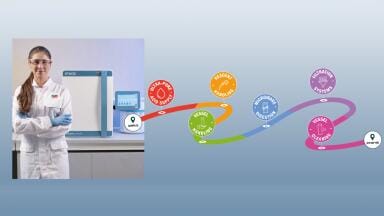
Permafrost Hg monitoring is best treated as an end-to-end workflow that links a soil reservoir to measurable atmospheric and aquatic pathways, and then to methylation conditions and exposure endpoints.
A mechanistic modelling study adds Hg cycling to a land-surface carbon model and explicitly frames thaw-driven releases as atmospheric evasion of Hg⁰ and hydrological export of Hg²⁺ (with a small fraction methylating to MeHg), emphasising lags and buffering via vegetation/soil re-uptake.
A permafrost‑Hg re‑emission monitoring design must combine ultra‑trace analytics with event‑driven sampling and micrometeorology, because thaw processes and high‑flow events can dominate annual signals.
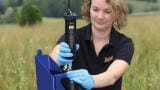
Use field platforms and protocols quantify stocks with depth‑resolved active‑layer and permafrost cores, kept frozen end‑to‑end, and measured with bulk density plus organic carbon to support inventories and Hg:C scaling.
For thermokarst/erosion (slumps, bank failures) and rivers, treat sampling as a combined water–sediment problem, collect paired filtered/unfiltered waters and suspended sediment while logging discharge and turbidity so event loads and partitioning can be calculated.
During spring freshet, plan daily to sub‑daily sampling for ~2–4 weeks, because >90% of annual THg export can occur during peak discharge.
Air–surface exchange needs both flux chambers (plot‑scale) and flux towers/eddy covariance (ecosystem‑scale); validated eddy covariance Hg⁰ systems report a laboratory flux detection limit ~0.22 ng m⁻² h⁻¹ but require sonic anemometry, stationarity screening and synchronised PAR/wind/temperature to manage storage and photoreduction artefacts.
Continuous GEM/TGM reference stations typically use 2537‑class CVAFS from Tekran Instruments Corporation with stated detection limits <0.1 ng m⁻³ (high quality, low portability, power/maintenance intensive). Portable vapour analysers (RA‑915M class) from Lumex Instruments report LODs ~0.5–2 ng m⁻³ with near‑real‑time response, suitable for transects over thaw features and rapid incident response.
Add passive air samplers for electricity‑free multi‑day to multi‑week averaging and spatial coverage; some designs can quantify background GEM with 1–3 day exposures after calibration (McLagan et al., 2016). Drone/UAV GEM mapping (e.g., RA‑915M on heavy‑lift platforms) has demonstrated near‑real‑time 3D concentration fields for source localisation and vertical gradients.
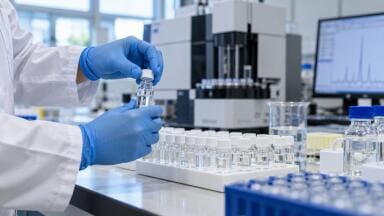
For aquatic-lab methods, THg by CVAFS (EPA 1631E) has MDL ~0.2 ng L⁻¹ and MeHg by GC‑CVAFS (EPA 1630) has MDL ~0.02 ng L⁻¹ (ML ~0.06 ng L⁻¹) from the U.S. Environmental Protection Agency, but permafrost waters are typically contamination/interference‑limited rather than detector‑limited. Use ultraclean handling, field/equipment blanks, matrix spikes/duplicates, strict chain‑of‑custody, filtration controls, light protection (photoreduction) and frequent zero/span checks.
Sample porewaters with low‑disturbance devices, interpret alongside DOC, redox (Eh), sulphate and Fe to flag methylation windows, and screen methylators via hgcA/hgcB qPCR/metagenomics with inhibition controls; hgcA/hgcB are required for microbial Hg methylation.
Integration and policy: implement tiered monitoring— super‑sites, distributed passive/seasonal coverage and rapid response for thaw failures—then assimilate to constrain warming‑driven release projections and to provide comparable monitoring data required under the Minamata Convention on Mercury and emphasised in the United Nations Environment Programme Global Mercury Assessment process.
Sources for analytical performance and platform demonstrations: EPA 1631/1630 method documents; eddy-covariance validation; passive sampler review; UAV GEM measurement study; RA-915M manual.
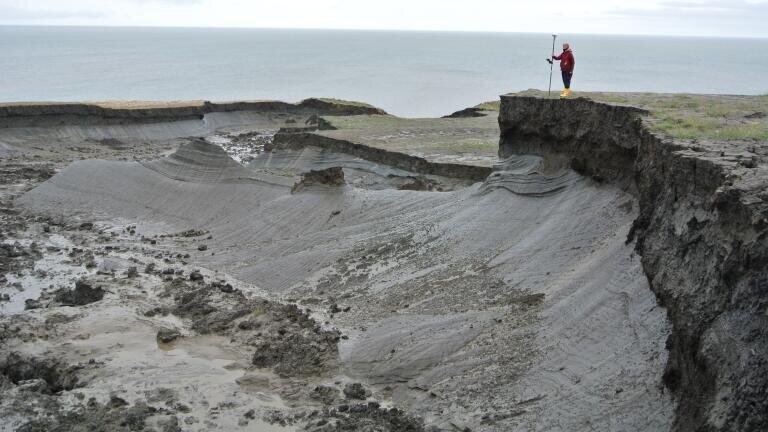
A well-documented thermokarst signal comes from retrogressive thaw slumps on the Peel Plateau, where downstream fluvial concentrations were reported up to 1,270 ng/L (THg) and 7 ng/L (MeHg)—up to two orders of magnitude above upstream—alongside open-water season yields of 610 mg km⁻² d⁻¹ (THg) and 2.61 mg km⁻² d⁻¹ (MeHg).
The same work notes that >95% of downstream Hg was typically particle-bound, which is critical when translating concentration spikes into bioavailability and monitoring priorities (dissolved vs particulate partitioning, reservoir formation behind debris tongues, and methylation potential).
At the circumpolar scale, a coordinated, year-round sampling programme across six major Arctic rivers—Ob River, Yenisei River, Lena River, Kolyma River, Mackenzie River and Yukon River—estimated average export of ~20,000 kg THg per year from these six rivers (2012–2017), scaling to a pan-Arctic estimate of ~37,000 kg THg per year, with >90% of flux during spring/summer high discharge.
This is a direct design cue for monitoring frequency: without freshet capture, annual loads will be biased low even if concentration analytics are exemplary.
For atmosphere–surface exchange in thawing peatlands, a thaw-sequence study at Stordalen Mire used manual chambers plumbed to a Tekran Instruments Corporation 2537B and reported chamber-based total gaseous mercury fluxes on the order of ~−0.90 to +1.82 ng m⁻² h⁻¹, with continuous near-surface TGM typically around ~1 ng m⁻³.
Small magnitudes like these explain why flux QA/QC (zero stability, artefact control, meteorological synchronisation) is often the determiner of interpretability.
Schematic points correspond to representative sites and river systems discussed above (thermokarst slumps; thawing peatland gradient; major Arctic rivers).
A mechanistic permafrost Hg modelling study projects that, under high-emissions forcing, net Hg⁰ fluxes from permafrost regions could peak around 1.9 ± 1.1 Gg Hg yr⁻¹, comparable in magnitude to modern global anthropogenic emissions as framed in that analysis; under a lower-emissions pathway, net Hg⁰ fluxes rise to about 0.5 ± 0.3 Gg Hg yr⁻¹.
The same model highlights that a large fraction of released Hg is recycled back into vegetation/soil organic matter, creating lags between thaw onset and atmospheric signal emergence, and that projections are dominated by uncertainty in the underlying soil Hg map.
For QA/QC, the permafrost context amplifies familiar ultra-trace issues: contamination control (field blanks, reagent blanks, system blanks), matrix-specific oxidation/reduction completeness, and consistent reporting relative to method detection/quantitation levels. In practical terms, a defensible monitoring strategy is a tiered design.
To measure flux and biogeochemistry at core super-sites, co-located Hg⁰ flux (tower or chambers), meteorology, hydrology, DOC and redox profiling, and microbial potential assays (hgcA/hgcB conceptual targets) to mechanistically attribute methylation conditions rather than infer them from bulk THg alone.
We need passive GEM samplers across permafrost landscape classes and along transport corridors to capture gradients without power or continuous staffing.
Rapid-deploy field teams using portable analysers (e.g., Lumex Instruments RA-915M-class) and UAV mapping when thaw slumps, thermokarst lake expansion, or wildfire smoke create short-lived but high-consequence signals; UAV-based GEM mapping has been demonstrated in near-real time with heavy-lift platforms.
When it comes river network priorities, high-frequency sampling at least through spring freshet and major summer storm pulses, because discharge and suspended sediment drive a dominant share of annual Hg export.
The policy implication for the Minamata Convention on Mercury is interpretive: the treaty’s effectiveness evaluation framework explicitly relies on comparable monitoring data and trends in environmental and biotic media, but climate-driven remobilisation of legacy Hg can weaken simple expectations on policy timescales.
IET Guide 2026

 Product directory