Water testing
Under the change, the Environment Agency no longer has to prove a breach beyond reasonable doubt.
Cases are now decided on the balance of probabilities, the standard used in most civil litigation.
The reform is enabled by the Water (Special Measures) Act 2025 and follows a period of change aimed at speeding up enforcement against pollution incidents.
Alongside the £500,000 civil monetary penalty, the Environment Agency has introduced smaller automatic penalties for specific, clearly defined breaches.

Large water companies face a fixed £10,000 penalty, doubling to £20,000 if unpaid after 28 days, for offences including more than three emergency overflow discharges in a year, failing to report a pollution incident within four hours, and failing to submit monthly event duration monitoring (EDM) data.
The Environment Agency estimates these automatic penalties will cost the sector between £50m and £67m a year.
No-notice inspection powers also form part of the reform package, though these are set out as part of proposals for a new single water regulator, which has not yet been established.
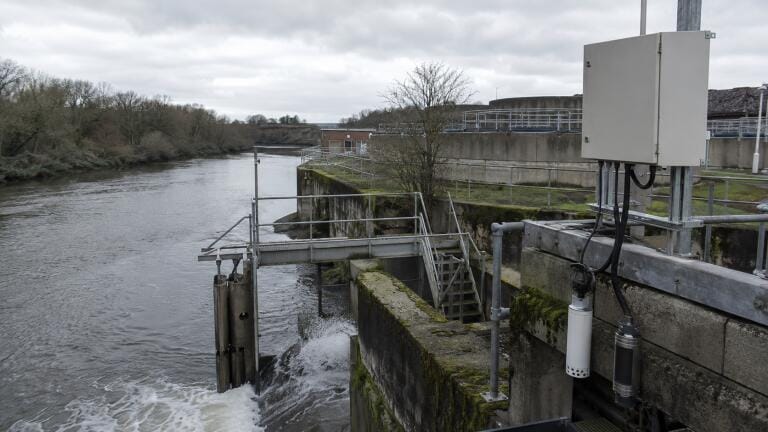
Real-time public monitoring at every emergency overflow is the culmination of two years of reform work by water companies and the agency, rather than a requirement introduced on 6 July alone.
For laboratories, instrumentation suppliers and monitoring contractors, the practical implication sits in event duration monitoring infrastructure.
Water companies must demonstrate, with continuously logged and defensible data, when an emergency overflow discharges, for how long, and how often.
Monthly EDM submissions are no longer a reporting formality; failing to file them is now itself a chargeable offence.
That raises the operational bar for the sensors, telemetry and data management systems behind overflow monitoring.
Equipment certified under the Environment Agency's MCERTS scheme, which sets performance standards for environmental monitoring instruments, is likely to see sustained demand as water companies work to defend their compliance position under a lower evidential threshold.
The move to a civil standard of proof also changes the calculus for laboratories providing verification and audit services.
Cases that might once have stalled for lack of evidence sufficient to meet a criminal threshold can now proceed on a lower bar, increasing the value of continuous, traceable monitoring data as a defence as much as an accusation.
The enforcement changes sit alongside a wider £104bn programme of private investment in water infrastructure over five years, described as the largest since privatisation.
Ofwat remains the economic regulator responsible for company finances and pricing; the Environment Agency is the enforcing body for environmental compliance under the new penalties regime.
For monitoring professionals, the immediate significance is less about the size of any single penalty and more about the shift in evidential threshold.
Real-time, continuously logged, MCERTS-certified monitoring output is moving from useful supporting evidence towards a baseline expectation for both compliance and defence.
IET Guide 2026



 Product directory