Gas detection
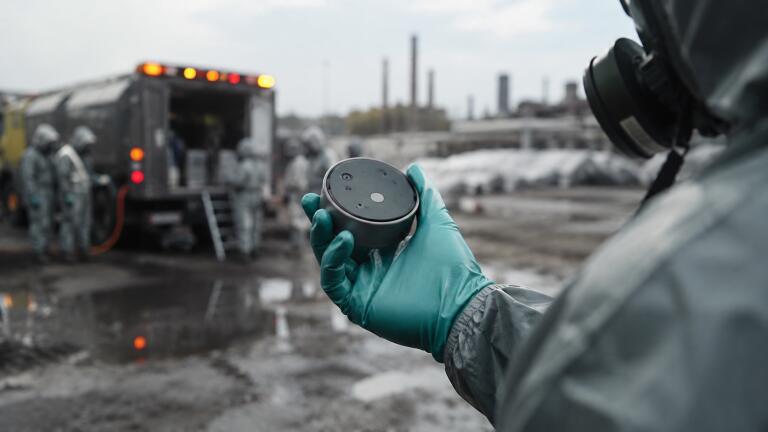
Researchers at MIT Lincoln Laboratory have developed a throwable, baseball-sized sensor that can remotely detect hazardous vapours and aerosols.
The device, called the Tactical Optical Spherical Sensor for Interrogating Threats (TOSSIT), is designed to warn military personnel, first responders and law enforcement of chemical threats.
Those threats include nerve and blister agents, industrial chemical accidents, and fentanyl dust. Users can throw, drone-drop or launch TOSSIT into an area of concern, keeping themselves at a safe distance while the device does the sampling.
TOSSIT uses colorimetry, the measurement of colour changes produced by chemical reactions, to identify what is present in an air sample.
The sensor draws in air and uses an internal camera to observe colour changes on a removable dye card.
If certain chemicals are present, the device alerts users through an app or through alarms built into the sensor itself.
Because it is encased in a small spherical shell, it can be thrown, dropped or rolled into tight or precarious spaces, letting responders assess airborne risk before entering an area themselves.
"TOSSIT fills an unmet need, providing a low-cost sensing option for vapours and solid aerosol threats, think toxic dust particles, that would otherwise not be detectable by small deployed sensor systems," said principal investigator Richard Kingsborough.
The device was developed with investment from the Defense Threat Reduction Agency, working alongside researchers at MIT Lincoln Laboratory and the US Army Combat Capabilities Development Command Chemical Biological Center.
It follows extensive field testing, and the technology is now being transferred to the US military.
While TOSSIT has been developed primarily for military and law enforcement use, the underlying detection challenge, identifying hazardous vapours and aerosols quickly and from a safe distance, is one that industrial safety, emergency response and environmental monitoring teams also face.
Rapid, low-cost screening tools for airborne chemical threats could have a role wherever a fast initial assessment of an unknown atmosphere is needed.
One example is an industrial site following a suspected chemical release, before larger continuous monitoring or laboratory analysis confirms the extent of any contamination.
The work is one of several sensor projects at MIT Lincoln Laboratory; the laboratory has separately developed a fabric-based sensor for detecting chemical vapours, reflecting a broader push toward low-cost, field-deployable chemical detection tools.

Industrial sites already rely on a mix of fixed gas detectors, portable multi-gas monitors and, following an incident, laboratory analysis to characterise a release in detail.
What most of these approaches share is that someone, or some fixed piece of equipment, has to be relatively close to the source before a reading can be taken.
That is the specific gap a throwable, remotely readable sensor is designed to close. Rather than replacing fixed detection networks or laboratory confirmation, a device such as TOSSIT would sit ahead of them.
It would give responders an early, low-cost read on whether an area is safe to approach at all.
The colorimetric method behind TOSSIT, reading chemical-driven colour changes on a dye card through a built-in camera, is a relatively mature and well-understood detection principle.
That maturity, combined with the device's low unit cost compared with continuous monitoring instrumentation, is part of what Kingsborough points to when describing the sensor as filling an unmet need rather than duplicating existing capability.
IET 36.5 Sept/Oct 2026



 Product directory