Environmental laboratory
It is more likely to be built around measurable ecological performance: biodiversity uplift, nutrient reduction, flood-risk reduction, soil carbon, water retention, habitat condition and the resilience value of natural infrastructure.
For environmental monitoring professionals, this matters because these markets cannot function without trusted evidence.
The financial product may be a biodiversity credit, a natural capital investment, a resilience bond or a nature-based insurance policy but the underlying commodity is increasingly a monitored environmental outcome.
This is the central tension in the emerging nature finance sector. Nature is being brought closer to the balance sheet, but nature is not naturally balance-sheet shaped.
A tonne of carbon dioxide can at least be treated as a common unit. Biodiversity, soil health, catchment resilience and ecosystem condition are more local, more complex and harder to compare.
That makes monitoring, reporting and verification not a back-office function but the core infrastructure of the market.

In accounting terms, natural capital equity can be understood as the residual value left once natural capital liabilities are deducted from natural capital assets.
Recent work on natural capital balance sheets frames ecosystem assets, liabilities and equity in ways that mirror financial accounting, translating ecological condition and ecosystem service flows into an accounting language familiar to boards, investors and public bodies.
The logic is simple enough: if land, water, soils, reefs or forests generate services with economic value, then degradation appears as a liability and restoration appears as an asset-enhancing activity. The difficulty is proving that those changes are real.
That is why environmental monitoring is moving from a compliance role into a financial assurance role. A wetland restoration scheme may claim nutrient reduction, flood storage, biodiversity uplift and carbon benefits.
Each claim requires a different evidence base. Water quality sampling, flow measurement, soil testing, ecological surveys, remote sensing, acoustic monitoring, eDNA analysis and hydrological modelling may all become part of a single investable project.
In this setting, monitoring is helping to establish whether a financial claim has integrity.
The policy direction is already visible. The European Commission published its Roadmap towards Nature Credits in July 2025, describing nature credits as a way to complement public funding with private investment and reward farmers, foresters, fishers, landowners and local communities for restoring or protecting ecosystems.
It also says these credits should be based on science-based and trustworthy ways to measure improvements in ecosystem condition. Reuters reported that the EU sees these credits partly as a response to an estimated €37 billion annual biodiversity funding shortfall, with an expert group developing methodologies, certification and governance options.
The UK is moving in a similar direction through nature market standards. In March 2026, Defra and BSI announced new standards for biodiversity and nutrient markets, intended to define how credits should be designed, measured and reported.
The government’s Nature Investment Standards page says the standards are intended for credit suppliers, crediting programmes, market intermediaries, registries and trading platforms, with buyers and investors also able to use them to identify higher-integrity credits.
It also sets out a phased assurance model, beginning with at least two years of self-assessment from March 2026 before accredited conformity assessment bodies become the primary assurance route.
That transition from self-assessment to third-party assurance is significant for monitoring professionals. It suggests that the future nature market will not only need ecologists and project developers but also auditors, laboratories, data platforms, calibration protocols, field technicians and conformity assessment bodies able to trace environmental claims back to defensible measurements.
Defra’s own assurance guidance makes the point directly: because nature is complex and hard to measure, checks are needed to ensure that credits represent real environmental improvement, measured properly and based on robust evidence.
Nature-based insurance shows the same pattern from a different angle. Instead of turning nature recovery into a credit, it turns ecosystem protection into a risk-transfer product. Coral reefs, mangroves, wetlands and other natural infrastructure can reduce storm surge, erosion, flooding and economic loss. If those assets are damaged, insurance can provide rapid funding for repair.
The Nature Conservancy’s coral reef insurance work in Hawai‘i and Quintana Roo is the most visible example. Its Hawai‘i policy was renewed in 2025, while the earlier Quintana Roo scheme produced a nearly $850,000 payout after Hurricane Delta in 2020, funding reef recovery after parametric triggers were met.
The Mesoamerican Reef Insurance Programme shows how this model is scaling. In 2022, Hurricane Lisa triggered a payout for Turneffe Atoll in Belize after wind speeds reached 70 knots; the payout was received within two weeks, and response teams assessed reef damage and stabilised nearly 200 coral fragments within 15 days of the hurricane.
The programme has expanded from four sites in 2021 to 11 reef sites across the region since 2023. Here, monitoring operates across the whole insurance cycle: baseline ecological condition, hazard modelling, trigger design, post-event assessment and verification that restoration work has actually occurred.

Remote sensing and Earth observation can support land-cover mapping, vegetation condition, habitat extent, floodplain change and catchment-scale risk assessment.
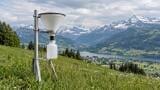
In-situ sensors can track water quality, turbidity, nutrients, flow and meteorological conditions. eDNA, camera traps, passive acoustic monitoring and field surveys can help establish species presence and ecological change.
A 2025 study comparing monitoring methods for biodiversity credits evaluated in-person surveys, trail cameras, eDNA metabarcoding and passive acoustic monitoring, explicitly in the context of repeated reporting requirements for biocredit schemes.
The opportunity is not only more monitoring, but more consequential monitoring. In conventional environmental regulation, poor data may weaken enforcement or delay intervention. In financialised environmental markets, poor data can also misprice assets, mislead investors, create low-integrity credits, trigger insurance disputes or allow ecological harm to be offset by questionable claims elsewhere.
This is why the sector is increasingly interested in audit trails, registries, independent verification, georeferenced datasets, repeatable methods and transparent uncertainty estimates.

Nature markets can create incentives for real restoration, but they can also turn complex ecosystems into over-simplified units.
The UK government’s consultation on voluntary carbon and nature markets recorded concerns about greenwashing and the risk that credit use could delay genuine business transformation if not tightly framed.
Scientific reviews have also highlighted persistent integrity problems around additionality, leakage, permanence and whether chosen metrics actually track the ecological outcomes being claimed.
This is where environmental monitoring professionals may become gatekeepers of credibility. A biodiversity uplift that cannot be monitored is not a robust financial asset. A flood-reduction claim that cannot be linked to hydrological evidence is not a reliable insurance proposition.
A nutrient credit without defensible sampling, modelling and verification is not a trustworthy unit of exchange. The more nature is financialised, the more important it becomes to define what is being measured, why that proxy has been chosen, how uncertainty is handled and who is responsible when the claimed benefit does not materialise.
The future of natural capital finance will therefore be shaped less by a simple expansion of “green investment” than by the construction of a measurement economy around nature.
Sensors, surveys, laboratories, satellites, models, standards and auditors will become part of the same system as insurers, banks, landowners and regulators.
For the monitoring sector, that creates a new commercial frontier. It also creates a responsibility: to make sure that ecological data becomes a constraint on what those claims are allowed to say.
IET 36.5 Sept/Oct 2026



 Product directory
















.jpg)