Business news
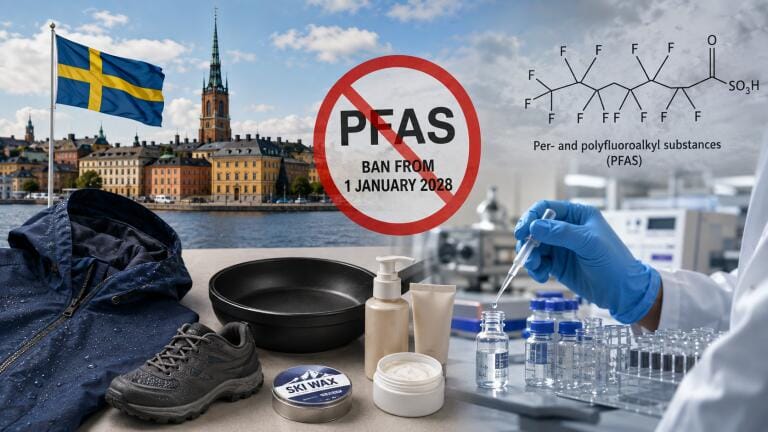
Sweden has announced plans to prohibit per- and polyfluoroalkyl substances (PFAS) in a range of consumer products from 1 January 2028, putting the country ahead of the European Union's own restriction, which is still working through the regulatory process in Brussels.
The Swedish government confirmed the move in a statement on Thursday, 23 July 2026. The ban is expected to cover clothing, footwear, waterproofing agents used on clothing and footwear, kitchenware, cosmetic products and ski wax.
PFAS, often referred to as "forever chemicals" because of how slowly they degrade, are used across consumer and industrial products for their resistance to heat, water and grease. Regulators in a growing number of jurisdictions have moved to restrict their use amid concerns over their persistence in the environment and in the human body.
Sweden's Minister for Climate and the Environment, Romina Pourmokhtari, said: "PFAS have no place in clothing, cosmetics, cookware and other everyday products when effective alternatives exist." She added: "Sweden has no intention of standing by while 'forever chemicals' continue to spread in our homes, in nature, and in our bodies."
The national ban is a stopgap rather than a permanent parallel regime. Once EU-wide rules are agreed, they will supersede Sweden's own legislation.
At EU level, the European Commission is expected to bring forward a proposal in 2027 for a broad restriction on PFAS in common consumer products, including clothing and pizza boxes, with exemptions proposed for strategic sectors such as medical applications.
Before the Commission can act, it requires a further opinion from the European Chemicals Agency (ECHA) on the socio-economic impact of restricting PFAS. ECHA's Committee for Risk Assessment adopted its scientific opinion on the proposed restriction on 3 March 2026, concluding that PFAS pose an EU-wide risk that justifies action; this fed into a public consultation on the accompanying socio-economic assessment, launched in late March, with a final opinion from ECHA's Committee for Socio-Economic Analysis expected by the end of the year.
Sweden's approach follows France, which has restricted certain PFAS in clothing, footwear, cosmetics and ski wax since January, subject to several exemptions.
For environmental laboratories, regulators and technology suppliers, national measures of this kind ahead of EU-wide agreement point to a period of divergent requirements across member states. Analytical and monitoring providers working across multiple jurisdictions will need to track both the developing EU restriction and any interim national rules, including how each defines the PFAS class, which uses are covered, and what exemptions apply.
The direction of travel, however, is consistent: sustained regulatory pressure on PFAS use in consumer goods, moving from targeted restrictions toward broader class-based measures, with implications for testing, certification and supply-chain due diligence across the sectors affected.
IET 36.5 Sept/Oct 2026





 Product directory