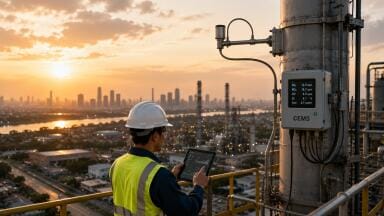
CEMS
Stretching more than 3,500 kilometres from Afghanistan in the west to Myanmar in the east, this vast arc of mountains and plateaus holds the largest concentration of glacial ice outside the Arctic and Antarctic.
Its ten major river systems – including the Indus, the Ganges and the Mekong – collectively provide freshwater to somewhere close to two billion people.
A quarter of humanity, in other words, depends on this region for water security.
Air quality across the region is deteriorating, with transboundary pollution drifting across multiple national borders.
The science is unambiguous: at 2°C of global warming, the region stands to lose half the volume of its glaciers, with consequences that will cascade downstream to irrigated food baskets and megacities across Asia.
This is the operating environment of the International Centre for Integrated Mountain Development – ICIMOD – a Kathmandu-based intergovernmental body serving eight regional member countries (RMCs): Afghanistan, Bangladesh, Bhutan, China, India, Myanmar, Nepal, and Pakistan.
For more than four decades, ICIMOD has served as the region's foremost knowledge and learning centre on mountain development, climate science and environmental risk.
But as the organisation moves into the second half of this decade under its Strategy 2030 framework, it is shifting its posture in ways that have real consequences for how it sources, deploys and specifies the environmental monitoring technology that underpins its work.
For providers of monitoring equipment and services, understanding where ICIMOD is headed – and why – matters.
Not only is ICIMOD itself a direct buyer of sensing, remote observation and data infrastructure but what it endorses and operationalises tends to become the de facto standard across national monitoring agencies and field programmes spanning eight countries.
ICIMOD's procurement footprint is far larger than the organisation's own budget would suggest.

The key shift embedded in Strategy 2030 is one of ambition and pace. ICIMOD's own framing is explicit: "the time for business as usual is over."
Its four long-term impact areas – transboundary risk reduction and adaptation, air quality, biodiversity and environmental health and green mountain economies – are to be pursued not merely through scientific publication and policy advisory but through "transformative action at scale."
This matters for procurement because scaling action requires a fundamentally different monitoring infrastructure than producing academic outputs.
Peer-reviewed assessments of glacier retreat can be based on satellite-derived data processed over months.
Early warning systems for glacial lake outburst floods, real-time air quality dashboards for populations in Kathmandu or Lahore, or operational hydrological forecasting for downstream river basin management – these demand continuous, networked, high-reliability instrumentation deployed and maintained in some of the world's most hostile terrain.
ICIMOD's Medium-Term Action Plan V (MTAP V), covering 2023–2026, lays out the interim steps.
The transition to MTAP VI, which will run from 2027 to 2030, is where the procurement implications sharpen considerably.
Organisations in this space typically re-evaluate frameworks, preferred suppliers and technology architectures at major strategic transitions, and the MTAP V–VI handover is the most significant ICIMOD will have undertaken in a decade.
ICIMOD's cryosphere programme has long maintained one of the most technically demanding field monitoring operations in the world.
Its three-pronged approach – field-based observation, remote sensing and process modelling – draws on a wide equipment portfolio that is now under increasing pressure to evolve.
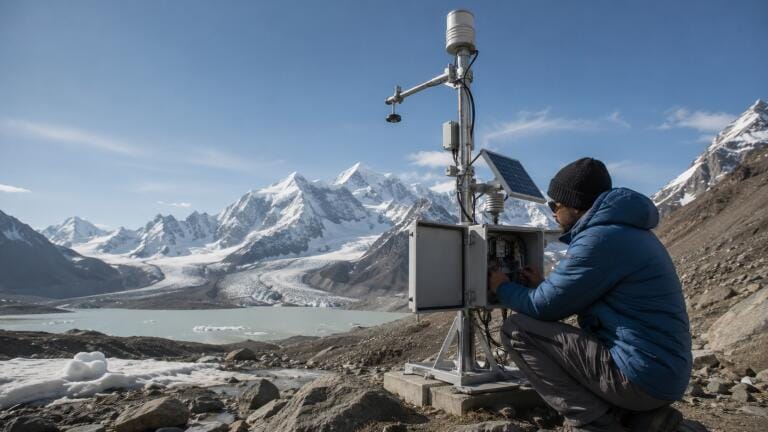
On the ground, benchmark glacier sites across the HKH require continuous mass balance measurement, meteorological station networks positioned both in valleys and on glacier surfaces, snow cover and precipitation monitoring, and ground surface temperature sensing for permafrost characterisation.
The use of Tidbit sensors for ground temperature and specialist micro-climate stations for near-surface atmospheric monitoring are established practice.
GNSS receivers for ice dynamics, Ground Penetrating Radar for sub-surface ice volume estimation, and glaciological measurement campaigns all generate procurement requirements at equipment refresh and programme expansion phases.
The most visible evolution in cryosphere technology procurement has been the adoption of Unmanned Aerial Vehicles.
ICIMOD has used UAVs for glacier and glacial lake mapping since 2014, generating ortho-photos and digital elevation models that would be practically impossible to obtain by any other means at comparable resolution and cost.
As the technology has matured – in terms of payload capacity, flight duration in high-altitude, low-pressure conditions, and onboard sensing capability – the procurement specification for next-generation deployments has become more complex.
The integration of LiDAR, multispectral imaging and thermal cameras onto UAV platforms now features in field operations where point cloud terrain modelling and ice surface temperature mapping are required alongside standard photogrammetric outputs.
Providers that can demonstrate reliable operation above 4,000 metres, compliance with the diverse civil aviation regulatory environments of the eight RMCs and the capacity to support local maintenance and operator training will have a significant advantage in this segment.
If cryosphere monitoring is ICIMOD's most technically challenging procurement domain, air quality has become its most rapidly expanding one.
Under Strategy 2030, reducing the adverse health impacts of air pollution while capturing mitigation co-benefits is one of ICIMOD's four core impact areas – and it is an area where the gap between current monitoring coverage and what is operationally needed is very wide.
At present, formal air quality monitoring infrastructure in the HKH region is sparse.
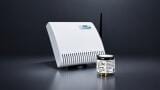
ICIMOD, working alongside national environment agencies, has established 13 monitoring stations in Nepal and five in Bhutan, equipped with instruments capable of measuring aerosol concentrations, trace gases including SO₂ and NO₂, and atmospheric optical depth.
These stations provide ground truth for satellite-derived air quality products and feed into ICIMOD's Air Quality Explorer platform, which generates regional maps of pollutant distribution.
The challenge is coverage. Mountain terrain creates sharp gradients in pollutant concentrations that cannot be characterised by stations positioned tens or hundreds of kilometres apart.
ICIMOD has been explicit about this limitation, and its response has been a dual-track procurement strategy: continued investment in reference-grade fixed station infrastructure, combined with an accelerating push into low-cost sensor networks capable of dense spatial deployment.
The low-cost sensor segment is one of the most commercially dynamic areas in environmental monitoring globally, and ICIMOD's engagement with it is significant.
Where it once required six-figure investment to instrument a single monitoring site to regulatory reference standards, it is now possible to deploy a network of dozens of nodes for a comparable budget – provided the data quality, calibration, and drift management challenges can be addressed.
ICIMOD has been piloting low-cost sensor approaches across South Asian partner countries, working with institutions including Duke University, and is in the process of developing guidance frameworks for their deployment.
For monitoring technology providers, this creates a clear opportunity. ICIMOD is not simply a buyer of low-cost sensors; it is actively shaping the standards and protocols against which such sensors will be evaluated across the region.
Providers who engage early in co-development, validation studies and calibration methodology work are positioning themselves not just for a single contract, but for regional adoption across eight national monitoring programmes.
Running through all of ICIMOD's monitoring procurement is an increasingly prominent requirement for digital integration.
Strategy 2030 explicitly identifies "harnessing innovation and digital technology" as one of seven delivery priorities.
In practice, this is reshaping the specification requirements for monitoring equipment in ways that suppliers need to understand.
The benchmark is no longer whether a sensor can measure accurately in the field.
It is whether it can transmit data reliably in the connectivity-constrained environments typical of remote HKH sites, integrate with ICIMOD's Mountain Environment Regional Information System and Regional Database System, support the AI-driven analytics workflows being developed through the SERVIR-HKH partnership with NASA and USAID, and provide outputs in formats compatible with regional climate services and early warning systems.
SERVIR-HKH has been particularly important in shifting ICIMOD's technology expectations.
It has built ICIMOD's internal capacity in earth observation, geospatial analysis and the blending of satellite data with ground-based observations into operational services.
The practical effect is that ICIMOD's scientists and project managers are more sophisticated buyers of monitoring technology than they were a decade ago.
They understand the difference between a sensor specification and an operationally deployable monitoring system, and they are increasingly specifying accordingly.

The transition from MTAP V to MTAP VI, expected to take shape formally from 2027, is the signal moment.
Organisations that want to be in ICIMOD's procurement landscape for the 2027–2030 period need to be visible and technically engaged now – during the second half of MTAP V, when programme reviews are conducted, lessons are drawn, and next-period technology needs are being scoped.
The practical implications point in several directions.
Suppliers of field meteorological and hydrological instrumentation need to demonstrate interoperability with ICIMOD's data infrastructure and critically, the capacity to support maintenance and calibration across decentralised networks in challenging environments.
UAV and airborne sensing providers need altitude performance credentials and a credible regional service and training capability.
Air quality technology suppliers – particularly those working in the low-cost sensor space – need to be engaging with ICIMOD's validation frameworks and co-development opportunities now.
And providers of data integration, telemetry and platform solutions need to understand how ICIMOD's Regional Information System architecture is evolving.
Above all, ICIMOD's explicit strategic priority of building the monitoring capability of its eight RMCs means the procurement effect is multiplied.
What ICIMOD standardises through its own operations tends to propagate into national programmes in Afghanistan, Bangladesh, Bhutan, China, India, Myanmar, Nepal and Pakistan.
The Third Pole's procurement decisions, it turns out, have a very long reach.
ICIMOD's Strategy 2030 and MTAP V documentation are publicly available at icimod.org.
IET 36.5 Sept/Oct 2026



 Product directory


















.jpg)





.jpg)