CEMS
But on the ground, those changes quickly become practical questions: where will the instruments be installed, what pollutants must be measured, how will data be verified, who will maintain the systems, and what happens when the numbers are no longer just internal records but live regulatory evidence?
That is why Thailand’s recent environmental monitoring reforms deserve close attention. In the first quarter of 2026, Thailand issued a series of measures that, taken together, point to a more demanding and more data-driven phase of environmental oversight.
The immediate focus is air quality, and particularly Bangkok’s long-running struggle with PM2.5 pollution, but the implications reach further.
For instrument suppliers, CEMS specialists, environmental consultants, factory operators and service providers across Southeast Asia, Thailand is offering a clear example of how pollution regulation is moving from periodic inspection towards continuous, connected and enforceable monitoring.

The sequence began on 21 January 2026, when Thailand’s National Environment Board promulgated a revised national ambient air quality standard.
The update, which took effect the following day, was framed as a full revision of the country’s general ambient air quality standards in light of scientific and technological progress, as well as changes in Thailand’s economic and social conditions.
That wording matters. Ambient standards are not simply public health targets. They shape the design of monitoring networks, the expectations placed on local authorities, and the pressure applied to industrial and transport sources.
When a country revises what it considers acceptable in the air people breathe, it also changes the evidence base needed to demonstrate whether those conditions are being met.
Thailand’s air quality challenge is highly visible. PM2.5 episodes have become a recurring public concern, particularly in Bangkok and the northern provinces, where urban emissions, agricultural burning, seasonal meteorology and transboundary haze can combine to produce prolonged pollution events.
For the public, that means masks, health warnings and daily AQI checks. For monitoring professionals, it means a growing need for more resilient measurement infrastructure: better spatial coverage, reliable particulate monitoring, robust calibration procedures, defensible data handling and clearer links between ambient measurements and source-control decisions.
The revised ambient standard therefore creates pressure not only to measure pollution, but to measure it well. Low-cost sensor networks may have a role in public awareness and spatial mapping, but regulatory decision-making still depends on data quality, traceability and confidence.
In practice, that means demand for reference-grade monitors, equivalent methods, calibration services, maintenance contracts, QA/QC systems and platforms capable of turning raw readings into usable compliance intelligence.
In March 2026, that broader policy direction moved more directly into the industrial sector. Thailand’s Ministry of Industry issued new measures for factories in Bangkok, including tighter limits for chimney emissions and requirements for pollutant emission monitoring devices.
The Bangkok focus is significant. The capital is not only Thailand’s political and economic centre; it is also a dense urban environment where industrial emissions sit alongside road traffic, construction, residential exposure and intense public scrutiny.
Applying stricter controls here reflects a shift towards more place-specific regulation, rather than relying only on uniform national limits.
For covered factories, the practical message is straightforward: emissions data can no longer be treated as a periodic compliance exercise. The direction of travel is towards continuous measurement, real-time reporting and faster regulatory response when limits are exceeded.
For many operators, this changes the role of emissions monitoring from a back-office obligation into part of day-to-day plant management.
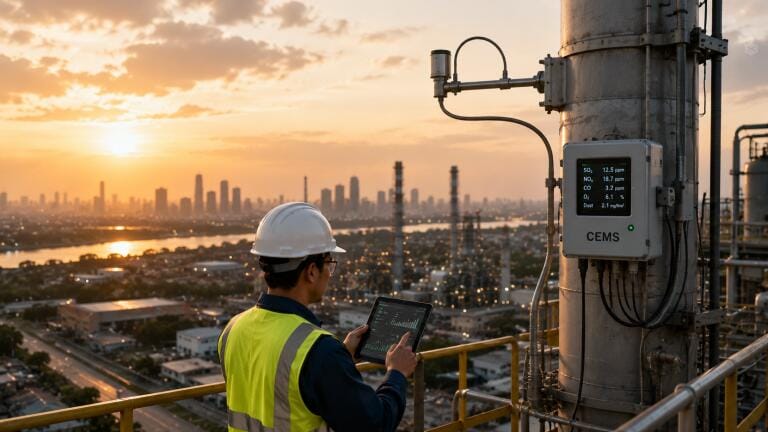
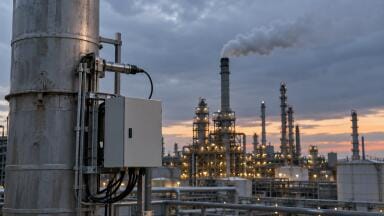
That is especially important for CEMS. Continuous Emission Monitoring Systems are not simply instruments bolted onto a stack. They are operating systems for compliance. They require correct analyser selection, representative sampling, appropriate conditioning, calibration gas management, data acquisition, secure transmission, alarm handling, maintenance planning and documented quality assurance. Poor installation or weak upkeep can create as many compliance risks as no system at all.
This is where the human side of the regulation becomes visible. A factory manager faced with a new CEMS requirement is not only buying a box. They are taking on a new operational discipline. Engineers need to understand how the system behaves during start-up, shutdown, load variation and abnormal operation. Environmental teams need to know when data gaps are acceptable and when they create a reporting problem. Maintenance staff need training. Procurement teams need to compare lifetime reliability rather than simply upfront cost. Regulators need confidence that the data reaching them is complete, accurate and resistant to manipulation.
For suppliers and service providers, this creates opportunity, but it also raises the bar. The strongest market position will not belong simply to those who can provide analysers quickly. It will belong to those who can support the full compliance chain: stack surveys, system design, installation, commissioning, calibration, data integration, operator training, remote diagnostics and after-sales service. As monitoring becomes more networked, digital capability becomes just as important as measurement capability.
The Bangkok measures should also be read in the context of Thailand’s earlier CEMS direction. The country had already begun expanding continuous emissions monitoring requirements for major industrial pollution sources, with data linked to the Department of Industrial Works for real-time oversight. The 2026 Bangkok rules therefore do not represent a sudden move from no monitoring to full monitoring. They represent a further tightening and localisation of an existing trend: more facilities, stricter urban limits, more public visibility and greater reliance on live emissions data.
This distinction is important because it suggests that Thailand’s framework is maturing. Early CEMS policies often focus on proving that continuous monitoring is technically and administratively possible. Later phases tend to focus on coverage, enforcement, data quality and integration with wider air quality management. Thailand now appears to be moving into that second phase.
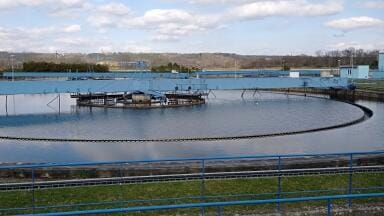
The same pattern can be seen in the water sector. In March 2026, Thailand also issued updated licensing requirements for wastewater treatment system controllers and service providers. While this may appear separate from the air quality measures, it points in the same direction: environmental compliance is becoming more professionalised, more formalised and more dependent on qualified service provision. For facilities with process water or wastewater discharge obligations, the message is similar to that facing factories with stacks: treatment and monitoring systems must be managed by people and organisations with recognised responsibility, not treated as peripheral infrastructure.
For environmental monitoring professionals, the combined effect is a broader compliance environment in which air and water monitoring are becoming harder to separate from operational governance. A wastewater treatment plant, a boiler stack, a scrubber, a dust collector and a discharge point are no longer merely engineering assets. They are evidence-generating systems. Their performance has to be measured, recorded, reported and defended.
This has direct implications for procurement. In a less demanding regime, a facility may be tempted to select instruments primarily on price, especially where monitoring is periodic and enforcement risk is low. In a continuous reporting regime, that calculation changes. Downtime, drift, poor data capture, weak support and unclear audit trails can all become business risks. The cheapest system may become expensive if it produces disputed data, repeated non-compliance alarms or frequent maintenance interruptions.
For suppliers, the commercial opportunity is therefore real but specialised. Demand is likely to grow for CEMS, particulate monitors, gas analysers, flow and temperature measurement, data acquisition systems, telemetry, environmental data platforms and third-party calibration services. But buyers will increasingly want evidence of reliability, local support capability, compatibility with reporting requirements and a clear plan for maintaining data integrity over time.
Thailand’s reforms also matter because they sit within a wider Southeast Asian pattern. Across the region, governments are facing overlapping pressures: urban PM2.5 exposure, industrial growth, public health concern, transboundary haze, climate commitments, water stress and rising public expectations around environmental transparency. Malaysia’s recent Environmental Quality Act amendments point in the same broad direction, with stronger enforcement tools and greater attention to environmental reporting systems. The specific legal mechanisms differ from country to country, but the trend is consistent: environmental monitoring is moving from best practice towards legal infrastructure.
That shift has consequences for the whole monitoring market. In the past, environmental monitoring in parts of Southeast Asia could be uneven, project-based or concentrated around high-profile industrial zones. The emerging model is more systematic. It favours continuous data, formal reporting channels, professional service providers, regulatory dashboards and closer links between ambient conditions and source controls.
Implementation will decide the impact
For Thailand, the challenge will be implementation. Standards and notifications are only the first step. The effectiveness of the system will depend on whether instruments are properly installed, whether data is trusted, whether regulators have the capacity to interpret and act on it, and whether facilities treat monitoring as part of operational performance rather than a narrow compliance burden.

For the monitoring profession, that creates an important role. Better air and water regulation cannot be delivered by law alone. It depends on the people who design monitoring networks, specify instruments, maintain analysers, validate datasets, troubleshoot abnormal readings and explain what the numbers mean. Thailand’s 2026 reforms are therefore not just a regulatory story. They are a signal that environmental monitoring expertise is becoming more central to industrial governance in Southeast Asia.
The lesson for suppliers and service providers is clear. The next phase of the market will not only be about selling more instruments. It will be about helping operators build monitoring systems that regulators, communities and companies themselves can trust.
IET 36.5 Sept/Oct 2026


 Product directory




.jpg)



















.jpg)






.jpg)
.jpg)