Water quality monitoring
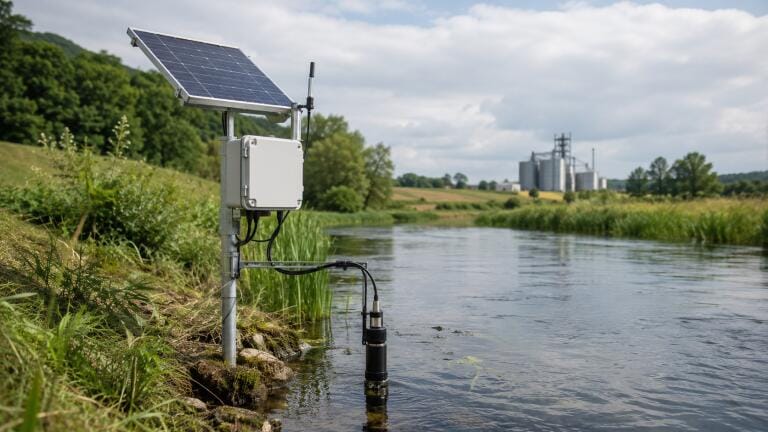
A new review published in npj Clean Water charts the progress being made in solar-powered sensor systems capable of detecting multiple contaminants simultaneously in the field.
These systems could play a growing role they could play in delivering the kind of continuous, spatially distributed monitoring that regulators and water managers increasingly require.
The review, authored by Emmanuel Ninsiima of Kampala International University and published in April 2026, focuses on integrated platforms that combine photovoltaic power generation with multi-parameter sensor arrays capable of measuring indicators including pH, dissolved oxygen, turbidity, nitrates, heavy metals and biological contaminants – all without the need for grid power or manual sample collection and laboratory analysis.
 The case for solar-powered in situ monitoring is particularly compelling in contexts where water quality varies rapidly and unpredictably: river catchments subject to agricultural runoff, industrial discharge zones, drinking water abstraction points and remote locations where grid infrastructure is absent or unreliable.
In these settings, the alternative – periodic manual sampling followed by laboratory analysis – introduces significant time delays between a contamination event and its detection, with potentially serious consequences for human health and ecological management.
Modern multi-parameter in situ sensor platforms are increasingly able to measure a wide range of indicators simultaneously from a single deployed unit, with data transmitted in real-time via cellular or satellite networks to monitoring dashboards.
Advances in micro-sensing components — including miniaturised spectrometers and LED-based optical systems — have improved both the range of detectable parameters and the accuracy with which they can be quantified in turbid or chemically complex water matrices.
Solar integration addresses one of the key practical barriers to long-term autonomous deployment: power availability.
By combining energy harvesting with onboard data processing and wireless transmission, the latest generation of platforms can be deployed for extended periods in remote catchments, wetlands, coastal zones or groundwater monitoring networks with minimal maintenance intervention.
The review also notes the growing integration of machine learning techniques with in situ sensor data — enabling systems to distinguish between different types of contamination events, compensate for sensor drift or interference from co-occurring substances, and flag anomalies for rapid human review. One system described in the literature uses an on-device neural network to classify water impurity events — distinguishing between normal conditions, rainwater runoff and chemical contamination — with reported accuracy of over 99%.
For environmental monitoring professionals, the convergence of solar power, multi-parameter sensing and real-time data transmission represents a significant shift in what is practically achievable in the field, particularly as the cost of sensor components continues to fall and the regulatory pressure for continuous rather than periodic monitoring increases.
IET 36.5 Sept/Oct 2026



 Product directory





















.jpg)