Portable & field testing
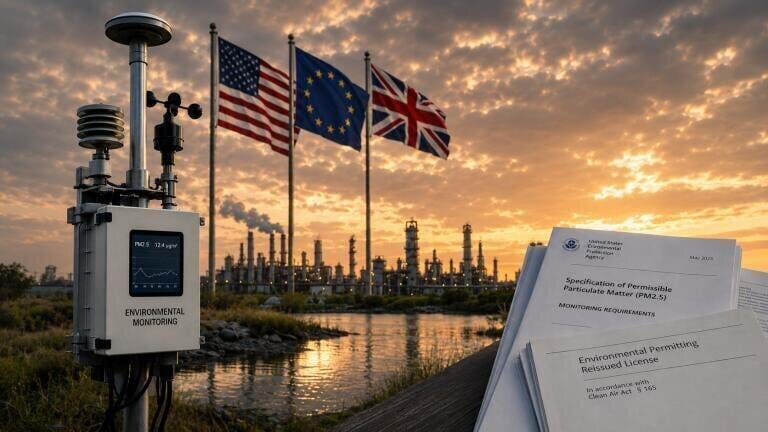
Everywhere you look, the regulatory architecture that environmental monitoring was built to serve is shifting.
On Monday, the US Environmental Protection Agency issued two press releases in the same afternoon.
The first announced guidance streamlining the Clean Air Act's Title V operating permit process – shaving time off approvals and giving states more flexibility before public comment periods open.
The second proposed redefining when the obligation to comply with environmental permit requirements formally begins, removing what EPA Administrator Aaron Szabo called 'unnecessary impediments to building'.
Neither release used the word deregulation. Both were framed as clarifications, efficiencies, common sense readings of existing law.
This framing is worth noting, because it is the same framing being used in Brussels and Westminster simultaneously, and its implications for those who build and operate environmental monitoring systems are serious and largely undiscussed.
 Three deregulatory agendas, one direction
In the EU, the European Commission's 2026 work programme is pursuing simplification through Omnibus packages – consolidating and weakening multiple laws together.
The Water Framework Directive is undergoing a formal stress test in the first half of this year, responding to corporate lobbying around mining permit timelines. The CSRD reporting requirements – which drove significant investment in environmental data infrastructure – have been delayed and reduced in scope. Horizon funding for environmental monitoring research is being squeezed by competing priorities.
In the UK, the Product Regulation and Metrology Act 2025 created powers to align or diverge from EU product standards, including measurement and testing requirements.
The current government's growth agenda has explicitly identified environmental regulation as a source of friction to be reduced. Planning reform, permit reform, and regulatory simplification are all in motion.
In the US, the trajectory is steeper and faster. The Trump EPA is not stress-testing regulations – it is rewriting them, and publishing press releases about it before the ink is dry.
These are three different political contexts producing the same vector of travel. For environmental monitoring professionals, that vector matters because of a fundamental structural relationship: monitoring exists to serve regulatory compliance. If compliance obligations weaken, monitoring procurement decisions change.
This is not a point made often enough. The market for environmental monitoring instruments, services, and certified personnel is not driven primarily by voluntary concern for the environment.
It is driven by regulated entities needing to demonstrate compliance with specific standards, using certified methods, with traceable results. Permit holders monitor because they must. Utilities measure discharge because the Environment Agency requires it. Stack operators run continuous emissions monitoring systems because industrial emissions permits demand it.
When the standards those obligations are pegged to shift, the whole system shifts with them. BAT Reference Documents – the technical backbone of industrial emissions regulation under the Industrial Emissions Directive – take years to negotiate and represent enormous analytical investment by manufacturers and operators alike.
If Omnibus simplification weakens BAT conclusions, the monitoring obligations written around them weaken too. MCERTS certification, which certifies instruments against specific performance standards, has value because those standards are referenced in regulation. Change the regulation, and the value proposition changes.
Some instrument manufacturers understand this clearly. Tighter standards create markets. A monitoring obligation that did not exist last year is a sales opportunity this year.
The companies most invested in rigorous environmental standards are often the ones making the most sophisticated measurement systems – because sophisticated measurement is what rigorous standards require. Their commercial interest and the public interest in environmental protection run in the same direction.

The specific risks in the current period are identifiable. In the EU: whether the WFD stress test results in Watch List contaminants being deprioritised or timelines for compliance extended.
Whether the IED revision produces weaker BAT conclusions for key industrial sectors. Whether CSRD simplification reduces the mandatory environmental data that large corporations must collect, audit and report – reducing demand for certified monitoring across supply chains.
In the UK: whether the Product Regulation and Metrology Act is used to diverge from EU instrument standards in ways that fragment the market and reduce comparability of data. Whether EA enforcement, already constrained by decades of budget cuts, is further weakened under a growth mandate.
In the US: whether Title V streamlining reduces the frequency or rigour of stack emissions monitoring at permitted facilities. Whether redefined construction timelines allow facilities to operate in an ambiguous compliance state for longer.
None of these risks are hypothetical. All of them have specific technical implications for what gets measured, how, by whom, and to what standard.
The monitoring community – instrument manufacturers, commercial laboratories, professional bodies, source testing associations – has a stake in this that goes beyond compliance.
Environmental data that cannot be trusted, because the methods behind it were weakened or the oversight reduced, serves no one. The current moment requires active engagement with regulatory processes, not passive observation of them.
The rules are moving. The question is whether the people who build monitoring systems are at the table when they move, or finding out afterwards.
IET 36.5 Sept/Oct 2026




 Product directory



























.jpg)