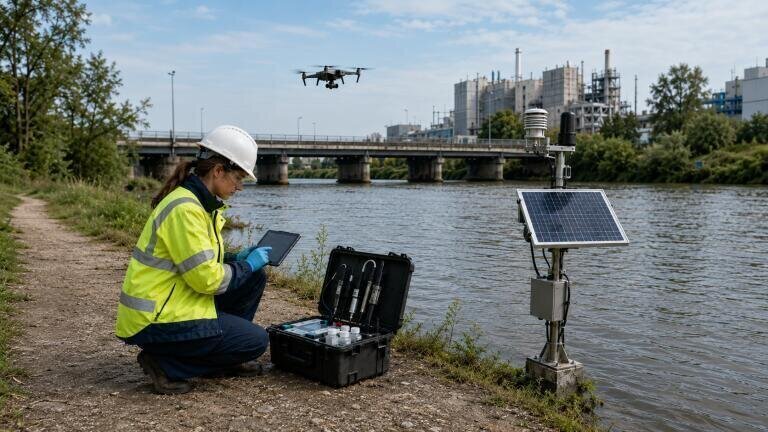
Portable & field testing
The King’s Speech describes it as legislation to reduce unnecessary regulatory burden through innovation, while the government’s briefing notes say it will create cross-economy sandboxing powers to allow new products and technologies to be tested in real-world settings under strict controls.
The immediate examples in the briefing notes are not environmental monitoring-specific. The government refers to AI, medical devices, autonomous maritime technology and defence applications.
However, the mechanism is relevant to any sector where regulation struggles to keep pace with new technology. That could include remote sensing, autonomous sampling, continuous water quality monitoring, AI-enabled compliance screening, digital MRV platforms and sensor networks used in environmental permitting.

A regulatory sandbox allows controlled experimentation where existing rules may be temporarily relaxed or modified. In principle, this can help regulators test whether a new technology can deliver equivalent or better outcomes than the established approach. In environmental monitoring, that question comes up repeatedly.
Can continuous sensors support or replace periodic manual sampling? Can AI identify pollution events before a human analyst would? Can satellite or drone observations provide evidence regulators can act on? Can lower-cost sensors be trusted if they are used in dense networks and calibrated against reference methods?
The Bill also proposes strengthening the Growth Duty for regulators, including Natural England, the Environment Agency and the Health and Safety Executive, while stating that this should not undermine core duties on safety or the environment.
That wording will matter. Monitoring professionals operate in sectors where innovation is valuable, but where bad data can undermine enforcement, public trust and environmental protection.
For instrument manufacturers and technology developers, sandbox powers could be useful if they create clearer routes for proving new systems in the field. Many monitoring innovations struggle not because the technology is impossible, but because the regulatory pathway is unclear.
A sensor may perform well technically but still not be accepted for permit compliance. A data platform may improve visibility but not meet evidential standards. A remote method may be cheaper and faster but not yet recognised in guidance, standards or enforcement practice.
For regulators, the challenge is different. They need innovation without weakening evidence quality. A sandbox that allows poor-quality monitoring to be treated as equivalent to accredited methods would be damaging.
But a well-designed sandbox could help regulators define performance requirements, uncertainty thresholds, calibration protocols, audit trails and acceptable use cases for new tools.
This is particularly relevant as environmental monitoring becomes more data-intensive. Regulators are increasingly expected to assess continuous data streams, digital records, remote observations and public-facing dashboards.
The old model of periodic sampling and delayed reporting is not disappearing but it is being joined by faster, messier and more automated forms of evidence.
The opportunity is that sandboxes could make this transition more orderly. Instead of letting technologies drift into use before their limits are understood, regulators could test them against known problems: wastewater event detection, methane leak identification, fugitive emissions screening, river quality alerts, odour complaints, industrial discharge monitoring or AI-assisted anomaly detection.

The risk is that innovation becomes a synonym for lighter oversight.
That would be a mistake. In monitoring, regulatory confidence depends on method quality, traceability and independent scrutiny. The best case for sandboxes is not deregulation, but better evidence about which technologies are ready for which regulatory tasks.
For environmental monitoring suppliers, this may become an important policy space to watch. The Bill does not guarantee new routes for sensor approval or digital compliance tools.
But it does suggest that the government wants regulators to become more experimental, more responsive and more willing to test new technologies in controlled real-world conditions. That could shape how future monitoring systems are procured.
IET 36.5 Sept/Oct 2026



 Product directory





























.jpg)