Microplastics analysis
A new review of microplastic detection methods highlights a growing analytical toolbox, but also shows why laboratories should not expect one technique to answer every measurement question.
Microplastic analysis has moved well beyond simply finding suspicious particles under a microscope.
A review published in the International Journal of Precision Engineering and Manufacturing in July 2026 surveys recent developments spanning optical microscopy, electron microscopy, spectroscopy and artificial intelligence. It also considers emerging approaches including portable systems, real-time monitoring and standardised protocols.
For environmental laboratories, the important message is not that one new technology has emerged as the definitive method.
It is that different techniques answer different analytical questions.
Optical microscopy and camera-based systems can provide information about particle size and morphology. That makes them useful for rapidly assessing large numbers of particles.
The limitation is that visual information does not necessarily establish polymer identity.
The 2026 review therefore places optical methods alongside spectroscopic techniques capable of providing chemical information. Fourier-transform infrared spectroscopy (FTIR), Raman spectroscopy and optical photothermal infrared spectroscopy (O-PTIR) can provide polymer-specific identification.
This distinction matters when designing a laboratory workflow.
A laboratory interested primarily in particle counts and size distributions may require a different analytical configuration from one seeking detailed polymer composition.
FTIR remains an important technique for polymer identification, particularly where larger particles can be collected and mapped.
Raman spectroscopy offers a complementary approach and can be useful for smaller particles. However, fluorescence from pigments, organic material and other contaminants can interfere with Raman measurements. A recent review of analytical methods highlights this as one reason the two spectroscopic techniques are often treated as complementary rather than competing methods.
Sample preparation also remains critical.
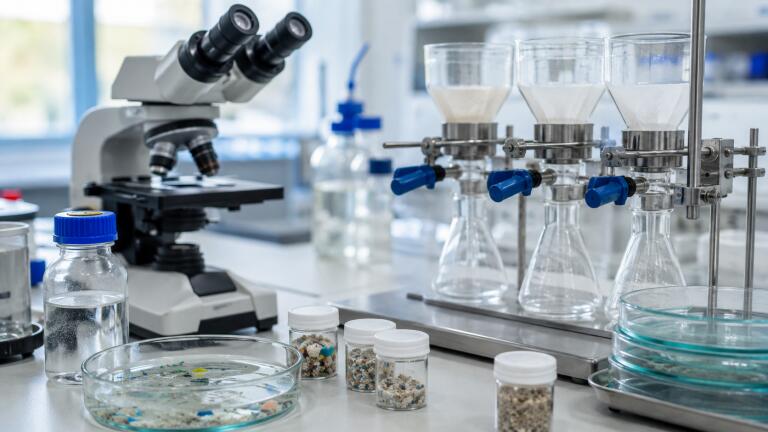
Filtration, separation and removal of interfering material can determine what reaches the instrument in the first place. A highly capable spectrometer cannot recover information from particles lost during preparation.
For laboratories comparing methods, the complete workflow therefore matters as much as the detector.
Pyrolysis-gas chromatography-mass spectrometry (Py-GC-MS) takes a different approach.
Instead of imaging individual particles, it thermally decomposes polymer material and identifies characteristic products using chromatography and mass spectrometry.
This can provide chemical information that complements particle-based spectroscopy. However, pyrolysis is destructive, so the original morphology of the analysed material is not retained. Complex matrices can also introduce analytical challenges.
The choice therefore depends partly on what the laboratory needs to report.
Particle number, particle size and polymer identity are not interchangeable measurements. Nor are they necessarily best obtained from the same instrument.
The July review also considers artificial intelligence for particle identification.
AI-assisted analysis could reduce some of the manual classification burden associated with microscopy and image-based approaches. The potential advantage is particularly relevant where laboratories need to process large numbers of particles.
But automated classification still depends on the quality of the underlying images, reference data and analytical workflow.
AI cannot remove the need for appropriate sampling, contamination control or chemical confirmation.
The more immediate opportunity may therefore be automation of established analytical steps rather than complete replacement of conventional methods.
The review identifies standardised protocols as an important area for future development. Other recent reviews have reached similar conclusions, highlighting continuing variation in sampling, isolation, identification and quantification approaches.
That is significant for environmental monitoring because results from different laboratories are only useful for comparison when the analytical methods are sufficiently comparable.
For laboratory managers, the question when selecting equipment should therefore begin with the measurement requirement.
Is the priority particle count? Size distribution? Polymer identification? Mass concentration? Or a combination?
There may be no single answer.
The direction of microplastic analysis is towards integrated workflows in which imaging, spectroscopy, chemical analysis and automated classification are used according to the question being asked.
That makes method validation and QA/QC increasingly important. The best analytical system is not necessarily the one with the most sophisticated detector. It is the one capable of producing the type of evidence the monitoring programme actually requires.
IET 36.5 Sept/Oct 2026


 Product directory