Water monitoring
Two research developments this month, from opposite ends of the instrumentation spectrum, sharpen that knowledge considerably.
One corrects a fundamental flaw in a widely used scientific measurement method.
The other demonstrates that high-accuracy, real-time water quality monitoring can now be achieved for less than the cost of a good pair of waders.

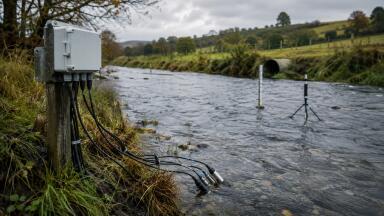
For several decades, ecologists and water quality scientists have used a standard experimental approach to measure how efficiently streams and rivers absorb excess nutrients – particularly nitrogen and phosphorus, the compounds most likely to drive harmful algal blooms and aquatic dead zones when present in elevated concentrations.
The method, based on adding a measured pulse of nutrient to a stream and tracking how quickly it disappears downstream, is designed to calculate what researchers call "uptake length" – essentially, the distance water must travel before the stream community processes a given quantity of nutrient.
Researchers at Duke Kunshan University have now demonstrated that the most widely used analytical approach for calculating uptake length contains a systematic error.
Under high-nutrient conditions – precisely the conditions most relevant to degraded or pressurised catchments – the standard first-order model consistently overestimates uptake length, making streams appear less efficient at nutrient processing than they actually are.
The team has derived a corrected zero-order analytical approach that better captures stream behaviour when nutrient concentrations are elevated.
The practical implications are significant. Uptake length measurements feed directly into the models that regulators and water managers use to assess how much nutrient a river system can absorb without ecological harm, to evaluate the effectiveness of riparian buffer strips and constructed wetlands, and to prioritise catchment restoration spending.
If the baseline measurements are systematically biased, so are the management decisions built on them. The Duke Kunshan correction changes the quantitative foundation on which river health assessments rest.
The team is calling for a reassessment of existing datasets that used the first-order approach under high-nutrient conditions, and for the zero-order model to be adopted as standard practice in future spiralling studies.
Given how widely the original method has been applied – across hundreds of studies on six continents – the recalibration exercise is substantial, but the authors argue it is necessary before the data can be used with confidence in restoration planning.
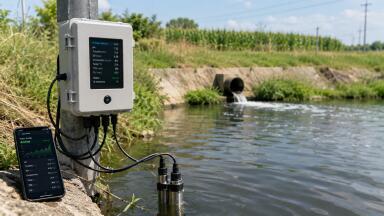
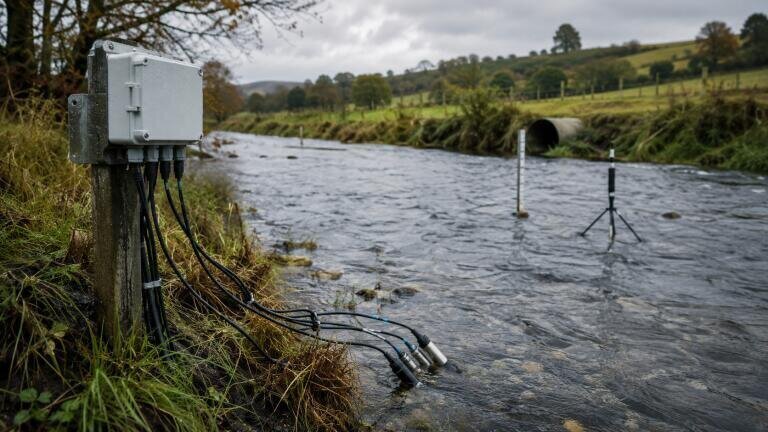
At the other end of the technological register, a paper published in Scientific Reports this week describes a water quality monitoring system that costs under $80 to build, runs on an ESP32 microcontroller, and achieves 99.28 per cent accuracy in distinguishing between three critical water states: normal conditions, rainwater runoff events and chemical contamination.
The system uses an on-device machine learning model – a TinyML neural network trained to classify multi-parameter sensor readings in real time without needing to transmit raw data to a cloud server.
It measures temperature, turbidity, conductivity, dissolved oxygen, and pH simultaneously, and the neural network processes these inputs locally, producing a classification and triggering an alert within seconds. The entire system is small enough to be deployed in a waterproof housing at a stream gauge, outfall point, or distribution network node.
Conventional water quality monitoring at the catchment or network level typically relies on either periodic grab sampling – which misses transient contamination events – or permanent installations of industrial-grade continuous monitors, which cost tens of thousands of pounds per site and require specialist maintenance.
The economics have always constrained the density of monitoring networks, leaving large portions of river catchments effectively unwatched.
A sub-£70 sensor capable of near-real-time classification changes that calculus.
It becomes feasible to instrument tributary confluences, agricultural drain outfalls, and urban stream sections that would never justify the cost of a conventional monitor – providing the dense, continuous spatial coverage that catchment managers have long needed but rarely had.
Combined with the kind of methodology correction that Duke Kunshan's work provides, higher-density monitoring networks could feed into models that are now, for the first time, actually calibrated correctly.
The two developments are independent, but they address complementary gaps.
Better measurement methodology tells us what the numbers mean. Better, cheaper sensors mean we can collect those numbers from far more places, far more continuously, at a fraction of the current cost.
The combination – rigorous science and democratised instrumentation – is precisely what catchment-scale water management has been waiting for, particularly as regulatory pressure on nutrients intensifies across the UK and EU.

For the environmental monitoring sector, the message is direct: the barriers to comprehensive river health surveillance – cost, complexity, and methodological uncertainty – are all falling simultaneously.
The question is now less about whether comprehensive monitoring is possible, and more about whether water authorities and regulators have the frameworks to act on what it will reveal.
IET 36.5 Sept/Oct 2026

 Product directory


.jpg)