Ambient air quality
The Greater London Authority’s new Air Quality in London 2016–2024 report is a public health success story.
It is also a technical case study in how continuous measurement can shape and sustain policy change.
Over eight years, London’s roadside nitrogen dioxide (NO₂) levels have fallen by 49%, which is the steepest decline since monitoring began, outpacing the 35% reduction across the rest of England.
PM₂.₅ levels have dropped below the WHO’s interim target, and many sites are meeting UK legal limits for the first time.
In 2016, 56 reference-grade sites breached the annual NO₂ limit; hourly breaches totalled 4,130 hours.
Then, in 2023, just five sites breached the annual limit; hourly breaches fell to 22.
These improvements came despite a growing population – and they were achieved without guesswork.
Central to London’s gains has been the Ultra Low Emission Zone (ULEZ), launched in 2019 and expanded city-wide in 2023 to become the largest clean air zone in the world.
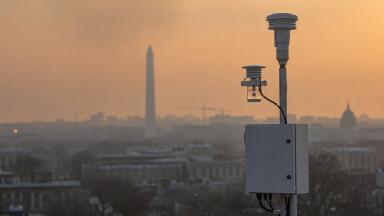
The GLA’s 150+ reference-grade stations provided the modelling evidence and verified outcomes in real time to sustain political momentum.
This same feedback loop transformed the city’s transport mix, with over 1,300 zero-emission vehicles now on the roads, more than half of black cabs are zero emission capable and rapid charging points scaled for private and commercial fleets.
Monitoring data has also underpinned air quality neutral and air quality positive planning policies, shaping emissions performance standards for new developments and construction sites.
The city’s monitoring architecture is no longer just high-spec roadside stations.
Community sensor nodes, deployed through the Breathe London network, extend coverage into residential streets and outer boroughs, providing hyperlocal exposure profiles.
This granularity has enabled interventions like school filtration pilots to reduce children’s exposure and targeted traffic restrictions in local pollution hotspots.
London has also pioneered the UK’s first Non-Road Mobile Machinery Low Emission Zone, with real-time emissions data from construction machinery enforcing PM and NOx standards on-site.
Air quality improvements have been largest in the most deprived boroughs, many of which initially opposed the ULEZ expansion.
This reversal demonstrates that localised, credible data can underpin politically sensitive measures and deliver measurable equity gains.
However, the report warns that progress is fragile. WHO’s tightened NO₂ guideline, 10 µg/m³, remains out of reach.
Even marginal increases could push hundreds of thousands back over the legal threshold.
London’s experience shows that continuous, credible data enables regulatory ambition and shields policies from legal and political challenge.
It also demonstrates that instrumentation diversity from reference stations to low-cost networks ensures both regulatory compliance and community engagement.
And finally, it's now clear that data transparency drives public support, especially in initially sceptical communities.
IET Guide 2026



 Product directory