Portable & field testing
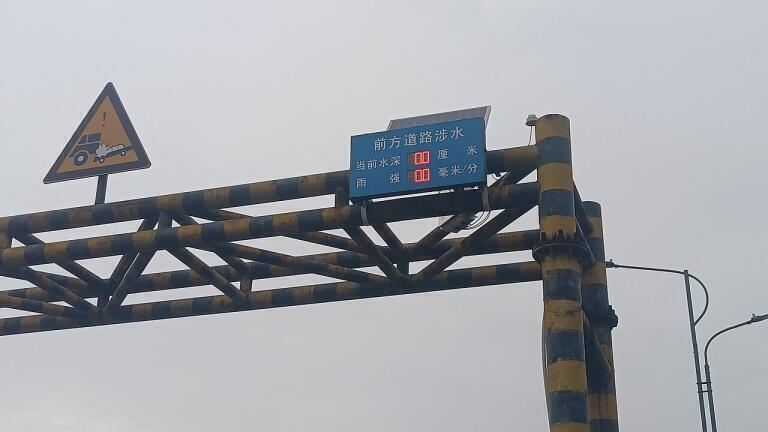
Chinese officials announced last year that they are building the world’s largest and most comprehensive environmental monitoring network.
The Ministry of Environment and Ecology (MEE) plans to bolster analytical and forecasting capabilities alongside developing standards for instrumentation.
State media noted that the plan includes integrated monitoring from the mountains to the coasts.
Over the past decade China has built more than 330,000 monitoring stations nationwide along with multiple orbiting satellites.
These facilities measure everything from PM₂.₅ and river chemistry to soil contamination and ocean currents.
The official goal of completing this nationwide environmental monitoring system is 2035.
Recent scandals can provide us with some context for this consolidation.
In 2016, a local official in Xi’an was arrested for repeatedly entering a monitoring station and covering sensors with cotton to filter pollutants and falsify air quality readings.
The scheme was meant to hide deteriorating air quality and avoid career consequences.
In 2018, Reuters reported that officials in Jiangxi and Henan provinces sprayed water on air quality sensors to lower smog readings.
MEE punished them and noted that some monitoring stations would be taken over by the central government to prevent local tampering.
These events prompted the ministry to remove monitoring stations from local control and deny local authorities access to them.
The upgraded network moves beyond traditional air pollution indicators.
MEE officials say the system will monitor air, water and soil quality as well as biodiversity across China’s various ecosystems.
Reports have described drones, satellites and automated labs feeding data into a central data platform that merges multiple data streams into predictive models for air pollution alerts and ecological health assessments.
Researchers claim these innovations have already helped reduce national PM₂.₅ levels by more than 35 % between 2015 and 2022.
For instrument suppliers, this broader scope means demand for multi‑parameter platforms that can measure not only SO₂ and PM₂.₅ but also noise, soil fertility, groundwater quality, vegetation indices and ocean acidification.
Modular sensors and devices that can be upgraded with additional probes or firmware will likely be preferred over single‑function instruments.
Remote sensing instruments (e.g., drone‑mounted hyperspectral sensors or LiDAR units) are becoming central to the system, while autonomous marine buoys and ship‑based sensors open opportunities in harsh‑environment instrumentation.
The ministry is determined to prevent data manipulation.
Monitoring bodies have been made structurally independent from local governments, and Beijing has emphasised that regulatory oversight will be paired with tamper‑proof technologies.
In the past, local officials altered data by burying or tampering with sensors to avoid sanctions; for example, the Xi’an case involved shielding sensors with cotton, and Reuters documents officials spraying water on monitors to falsify readings.
This history explains why MEE is now centralising data custody and exploring blockchain‑based provenance solutions.
Instrument vendors entering this market may need to offer anti‑tampering hardware, cryptographic data signatures and redundancy to assure regulators that readings are genuine.
Another shift is from retrospective reporting to anticipatory monitoring.
The central data platform is allowing officials to build AI‑driven predictive models.
These models generate early warnings for pollution spikes and ecological degradation.
MEE has signalled that improving forecasting is a priority.
This paradigm requires real‑time data streaming and interoperable interfaces so that instruments can feed analytics platforms without delay.
Suppliers may need to provide APIs or edge computing capabilities that support machine‑learning algorithms.
Beyond terrestrial stations, China is expanding airborne and marine monitoring capacity.
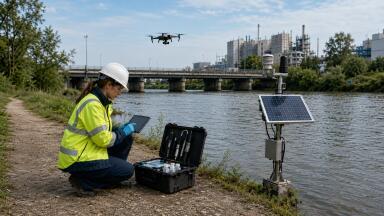
Research highlights the use of unmanned drones and satellites to collect high‑resolution environmental data.
State media reports mention integrated monitoring from mountainous regions to maritime territories, implying increased use of aircraft‑mounted sensors and ship‑based observation systems.
This opens markets for lightweight instruments that can operate on drones or aircraft as well as marine sensors resistant to corrosion.
Broader datasets mean new instrumentation categories.
Companies supplying to China must consider multi‑parameter, modular and remote‑sensing products.
Tools that can be upgraded or reconfigured will have longer lifespans. Instrument vendors with expertise in AI integration and data analytics stand to benefit.
Tamper‑proof design is essential.
Past scandals involving cotton‑covered sensors and sprayed sampling points mean that MEE now demands robust data custody.
Suppliers might need to provide compatibility for cryptographic signatures and tamper‑evident enclosures.
Instruments must interface with real‑time analytics platforms and may need built‑in edge processing.
With monitoring bodies under central control, vendors should anticipate national tenders and unified technical standards.
Compliance will likely involve adherence to Chinese data‑sharing regulations, cybersecurity laws and environmental standards.
Foreign firms might also need to partner with domestic integrators.
China’s monitoring super‑structure serves not only domestic environmental goals but also geopolitical ambitions.
China has exported its digital labs and sensing tools to Belt and Road countries, doubling laboratory efficiency and lowering costs.
Beijing’s ability to centralise and analyse environmental data allows policymakers to link compliance to funding allocations and to steer Five‑Year Plans.
As other nations evaluate their own monitoring frameworks, China’s system may serve as either a model for state‑led environmental oversight or a cautionary tale about data centralisation.
China is rapidly building a mountain‑to‑sea environmental monitoring superstructure.
On May 5 2024, the MEE counted 33,000 centrally managed sites and announced plans to finish the system by 2035.
Like much of China’s development in recent decades, this transformation could massively reshape global standards for environmental monitoring.
Companies that offer multi‑parameter, tamper‑proof and predictive‑analytics‑ready instruments will be best positioned to tap this emerging market.
IET 36.5 Sept/Oct 2026



 Product directory
















_-_DPLA_-_8e999bde09706920af593c74dca.jpg)








.jpg)