Ambient air quality
The scientist behind the figures has said the true total is probably higher than reported.
The admission points to a persistent weakness in the satellite systems used to track transboundary haze.
At the same time, the regional treaty meant to govern the problem faces renewed criticism over its lack of enforcement power.
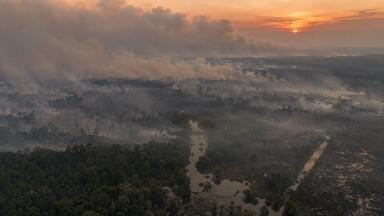
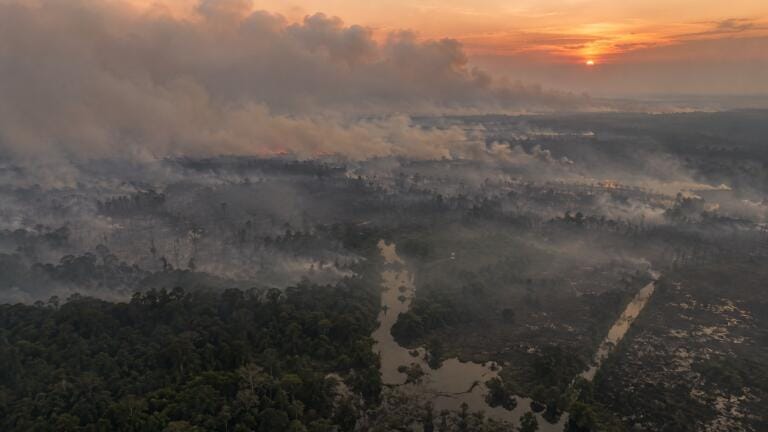
Fire emissions from Indonesia between 1 and 7 September reached 19.7 million tonnes of carbon dioxide.
That is more than a third of the global total for that week, and over ten times the level recorded across Russia.
The data comes from Fire Emissions Watch, a portal run by the Copernicus Atmosphere Monitoring Service (CAMS), the European Union’s climate monitoring service.
The bulk of the emissions came from Kalimantan, Indonesia’s part of Borneo, and the eastern lowlands of Sumatra.

Mark Parrington, a senior scientist at CAMS, said the underlying drought conditions were the main driver.
“We do expect to see some fires across the region at this time of year, but with El Niño, it clearly just gives a big enhancement to them,” he said.
He added that hotter, drier conditions meant fires were burning “in a far more extreme way” once ignited.
Parrington also said the published emissions figure was likely an undercount. Peat fires can burn at low temperatures or entirely underground, resurfacing at a different location once conditions change.
“If they’re burning at low temperatures or underground, they’d be below the detection limit of the sensors, which means we’re not actually seeing them,” he said.
That detection gap matters for how the region tracks and responds to haze events.
Satellite-based systems such as Fire Emissions Watch estimate particulate matter, volatile organic compounds and other fire-fuelled pollutants from thermal and optical signatures.
Sub-surface combustion in drained peatland, by design, produces less of the surface heat signature those sensors depend on.
That leaves a structural blind spot in the data regulators and health authorities use to gauge the scale of an event in near-real time.
Indonesia’s environment ministry, responding to the Copernicus data, said it was monitoring the figures.
But it noted the data did “not directly reflect air quality conditions in a specific area”, pointing to other factors that need to be accounted for.
The public health toll tracked alongside the emissions data has moved quickly.
Respiratory illness cases across the worst-affected provinces more than doubled in a week, from 50,891 on 1 September to 113,336 by 9 September, according to figures attributed to Indonesia’s health ministry.
Regional pressure is building on the instrument meant to govern cross-border haze, the ASEAN Agreement on Transboundary Haze Pollution (AATHP), signed in 2002 and in force since 25 November 2003.
Indonesia was the last of the ten ASEAN states to ratify it, in 2015 – more than a decade after Malaysia and Singapore.
Malaysian prime minister Anwar Ibrahim said on 8 September that the bloc needed to strengthen its response: “There is room for improvement.”
Malaysia’s government has since said it is open to a formal review of the agreement.
Separately, social activist Lee Lam Thye called for ASEAN to set “clear, measurable targets to prevent fires, reduce hotspots and eliminate recurring sources of transboundary pollution”.
He argued that more than two decades after the treaty took effect, the region needed to move “beyond promises”.

The AATHP has no binding penalty mechanism. Disputes between member states are to be settled “amicably by consultation or negotiation”, under its own text, rather than through enforcement action.
Reviews of the agreement over the past two decades have repeatedly identified this as its central weakness. Recurring haze seasons, including 2026’s, have done nothing to resolve it.
Taken together, the two threads point to the same underlying issue for environmental monitoring professionals.
The data infrastructure and the governance structure built to respond to it are each operating with a known gap, one technical and one legal.
Both have persisted through multiple major haze events without being closed.
IET 36.5 Sept/Oct 2026




 Product directory