Gas sensors
The device is designed to give early warning of thermal runaway in lithium-ion batteries.
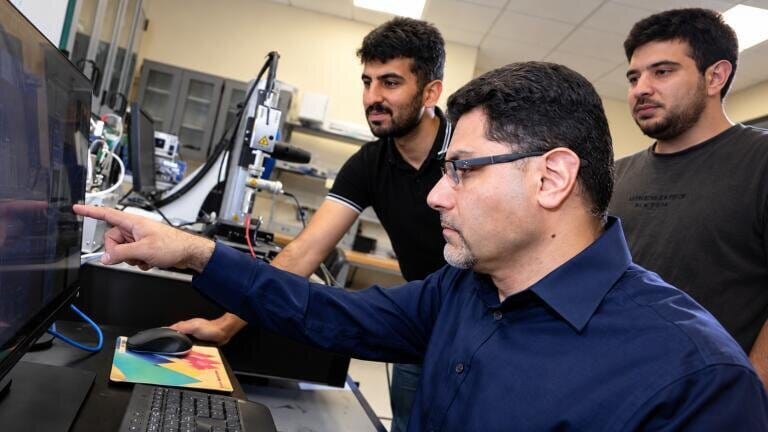
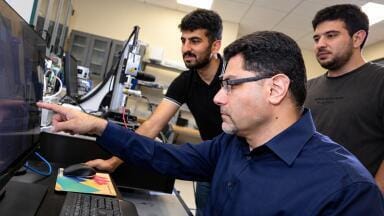
Mohammad Younis, professor of mechanical engineering at Binghamton University, State University of New York, is leading the work.
His research group builds MEMS devices: mechanical systems small enough to fit inside a microchip.
The new project aims to detect trace hydrogen or carbon dioxide, gases that can appear in the earliest stages of thermal runaway.
Thermal runaway is a rare but dangerous chain reaction in which rising temperature drives further heat generation, potentially ending in fire or explosion.

Younis's design differs from conventional gas detectors in that it does not simply sense and report.
The device is intended to sense, decide and act within a single self-contained unit, without transmitting data elsewhere for processing.
"I don't work on just sensors. I want the sensor to be part of a complete intelligent system," Younis said.
"In this case, it would be a sensor, an actuator, and the ability to make a decision based on one input or two inputs – all in the same MEMS device."
Because the device does not need to send its readings to the cloud, Younis argues it avoids two problems at once.
"We are overwhelming the network and the cloud with too much data," he said.
"Also, although sensors are cheap, it's not free when you transmit so much data from them, and processing the data is not free."
The hydrogen-sensing element uses a vibrating wire that responds to thermal conductivity.
When hydrogen is present, the wire cools and stiffens, lowering its rate of vibration and triggering an alarm.
Younis said this dynamic approach is more sensitive than the static, thermal-conductivity methods used by most existing sensors.
"The dynamical mechanism of this sensor is much more sensitive than a static mechanism, and I was among the first to do it using dynamics," he said.
For carbon dioxide detection, Younis is working with Roya Maboudian, professor of chemical and biomolecular engineering at the University of California, Berkeley.
Maboudian's research covers metal-organic frameworks (MOFs), a class of highly porous materials used for gas storage.
Coating the MEMS device with MOFs means that any additional mass from captured carbon dioxide can itself trigger an alert.
The project connects to Binghamton's wider battery-research base, including the Upstate New York Energy Storage Engine and the New Energy New York coalition.
Binghamton is home to M. Stanley Whittingham, the Nobel laureate and distinguished professor of chemistry credited as a pioneer of lithium-ion battery technology.
Maboudian's Berkeley colleague Omar Yaghi shared the 2025 Nobel Prize in Chemistry for his work on MOFs.
Yaghi has since moved to Tsinghua University in China, where he now leads an artificial intelligence-focused materials institute.
Younis and Maboudian have said that, when they first applied for NSF funding on this project two years ago, both could point to "one degree of separation" from a Nobel laureate.
Whittingham and Yaghi were the respective connections.

Younis said the underlying MEMS platform is not limited to gas detection.
"The application is not limited to gases. It can be magnetic, pressure, acceleration, or any other stimulus. I'm a mechanical engineer, so I don't have a loyal attachment to gases," he said.
IET 36.5 Sept/Oct 2026



 Product directory



















.jpg)