Gas detection
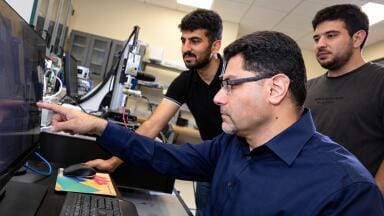
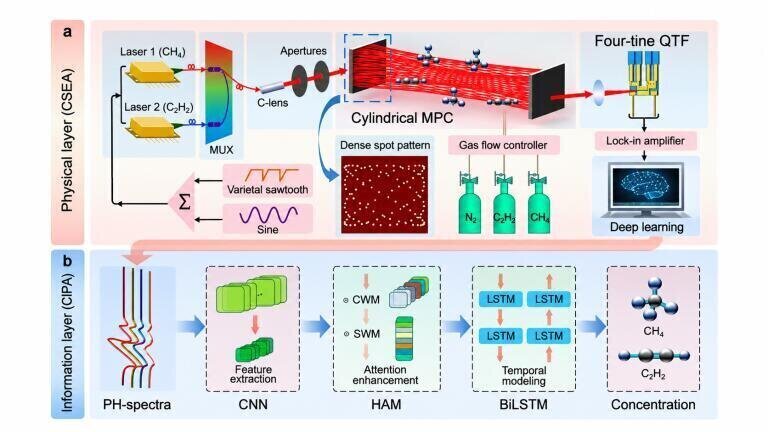
The team, led by Professor Yufei Ma, built what it calls a parallel heterodyne light‑induced thermoelastic spectroscopy sensor.
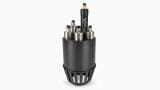
The design combines a compact multi‑pass gas cell with a four‑tine quartz tuning fork to strengthen weak absorption signals, then uses a deep learning model – integrating convolutional neural networks, an attention mechanism and bidirectional long short‑term memory – to separate the overlapping signals produced by different gases.

Simultaneous multi‑gas detection has become increasingly important across fields including deep‑sea origin‑of‑life research, environmental safety monitoring and planetary exploration, where several trace species often need to be identified within a limited detection window.
Existing laser absorption methods are typically constrained by long scanning times, complex system architectures or incompatibility with fixed‑frequency detectors when multiple gases must be measured together.
In tests targeting methane and acetylene, the sensor achieved minimum detection limits of 378 parts per billion and 285 parts per billion respectively within a scanning time of four seconds, with a concentration‑prediction correlation coefficient of 0.998.
Mean relative errors for the two gases were 8.9 per cent and 5.8 per cent across a range of concentration ratios.
The researchers say the architecture could support applications ranging from environmental hazard detection to atmospheric and planetary analysis where rapid, simultaneous measurement of multiple trace gases is required.
AET 30.4 Nov 2026

 Product directory