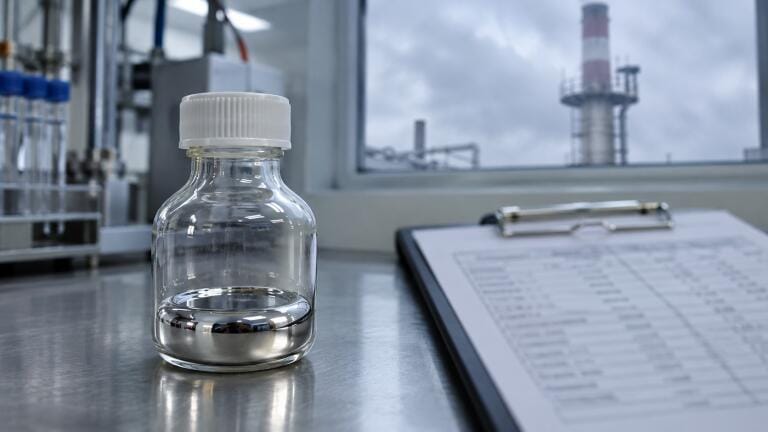
Environmental laboratory
Its own tables also show more mercury sold and used in manufacturing than three years earlier – and it is built on company reporting, not measurement.
The US Environmental Protection Agency (EPA) published its 2026 mercury inventory report on Friday, 6 November 2026. A notice of availability followed in the Federal Register on Thursday, 12 November 2026.
The report is the third in a triennial series on the supply, use and trade of mercury in the US. It covers activities in calendar year 2024.
EPA prepares the inventory under section 8(b)(10)(B) of the Toxic Substances Control Act (TSCA). The statute requires the agency to identify any manufacturing processes or products that intentionally add mercury.
It must also recommend actions, including proposed revisions of federal law or regulations.

EPA’s announcement leads with four figures. Mercury used in products made in the US fell by 48 per cent. Mercury used in products sold in the US fell by 58 per cent.
Total reported manufacture of elemental mercury fell by 56 per cent. Reported imports of mercury compounds fell by 99 per cent.
The report puts elemental mercury manufacture at 148,921 pounds in 2021 and 64,616 pounds in 2024. Including 108,680 pounds of mercury compounds, total reported manufacture in 2024 was 173,296 pounds.
Mercury-added products account for comparatively small quantities. The report gives 15,169 pounds for products made in the US and 7,932 pounds for products sold in the US in 2024.
The same report shows two measures moving the other way between the 2021 and 2024 reporting years.
Total mercury sold in the US rose by 41,291 pounds, an increase of around 76 per cent, to 95,835 pounds. Mercury used in manufacturing processes rose by 15,874 pounds, or around four per cent, to 376,459 pounds.
These figures are not fully consistent within the document. A later section gives the sales increase as 41,921 pounds and the process-use increase as 17,225 pounds, or around five per cent. One table also lists the 2024 process total as 375,459 pounds.
Manufacturing-process use is by far the largest category in the inventory. The report identifies two processes listed under the Minamata Convention on Mercury as still reported in the US.
One is chlorine production by the mercury-cell chlor-alkali process. The other is polyurethane production using mercury-containing catalysts.
The polyurethane use was not observed in the 2018 reporting year. It was reported in 2021 and again in 2024.
Reported on-site storage is also substantial. Companies reported a maximum of 288,189 pounds of elemental mercury stored on site in 2024.
EPA says it could further evaluate polyurethane production with mercury catalysts, the increase in mercury sold and used in manufacturing, and changes in on-site storage.
The inventory is compiled from submissions made under EPA’s mercury reporting rule, 40 CFR part 713. Reporters filed through the Mercury Electronic Reporting application, with a deadline of Tuesday, 1 July 2025, for 2024 activities.
For 2024, the agency received 76 individual submissions covering 94 reported activities.
These are declared quantities of mercury in commerce. They are not measured releases to air, water or land, and the inventory does not set out to quantify emissions.
The scope also leaves out several categories by design. Mercury that exists only as an impurity is not reported.
Nor is mercury present during a manufacturing process but not intentionally added, such as mercury in equipment or tools. Companies that only generate, handle or manage mercury-containing waste are excluded unless the mercury is recovered for use in commerce.
EPA sets out other limitations. The data are subject to submitter error, notwithstanding reporters’ self-certification of accuracy. A few reporters submitted their 2024 activities late.
The inventory also does not balance. EPA states that the amounts imported and manufactured do not equal the amounts used, distributed and exported.
Amounts for individual mercury compounds cannot always be determined because of how multiple compounds were listed. Product-specific quantities are not required by the rule.
For monitoring and compliance professionals, the inventory therefore indicates where intentional mercury use persists. It does not show what reaches the environment from those uses.
Measured mercury data for coal- and oil-fired power plants come from a separate regime: the Mercury and Air Toxics Standards (MATS).
On Thursday, 19 February 2026, EPA finalised the repeal of the 2024 amendments to MATS. Compliance reverts to the 2012 MATS requirements.
The repeal removes three elements of the 2024 rule. The first is the revised filterable particulate matter (PM) standard for coal-fired units. The second is the tighter mercury standard for lignite-fired units. The third is the requirement for all power plants to use PM continuous emissions monitoring systems (CEMS).
EPA estimates the repeal will save US$670 million between 2028 and 2037.
Under the 2012 framework, mercury monitoring provisions cover total vapour-phase mercury in emissions. The provisions allow either a mercury CEMS or a sorbent trap monitoring system.
EPA’s February announcement said mercury emissions from coal-fired plants in 2021 were 90 per cent lower than before MATS.

Taken together, the two regimes answer different questions. The TSCA inventory tracks how much mercury companies say they make, import, sell, export and use.
Stack monitoring under MATS records what leaves a regulated stack. Neither, on its own, provides a full mass balance of mercury from supply to environmental release.
EPA states it will continue to implement US obligations under the Minamata Convention.
AET 30.4 Nov 2026



 Product directory