Air monitoring
Alongside all of the other pollutants of concern, waste and co-incineration plants may also emit mercury (and its compounds) as well as dioxins.
Due to their high level of toxicity and long lifetimes in the environment, mercury and dioxins are perhaps the most dangerous air pollutants of all, even in very low concentrations.
Thankfully, strict emissions limit values (ELVs) and tight regulatory controls are in place to ensure that Best Available Techniques (BAT) are used to scrub out, mitigate and accurately measure stack emissions, demonstrating compliance.
In this article, we dig a bit deeper into these pollutants (with a slight detour into biogenic and non-biogenic CO2) and explore some of the Best Available Techniques for measuring them.
Let’s start with dioxins. Dioxins are a class of substances with many variations.
Whilst the base 1,4-dioxin is essentially harmless, they become hazardous when combined with chlorine or bromine.
Subgroups of dioxins are specifically referenced in the Waste Incineration WI-BREF/BATC reference documents under the Industrial Emissions Directive (2010/75/EU, the ‘IED’) and in Environment Agency permits due to their toxicity and include:
• PCDD/Fs (polychlorinated dibenzo-p-dioxins and -furans)
• PBDD/Fs (polybrominated dibenzo-p-dioxins and -furans)
• PCBs (polychlorinated biphenyls).
For simplicity, they are all referred to as ‘dioxins’ in this article.
These compounds can be very toxic (i.e. carcinogenic and mutagenic) whilst also being classed as persistent organic pollutants (POPs) as they don’t break down easily, bioaccumulate in living organisms and move through the food chain.
In addition, dioxins can travel long distances from the emission source.
Human exposure to dioxins occurs mainly through consumption of contaminated food of animal origin with typical half-lives in humans more than seven years.
Dioxins are mainly formed as unwanted by-products of waste incineration, paper pulp production as well as herbicide and pesticide production by reactions between organic materials, oxygen and chlorine/bromine at low to moderate temperatures (400-700 ºC).
Therefore, the use of BAT incineration technology operating at 850-1100 ºC and fitted with special gas cleaning equipment can greatly mitigate against dioxins emissions but they cannot always be completely removed due to process limitations and other complexities.
Thus, periodic sampling or continuous sampling is stipulated to both demonstrate compliance and to provide reassurance to local communities who may (and rightly so) be concerned about exposure to dioxins.
Whilst pretty much every other air pollution parameter that falls under the scope of the IED for waste incineration is measured in real-time by instrumentation, dioxins cannot currently be measured in-situ and in real-time due to the many variants and low concentrations.
Samples have to be taken manually using isokinetic sampling equipment and sent back to a laboratory where they are then analysed, typically using gas chromatography and mass spectrometry (GC/MS).
There is nothing wrong with manual isokinetic stack emissions testing – after all, it underpins the whole EN 14181 quality assurance of continuous emissions monitoring systems CEN standard and MCERTS; it is essential for regulatory compliance.
But if the sampling frequency of pollutants like dioxins (and mercury, for that matter) calls for more frequent sampling compared to the typical annual stack testing requirement, it can soon become very expensive and yet another thing for busy sites to have to manage.
Whilst we can’t measure dioxins automatically in real-time, we can now sample them using a fully automatic isokinetic stack sampling system combined with a temperature-controlled adsorbent sampler, with computer-controlled operation and automation.
Enter the OPSIS DX100 dioxins sampling system.
The OPSIS DX100 Automatic Dioxins Sampling System
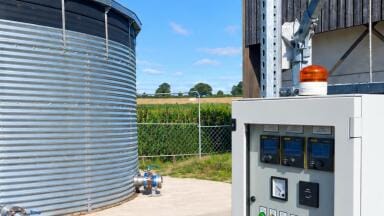
Fig 1 Photo shows one of four stack-mounted OPSIS automatic dioxin sampling boxes (yellow box) and four DX100 control cabinets at a large Swedish waste-to-energy plant.
In full compliance with the requirements of the EN 1948 standard for the determination of the mass concentration of PCDDs/PCDFs and dioxin-like PCBs, the system is therefore very suitable for demonstration of compliance with the European Union Best Available Techniques Conclusions for Waste Incineration (WI-BATC) requirements for dioxins.
The comprehensive measuring range for dioxins/furans concentrations is between 0.0001 and 10 ng/m3 making the DX100 system suitable for a range of applications, such as waste incinerators, power plants, cement industries as well as pulp and paper industries.
In addition to automatic sampling of dioxins, the OPSIS DX100 system can also be equipped to automatically collect CO2 samples for reporting on the ratio of fossil-fuel to non-fossil fuel-derived CO2 emissions.
Essentially, all carbon in CO2 emissions originates from the fuel being burnt.
But not all CO2 is equal when it comes to where the carbon comes from, and this has implications on the carbon dioxide emissions footprint.
Biogenic carbon can be described as carbon from recently living material (i.e. plants, food, paper, wood) whilst fossil carbon, as we know, originates from long-buried sources.
In the case of waste incinerators, waste-to-energy plants and co-incineration plants, the type and nature of the fuel and waste streams can vary and therefore, so can the biogenic and non-biogenic fuel content of the overall CO2 emissions.
Why is this important? Without knowing the exact ratio of biogenic to non-biogenic CO2 emissions over a period, assumptions must be made which may not accurately reflect the actual contribution from renewable, partly renewable and non-renewable carbon being combusted in the waste-to-energy process.
This is especially important when the source and composition of the waste stream is variable. Incorrect assumptions could then lead to higher amounts of non-renewable CO2 emissions, taxation or other punitive measures for operators, either now or in the future.
Thankfully, the biogenic component of any given CO2 can be determined in the laboratory using a well-established 14C/12C isotope ratio analysis method, allowing it to be subtracted from the total CO2 emissions and leaving just the non-biogenic (fossil fuel-derived) CO2 to be subject to any carbon taxation.
OPSIS has developed a simple and effective add-on option to the DX100 dioxins sampling system which enables long-term CO2 sampling to take place simultaneously with the sampling of dioxins.
If dioxin sampling is not required, there is also a stand-alone CO200 carbon dioxide sampling system based on the same principles and components.
Like dioxins, mercury and its compounds are highly toxic, hazardous and long-lasting pollutants that bioaccumulate in organisms and upwards through the food chain.
Human exposure to mercury has been associated with over 250 medical conditions, including effects on the brain and central nervous system, pulmonary and cardiovascular systems as well as renal, digestive and immune systems.
Mercury is released from both natural and human-related sources.
Natural sources include volcanoes and ocean emissions, while major human-related sources include artisanal gold mining, coal combustion, metal production and cement production.
Mercury can also be re-emitted from land and water after earlier deposition.
Mercury exists as both elemental mercury (here denoted Hg0) and in compounds, including mercury chloride (HgCl2), mercury sulphide, the methylmercury cation and the very toxic dimethylmercury.
From now, let’s call this group of compounds total mercury (THg).
Driven by legislation and international conventions like the 2013 Minamata Convention, efforts are on-going to phase-out widely used mercury-containing products, and the manufacture, import and export of products containing mercury has been prohibited since 2020.
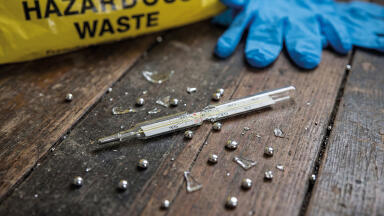
But due to the legacy of mercury use in industry and manufacturing over the last 100 years, there are still a great many products in circulation which may ultimately end up in deposits or being disposed of at municipal waste incinerators and energy-from-waste plants.
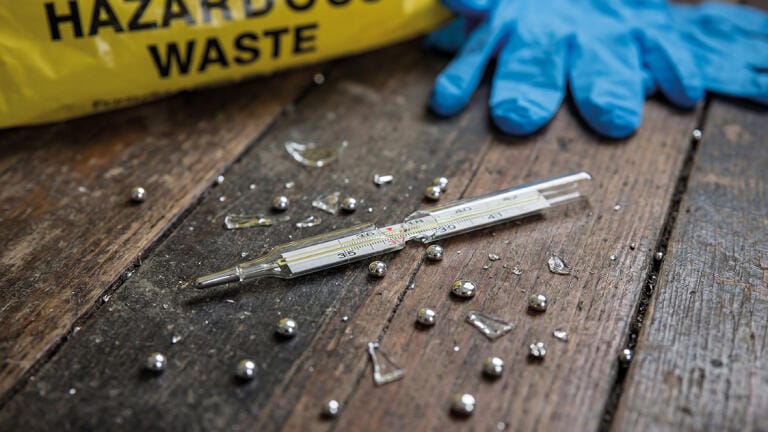
These products include thermometers, fluorescent light tubes, lamps as well as billions and billions of batteries of all shapes and sizes.
Like dioxins, industrial emissions of mercury in the EU are governed by the Industrial Emissions Directive 2010/75/EU and sector-specific BAT Reference Documents (BREFs) and Beat Available Techniques Conclusions (BATCs).
Waste incineration (WI) BREFs and BATCs have been developed over the years, with the most recent WI BREF and WI BATC published at the end of 2019.
Like with dioxins, the most effective techniques and pollution abatement technologies that waste-to-energy facilities and hazardous waste incinerators can adopt to mitigate THg emissions to air are set out in the WI BREF. But airborne emissions can still occur.
Even in very low concentrations (micrograms per cubic metre), mercury remains a serious concern and requires periodic stack testing and increasingly now continuous emissions monitoring with CEMS.
The MCERTS-approved OPSIS CEM system is based on the DOAS technique (differential optical absorption spectroscopy).
Different gases – including elemental mercury in gas phase, absorb specific wavelengths in the UV and IR regions of the electromagnetic spectrum – can be quickly and very accurately analysed their differing spectral fingerprints and absorption characteristics.
The concentration of elemental mercury (Hg0) is measured with an OPSIS UV-DOAS analyser in the AR600 series.
However, as other non-elemental mercury compounds exist, the BAT conclusions for the IED call for the measurement of ‘the sum of mercury and its compounds, expressed as Hg’ – i.e., what we call total mercury (THg).
To measure total mercury, the system utilises a specific mercury converter which catalytically decomposes mercury compounds back to elemental Hg0 while allowing already existing Hg0 to pass through.
The resulting Hg0 concentration is effectively the THg concentration ‘expressed in Hg’.
Figure 3 shows a total mercury-only OPSIS CEM system with a single UV-DOAS analyser, whilst Figure 4 shows an expanded system with both UV- and FTIR-DOAS analysers enabling the measurement of THg along with the other main waste incinerator gases including NO, SO2, CO, HCl and HF.
In other words, the OPSIS mercury CEM system can be offered to clients as a mercury-only CEM solution (which can be upgraded to cover other gases over time) or a part of a comprehensive multi-gas CEM. It is inherently versatile and future-proof.
Whichever option is chosen, with Hg detection limits typically less than 0.5 µg/m3 and MCERTS-certified measurement ranges being best-in-class, the OPSIS mercury CEM system is suitable for all existing and new waste incineration plants as either a stand-alone system or a highly cost-effective multi-gas CEM.
IET 36.5 Sept/Oct 2026



 Product directory
























.jpg)