Air quality monitoring
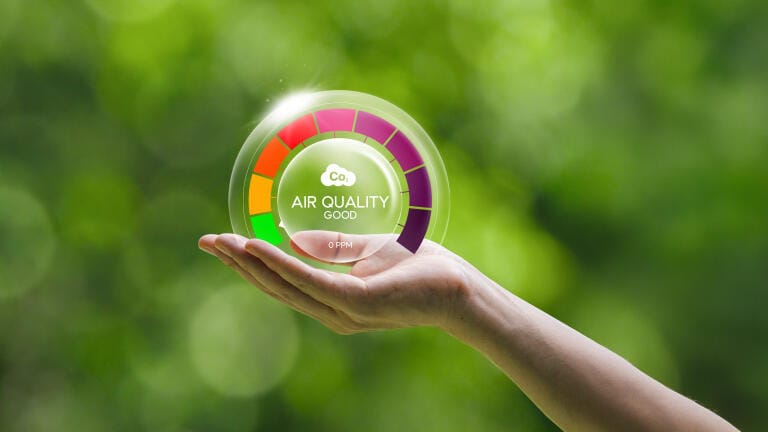
Choosing an air quality sensor involves more than comparing prices, the number of pollutants measured or battery life. The right choice depends on what needs to be monitored, the conditions in which the sensor will operate, and the quality of data required. Calibration, drift, independent testing and ongoing maintenance all have a bearing on performance. The best sensor is the one that meets the needs of the application.
Air quality sensor manufacturers make plenty of claims about accuracy, reliability and performance compared with reference instruments. But how can buyers tell which products will deliver the results they need?
A sensor that looks impressive on a datasheet may perform differently once installed in the field. If its readings are unreliable, the consequences can extend beyond the cost of the equipment, particularly when the data informs regulatory decisions, public health assessments or industrial operations.
The challenge is to understand what the sensor can measure, how well it performs under the conditions it will encounter and how that performance is maintained over time. Guidance from organisations including the US Environmental Protection Agency (EPA) and the Air Quality Sensor Performance Evaluation Center (AQ-SPEC) provides a useful starting point.
The first step is to establish the purpose of the monitoring programme. A sensor intended for academic research may have different requirements from one used for industrial emissions monitoring, while a system designed to measure particulate matter may not be suitable for monitoring gases.
Consider the pollutants involved, the expected concentration ranges, the deployment environment, the duration of the project and the required level of data quality. Power supply, communications, maintenance requirements, applicable regulations and the overall budget will also influence the decision.
For example, urban air quality monitoring may require measurements at low concentrations, whereas an industrial site could experience much higher levels around specific processes. The instrument must be capable of measuring the concentrations expected without losing accuracy or reaching the limits of its measurement range.
It is also worth considering whether every available measurement parameter is necessary. Additional sensors can increase the purchase price, maintenance requirements and complexity of the system. Selecting the parameters that are relevant to the application is generally more useful than simply choosing the instrument that measures the most pollutants.
Two sensors using the same technology can produce noticeably different results. Their performance depends not only on the sensing element but also on how the complete instrument is designed, calibrated and maintained.
Individual calibration, temperature and humidity compensation, the management of cross-interference between gases, manufacturing quality control and signal processing can all affect the readings. These differences may not be apparent from a product specification alone.
Price is not a reliable indicator of performance either. More expensive equipment may offer better calibration, more sophisticated software or improved long-term stability, but these benefits should be supported by evidence.
Independent evaluations and comparisons with reference instruments can help buyers establish how a particular model performs in practice. Ideally, the results should cover a range of environmental conditions and a sufficiently long period to reveal weaknesses that might not appear during short-term testing.
Comparing a sensor with a suitable reference instrument is one of the most useful ways to assess its performance. The AQ-SPEC programme, run by the South Coast Air Quality Management District (South Coast AQMD), evaluates air quality sensors through co-location and comparison with reference or equivalent measurement methods.
The resulting assessments can examine accuracy, precision, linearity, sensitivity to temperature and humidity, interference from other pollutants and differences between individual units of the same model.
It is important not to rely on a single performance figure.
The coefficient of determination, R², is often used to describe how closely sensor readings follow changes in reference measurements. However, a high R² does not necessarily mean that the readings are accurate. A sensor could follow the reference measurements closely while consistently reporting concentrations that are too high or too low.
Other measures, including the slope and intercept of the comparison, mean absolute error (MAE) and overall measurement uncertainty, help provide a more complete picture. The appropriate metrics will depend on the pollutant, measurement range and intended application.
Consistency between individual units is another consideration, particularly for projects involving dozens or hundreds of sensors. If a network contains 50 instruments, buyers need to understand whether the units produce comparable results or whether individual differences could affect the conclusions drawn from the data.
A certification logo can be useful, but buyers should establish exactly what has been tested, who carried out the assessment and what the results demonstrate.
Relevant frameworks include the European technical specification CEN/TS 17660, which addresses the performance evaluation of air quality sensor systems, the EPA’s performance testing protocols and the UK’s MCERTS scheme. The precise requirements depend on the pollutant, instrument type and intended application.
Kunak has also reported that its AIR Pro system received South Korea’s Grade 1 classification for PM2.5 following evaluation by KOTITI Testing & Research Institute. Buyers considering this claim should consult the relevant certificate or official listing to confirm the scope of the assessment and the applicable registration details.
Regulatory requirements and product certifications should not be confused. For example, Directive (EU) 2024/2881 establishes a revised framework for ambient air quality in the European Union. It is legislation for Member States to implement, rather than a product certification that a manufacturer can simply obtain.
The independence and scope of the supporting evidence matter as much as the name of the scheme. Manufacturer testing can provide useful information, while customer co-location, independent laboratory testing and published evaluations by environmental agencies offer additional forms of evidence.
Each has its limitations, so buyers should request the full report rather than relying solely on a summary or logo.
Temperature, relative humidity and the presence of other pollutants can affect sensor readings. Electrochemical sensors, for example, may respond to gases other than the one they are intended to measure. An NO₂ sensor can be affected by ozone, depending on its design and the compensation methods used.
Particulate matter sensors also need to be assessed
under different environmental conditions. The EPA’s testing protocols include controlled temperature and humidity conditions, as well as assessments of drift and performance
at different particle concentrations.
Field conditions can differ considerably from those encountered during laboratory testing. A sensor installed at a port, mine, landfill or newly developed urban site may experience conditions that were not fully represented during its evaluation.
Buyers should therefore establish the environmental conditions covered by the test results and whether the instrument is suitable for the intended deployment. Performance at one location does not automatically demonstrate equivalent performance everywhere, particularly where temperature, humidity, pollutant mixtures or concentration ranges differ.
Sensor performance can change over time. Ageing of the sensing element, contamination, changes in sensitivity and prolonged exposure to challenging conditions can all contribute to drift.
The important question is how the system detects and manages these changes. Buyers should ask whether each unit is calibrated individually at the factory, whether recalibration is possible, how often it may be required and whether the system records calibration history and changes to its correction settings.
Some systems use automated compensation algorithms or remote zero and span adjustments to help maintain performance. These features can be valuable, but their effectiveness should be assessed against documented procedures and performance data.
Co-location with a reference station and calibration
using traceable gas standards serve different purposes.
Co-location shows how the instrument compares with reference measurements under the conditions encountered at a particular site. Calibration establishes its response to known concentrations under defined conditions. Neither approach alone guarantees reliable measurements in every environment, and the two can be used together.
Air quality sensors are available across a wide range of prices and performance levels. Low-cost systems can be useful for identifying trends, raising awareness and providing indicative measurements, provided their limitations are understood.
Professional systems may offer more extensive calibration, better environmental compensation, improved data management and stronger evidence of performance. Near-reference is a descriptive term rather than a universal regulatory classification, so buyers should look for measured performance data rather than relying on the label.
The level of performance required depends on how the data will be used. A system intended to show general changes in local air quality may have different requirements from one supporting a regulatory assessment, formal investigation or decision with legal implications.
Where the consequences of inaccurate measurements are significant, independent evaluation, documented uncertainty and a clear maintenance programme become particularly important.
Choosing an air quality sensor requires a clear understanding of what the monitoring programme needs to achieve.
The sensing element is only one part of an air quality monitoring system. Electronics, sample handling, temperature and humidity compensation, firmware, communications and data-processing software all contribute to the final result.
Depending on the application, the system may also need particle filters, heated sampling lines, meteorological measurements or automated quality assurance and quality control (QA/QC).
The availability of replacement parts and the ease of servicing the instrument can also affect its suitability for long-term deployment.
Purchase price is only part of the overall cost. Total cost of ownership includes installation, communications, calibration, consumables, replacement sensors, software licences, energy use, site visits and downtime.
A cheaper instrument may prove more expensive over its service life if it requires frequent intervention or produces data that cannot be used with confidence. Comparing these ongoing costs alongside the initial price gives buyers a more realistic basis for choosing between systems.
The requirements vary according to the monitoring objective.
Urban air quality networks commonly monitor nitrogen dioxide (NO₂), ozone (O₃) and particulate matter, including PM10 and PM2.5. Deployments may involve large numbers of sensors, making consistency between units, reliable communications and integration with existing data platforms important considerations.
Industrial fenceline monitoring focuses on pollutants associated with the site and the surrounding environment. Sensors need to be suitable for the relevant gases and concentration ranges, with meteorological data and timely alerts potentially helping operators investigate emissions or identify changes in local conditions.
Construction and mining projects often prioritise particulate matter, robust enclosures and reliable operation at remote locations. Solar power may be useful where mains electricity is unavailable, while alerts can help site teams respond to dust events.
Odour monitoring around wastewater treatment plants, landfills and farms may involve hydrogen sulphide (H₂S), ammonia (NH₃) and volatile organic compounds (VOCs). Wind speed and direction can help interpret measurements and investigate the possible movement of emissions.
In each case, the monitoring objective should determine the specification. A sensor suitable for one application should not automatically be assumed to meet the requirements of another.
Kunak’s approach provides an example of how a manufacturer can address calibration, maintenance and sensor replacement within a monitoring system.
According to the company, each smart cartridge is individually calibrated in the laboratory using gas standards traceable to recognised standards, with calibration data stored in the cartridge’s internal memory. Kunak also describes its systems as being evaluated against frameworks including CEN/TS 17660 and EPA testing protocols, alongside other performance assessments.
These claims should be considered alongside the relevant technical reports and the scope of each evaluation. As with any manufacturer, the evidence for a particular pollutant, configuration and operating environment is more informative than a general statement about performance.
Kunak’s patented GasPlug Technology uses intelligent cartridges that allow measurement parameters to be changed in the field in less than two minutes. Onboard algorithms and remote zero and span adjustments also help manage sensor drift.
For prospective buyers, the practical questions are how these features affect maintenance time, calibration requirements, consistency between instruments and the quality of the data over the system’s service life.
Choosing an air quality sensor requires a clear understanding of what the monitoring programme needs to achieve. Pollutant selection, measurement range, environmental conditions, calibration, independent evaluation and maintenance should all be considered alongside purchase price.
No single specification or certification logo can answer every question. The most useful evidence comes from testing that reflects the intended application, supported by transparent reporting of performance and limitations.
Where measurements will inform regulatory decisions, public health assessments or critical industrial operations, buyers need to understand not just what a sensor can measure, but how reliably it does so and what is required to maintain that performance over time.
AET 30.4 Nov 2026
 Product directory