
Air monitoring
The SPECTRO.sens gas measurement module uses tunable diode laser absorption spectroscopy in the near-infrared range to support selective methane measurement across ppm and vol% ranges.
Optical measurement methods are well established in industrial gas analysis.
Non-dispersive infrared (NDIR) measurement remains widely used because it can detect a broad range of gases with good accuracy.
Some applications now require lower detection limits, stronger long-term stability and reduced cross-sensitivity.
These requirements are particularly relevant where methane measurement is linked to process control, leak detection, emissions monitoring or safety-related gas detection.
The laser-based SPECTRO.sens gas measurement module uses tunable diode laser absorption spectroscopy (TDLAS).
It is intended to complement existing NDIR measurement capabilities where selectivity, low drift and ppm-level methane detection are important.
Optical gas measurement is based on the absorption of infrared radiation by gas molecules.
A light beam is passed through an analysis cuvette containing the gas mixture.
The concentration of the measured gas can then be calculated from the attenuation of the beam.
For the SPECTRO.sens methane configuration, the relationship is described using Lambert-Beer’s law:
U(c) = U₀ · exp(−α · c · L) [1]
In this expression, U₀ is the measurement voltage at the radiation receiver with nitrogen in the analysis cuvette.
U(c) is the measurement voltage with the gas mixture in the cuvette, α is the absorption coefficient of the measurement gas and L is the effective optical path length.
Rearranging the equation gives the concentration c:
c = −ln[U(c) / U₀] / (α · L) [2]
In the SPECTRO.sens optical arrangement, the laser beam passes through the analysis cuvette twice.
This increases the optical path length and supports sensitive measurement in the ppm range.
Pressure and temperature in the cuvette are measured and compensated because both affect gas density.
Figure 1: Optical path of the SPECTRO.sens with tunable laser diode, deflection mirrors, analysis cuvette, radiation detector, gas inlet, gas outlet and cuvette window
The methane measurement described here is carried out in the near-infrared (NIR) band around 1.667 µm.
In the selected band, the methane absorption spectrum can be measured without the same level of interference from water vapour or other hydrocarbons that can affect broader optical methods.
Gas measurement can use an absorption line within this band. In practice, strong lines are normally selected.
The supplied methane data use a line near 1.651 µm. During operation, the laser is tuned across the absorption line by changing the diode current, with a scan range of around 0.5 nm.
Figure 2: NIR absorption spectrum of methane around 1.667 µm, with water vapour shown for comparison
Figure 3: CH₄ absorption line between 1.6485 µm and 1.6525 µm, with a scan range of 0.5 nm around the centre of the absorption line
The spectral data are analysed using the concentration equation above.
Because each scan includes points outside the absorption line, the zero value U₀ is captured during measurement and used as a reference.
This reference measurement helps compensate for drift effects that can occur in conventional NDIR instruments.
The supplied device data indicate low cross-sensitivity for H₂O, CO₂ and N₂O. Test data supplied for the module also indicate compensation for high concentrations of ethane, propane and butane.
By design, the module does not require routine zero-point or end-point adjustment. The supplied specification lists an annual end-point check.
Figure 4: Calibration response for 0 ppm, 2.5 ppm, 5 ppm, 10 ppm and further increments up to 35 ppm CH₄ in N₂
The optical bench is temperature controlled to reduce the influence of external temperature changes.
The source data show matching calibration curves recorded at 30°C and 50°C, indicating a limited temperature effect under the tested conditions.
Temperature control also helps reduce the risk of condensation in the analysis cuvette. A pressure and temperature sensor measures values in the cuvette for compensation.
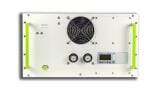
The SPECTRO.sens assembly is supplied in a Thermobox with sheet steel housing and internal thermal insulation.
Gas connections, the 24 VDC power input and RS232 and CAN communication interfaces are accessible from the outside.
Figure 5: SPECTRO.sens optical bench with signal processing electronics integrated into the thermal housing
Figure 6: Thermobox with integrated SPECTRO.sens assembly, gas connections, 24 VDC power input and data communication port
For the methane configuration described, the measuring range is specified up to 0–100,000 ppm CH₄, equivalent to 0–10 vol.% CH₄.
Accuracy is stated across the full measuring range, which means separate graduated ranges such as 0–100 ppm and 0–1,000 ppm are not required for the configuration described.
A shorter analysis cuvette could allow a maximum range up to 100 vol.% CH₄. The main supplied specifications are shown in Table 1.
Table 1: Device specifications for methane measurement
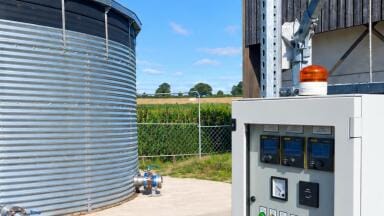
Biogas and wastewater treatment. Continuous methane measurement can support monitoring of raw biogas, digester gas production and methane recovery from sewage sludge. Selectivity against CO₂, H₂S and water vapour is relevant in these matrices.
Leak detection and repair. Regulation (EU) 2024/1787 introduced methane measurement, monitoring, reporting and verification requirements for the energy sector, including leak detection and repair (LDAR) surveys and restrictions on venting and routine flaring.
Ppm-level methane measurement can support leak survey work, although final suitability depends on the applicable method and approval requirements.
Landfills. Landfill gas monitoring can require methane measurement at the surface and in degassing systems. Low detection limits are relevant where fugitive emissions need to be identified.
Mining and tunnel construction. Methane measurement is also used in underground workings, tunnels and associated ventilation or extraction systems.
The measurement requirement is safety-critical, so response time, maintenance planning and alarms must be considered as part of the full system design.
Industrial safety and production areas. The module can be used in gas detection control centres, service shafts and plant rooms where rapid methane response is required.
The supplied T90 response time is less than 5 s.
Agriculture and packaging. Potential uses include methane measurement from slurry systems, livestock housing, agricultural biogas processes, modified atmosphere packaging lines and leak detection in natural gas infrastructure within production facilities.
For operators and instrument builders, the main practical issue is not only the detection limit.
Methane measurement in industrial environments also depends on drift control, cross-sensitivity, sample handling, condensation control, pressure compensation and maintenance intervals.
TDLAS can address several of these issues by using a narrow absorption line and an internal reference measurement during each scan.
In OEM systems, the Thermobox construction also gives a defined mechanical and thermal integration format.
Final deployment still depends on the application, matrix, safety case, alarm strategy, quality assurance procedure and any regulatory or site-specific performance requirements.
The SPECTRO.sens module provides a TDLAS-based option for methane measurement in industrial gas analysis.
For applications that need stable ppm-level detection and a wide measuring range, the combination of line-specific optical measurement, pressure and temperature compensation and temperature-controlled construction is technically relevant.
The supplied methane configuration covers 0–100,000 ppm CH₄, with a detection limit below 0.15 ppm and an update rate of 1 Hz.
Wi.Tec-Sensorik GmbH states that further gas measurements with SPECTRO.sens, including H₂O, NH₃, CO and O₂, are in development.
Wiegleb G (2023) ‘Gas Measurement Technology in Theory and Practice’. Springer Verlag Wiesbaden.
HITRAN (n.d.) ‘The HITRAN database’. Available at: https://hitran.org/ (Accessed: 3 July 2026).
Guerrero J and Gamba M (2025) ‘A review of theory and practical considerations of tunable diode laser absorption spectroscopy diagnostics’. Available at: https://doi.org/10.48550/arXiv.2512.18201 (Accessed: 3 July 2026).
European Parliament and Council (2024) ‘Regulation (EU) 2024/1787 on the reduction of methane emissions in the energy sector’. Official Journal of the European Union. Available at: https://eur-lex.europa.eu/legal-content/EN/TXT/?uri=CELEX:32024R1787 (Accessed: 3 July 2026).
European Commission (n.d.) ‘Methane emissions’. Available at: https://energy.ec.europa.eu/topics/carbon-management-and-fossil-fuels/methane-emissions_en (Accessed: 3 July 2026).
IET 36.5 Sept/Oct 2026



 Product directory


























.jpg)