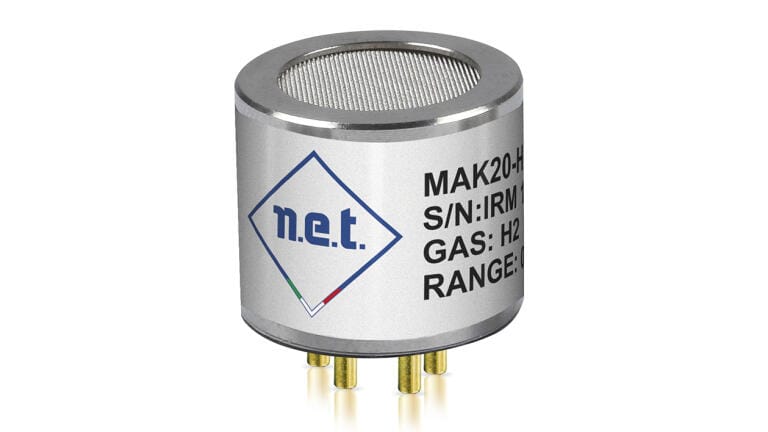
Gas sensors
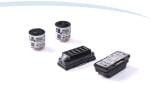
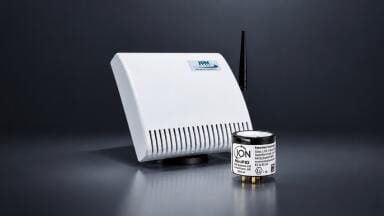
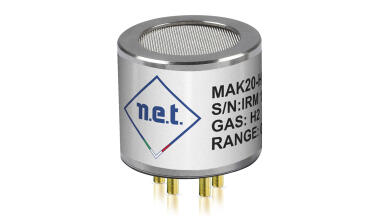
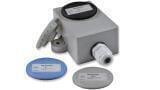
In the transition toward clean energy, thermal conductivity stands out as a superior method for gas detection. NET has developed the MAK series (MEMS Analogue Katharometer), a sensor designed to measure gas concentrations from 0 to 100% by volume by monitoring variations in heat conduction, a parameter that changes significantly in the presence of Hydrogen.
The MAK sensor leverages MEMS technology with an integrated membrane to deliver performance that exceeds that of traditional chemical or catalytic sensors. It provides full-spectrum gas detection, operating effectively from ppm levels up to 100% volume, even in oxygen-free environments. Unlike sensors that rely on chemical reactions and degrade over time, the MAK sensor offers exceptional long-term stability and an extended operational lifetime. Its robust design ensures reliable performance across a wide temperature range, from -40°C to +60°C, with automatic compensation for temperature, humidity, and pressure variations. The sensor is also highly durable, exhibiting strong resistance to mechanical shocks and complete immunity to poisoning, as common inhibitors cannot adhere to the active MEMS element. In addition, it delivers a rapid response time (T90 < 20 s), limited only by the resistance variations of the MEMS sensing element, making it well suited for demanding industrial applications.
As Hydrogen becomes central to innovation, reliable detection is critical across its entire infrastructure.
The MAK sensor is ideally suited for a wide range of applications. It supports electrolyser plants and water separation; enables safe operation of H₂ tanks, containers, and pipeline networks; hydrogen vehicle depots and testing centers; and enhances safety in battery rooms and industrial facilities.
IET 36.5 Sept/Oct 2026


 Product directory




.jpg)