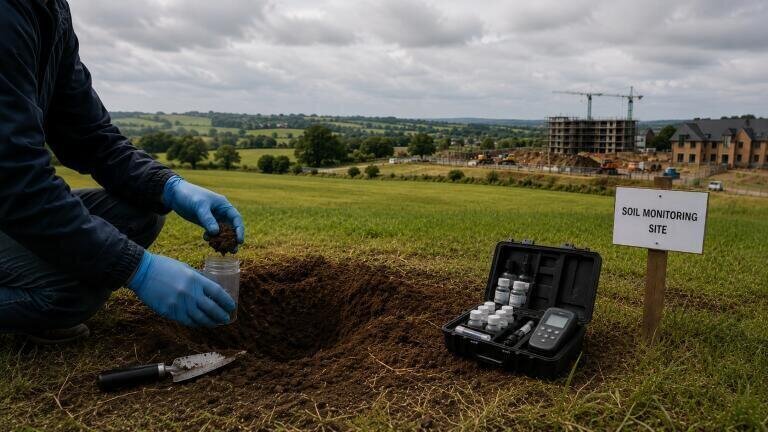
Soil testing
But only if it is understood as an evidence law first, not as a blunt new compliance burden for farmers, land managers or developers.
That distinction is important because it is also what makes the EU’s new Soil Monitoring Law interesting.
The law is not simply a pollution control measure, a farming rulebook or a restoration mandate. Its more distinctive function is to turn soil into a formally monitored environmental system.
In other words, it creates the shared measurements, categories and reporting duties needed to know whether soils are improving or degrading.
The EU law entered into force on 16 December 2025, with Member States required to transpose it into national law by 16 December 2028 and submit their first soil health implementation and assessment reports by 16 December 2031.
It applies to all soils, including agricultural land, forests, urban areas and other land types, and covers threats including erosion, loss of soil organic matter, contamination, compaction, sealing and loss of soil biodiversity.
Its uniqueness lies in the fact that it gives soil its first dedicated EU-wide monitoring framework. Before this, soil was dealt with indirectly through rules on agriculture, water, waste, chemicals, industrial emissions, nature protection and land use.
By contrast, the Soil Monitoring Law requires Member States to monitor and assess the physical, chemical and biological condition of soils using a common EU methodology, and to report regularly to the European Commission and European Environment Agency.
This matters because soil policy has often suffered from a basic evidence problem. Air quality can be discussed through monitoring networks, limit values and exceedances.
Water quality can be assessed through catchments, chemical status and ecological status. Soil, by contrast, is more heterogeneous, slower to change and harder to measure consistently. The EU law does not solve that problem by itself, but it does attempt to create a common monitoring language.
The law also goes beyond conventional agricultural soil testing. It includes land take, soil sealing and soil removal, meaning it connects soil health to planning, construction, infrastructure and urban development.
It also strengthens the framework for contaminated sites and points towards monitoring emerging contaminants such as PFAS, pesticides and microplastics.
For the UK, the relevant question is therefore not simply whether it should “copy” the EU. The better question is whether the UK needs a statutory soil evidence system of its own: one that gives soil the same seriousness in environmental governance as air and water.
At present, the UK is not starting from nothing. England’s Environmental Improvement Plan 2025 commits to bringing at least 40% of England’s agricultural soil into sustainable management by 2028, rising to 60% by 2030.
It also commits to publishing principles of sustainable soil management and guidance for consistent soil health monitoring by 2026, and to improving the quality, consistency and availability of soil data by 2029.
Those commitments are useful, but they remain closer to a policy programme than a durable statutory architecture.
The EFRA Committee has already argued that soil should be put on an equal footing with air and water in the Environment Act framework, and recommended that, once a baseline and indicators are in place, the Government should develop binding and measurable targets for improving soil health in England.
This is where the EU model becomes most useful. Its central lesson is not that every country needs identical soil targets or identical land management rules.
It is that soil cannot be governed properly if it is not measured consistently. A UK soil monitoring law could provide that foundation by setting minimum monitoring requirements, common indicators, transparent data standards and clear institutional responsibilities.
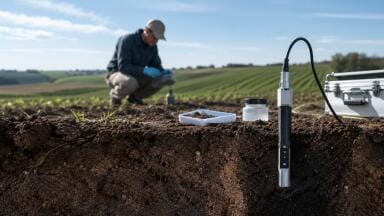
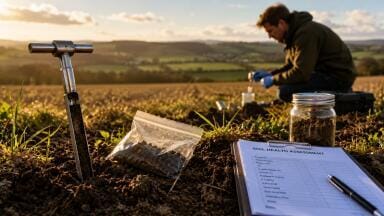
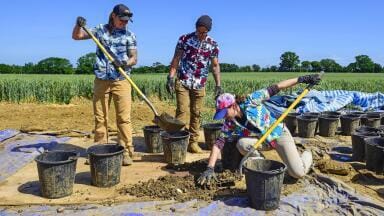
For environmental monitoring professionals, this would be a significant shift. It would create sustained demand not only for laboratory testing, but also for sampling protocols, field sensors, geospatial tools, remote sensing, data platforms, quality assurance systems and long-term trend analysis.
Relevant parameters would likely include soil organic carbon, bulk density, compaction, pH, nutrient status, biological activity, erosion risk, contamination and land sealing.
A monitoring law could help link soil evidence to flood risk modelling, water quality planning, nutrient management, carbon accounting, biodiversity recovery, contaminated land assessment and planning decisions. Soil would stop being treated as a background condition and become part of the measured infrastructure of environmental decision-making.
That is especially important because soil monitoring is technically difficult. JNCC’s recent work on a soil health indicator for England notes that assessing and monitoring soil health is challenging because soil health includes physical, chemical and biological properties, and because England’s soils vary significantly by soil type, climate and land use. It also notes that a national soil health indicator for England had been lacking before the current publication.
A UK law would also need to avoid one obvious mistake: confusing national monitoring with individual enforcement. Farmers and land managers already face practical pressures around input costs, nutrient planning, weather volatility and scheme complexity.
If a soil monitoring law were experienced mainly as another inspection regime, it would risk generating resistance and poor-quality data.
The better model would be layered. National monitoring should establish baselines and trends: where soils are gaining or losing carbon, where compaction is increasing runoff risk, where nutrient losses threaten water bodies, where urban soil sealing is accelerating, and where contaminated land presents persistent risks. Site-level testing should then support advice, remediation, farm planning, construction decisions and targeted incentives.
There is also a devolution question. Wales, Scotland and Northern Ireland have different soils, land uses and policy frameworks. Northern Ireland, for example, has already pursued a large-scale Soil Nutrient Health Scheme, while England is developing soil indicators and monitoring guidance through its Environmental Improvement Plan commitments.
A UK-wide law would therefore need to operate as a common framework rather than a single uniform scheme.

The strongest case for a soil monitoring law is that it would make existing environmental policy harder to design badly. Climate adaptation, flood resilience, food security, biodiversity recovery, water quality and brownfield redevelopment all depend partly on soil condition.
Yet without consistent monitoring, soil remains easier to invoke than to manage.
The EU’s Soil Monitoring Law is distinctive because it recognises that soil protection begins with visibility. It does not merely ask whether land is being farmed, built on, polluted or restored. It asks whether the underlying soil system is being measured in a way that allows deterioration to be detected and improvement to be demonstrated.
That is the lesson the UK should take seriously. A UK soil monitoring law would not, by itself, restore degraded soils. It would not replace farming support, planning reform, pollution control or remediation funding. But it could provide the evidence framework those policies currently lack.
So, would the UK benefit from a Soil Monitoring Law? Yes, if the aim is not simply to legislate for the sake of legislation, but to create a statutory soil evidence system: one capable of turning soil health from a vague environmental aspiration into a measurable public asset.
IET 36.5 Sept/Oct 2026



 Product directory