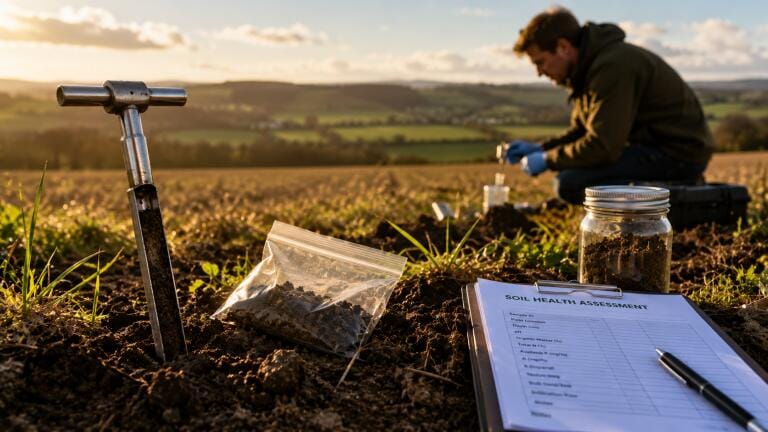
Soil testing
Air has legal limits, reference methods, continuous monitoring networks and public dashboards.
Water has permit conditions, catchment data, discharge monitoring and long-established laboratory workflows.
Soil, by contrast, has often been treated as a farm-management issue, a contaminated-land issue or a carbon issue, depending on who is looking at it.
That is beginning to change. The UK has not adopted an EU-style Soil Monitoring Law, and it may not do so soon.
But England is now moving toward something that could matter just as much for environmental monitoring professionals: a more formal system of targets, baselines, indicators and repeatable measurement.

The most visible target is Defra’s commitment to bring at least 40% of England’s agricultural soil into sustainable management by 2028, increasing to 60% by 2030.
Alongside that sits a second commitment to improve the quality, consistency and availability of soil data by 2029. Defra also says it will publish principles of sustainable soil management and guidance for consistent soil health monitoring, while aiming to establish a baseline by 2029.
A national soil-health framework only works if samples, analytical methods, metadata, data handling and interpretation are sufficiently comparable across locations, soil types, land uses and time.
Once government starts talking about baselines and progress against targets, soil health becomes a measurement system.
The UK is not starting from nothing.
In March 2026, JNCC published the Indicators of Soil Health for England, an official statistic in development.
It provides interim baseline data for three areas: soils’ influence on reducing runoff risk for surface water flood prevention; soil carbon and long-term carbon storage; and soils’ influence on sustainable arable crop provision.
The statistics are intended as a high-level national assessment of rural England’s soils, rather than a field-by-field diagnostic tool.
That distinction is important. The current indicator is not simply a list of laboratory results.
JNCC defines soil health as soils’ contribution to ecosystem-service delivery. Its technical report says the models focus on climate regulation, water regulation and sustainable production of arable crops, using a combination of measured data, modelling, literature review and expert elicitation.
Soil health is not one parameter. It is a moving relationship between physical structure, organic matter, nutrient status, biological activity, hydrology, land use and management.
A soil can have high carbon stocks and still be vulnerable if conditions favour future loss. A soil can support crop production in the short term while losing structure, biodiversity or long-term resilience.
A soil can be chemically acceptable but physically compacted. For laboratories, this means the market is likely to built around a suite of measurements tied to specific policy questions.
The first area is carbon. Soil organic carbon is already central to climate and natural-capital discussions but the JNCC statistics show why carbon monitoring is becoming more subtle than simply measuring how much carbon is present.
JNCC’s 2026 release reports a median average of 71 tonnes of carbon per hectare in rural England soils sampled in 2023–24, with mineral soils at 68 t C/ha and peat soils at 135 t C/ha. It also stresses that one timepoint cannot yet show whether soil carbon is improving or deteriorating through time.
That creates a clear role for laboratory and field-monitoring quality. If soil carbon is to support policy targets, carbon-credit claims, farm payments or resilience assessments, the data need to be repeatable.
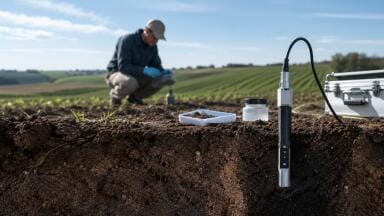
Sampling depth, bulk density, stone content, soil moisture, carbon fraction, spatial variability and resampling intervals all become critical. The analytical result matters, but so does the sampling design behind it.

The second area is water regulation. JNCC reports that rural England’s soils scored 63.5% for mitigating surface-water flood risk through changes in runoff overall, and 64.0% for how well management is optimising that function.
The indicator considers both inherent factors, such as texture, and manageable factors, such as compaction.
This is significant because it connects soil monitoring directly to climate adaptation. In policy terms, healthy soil is no longer only about farming productivity or carbon storage. It is also part of flood prevention, drought resilience and catchment management.
For monitoring professionals, this could increase demand for measurements that sit between traditional soil science and hydrological assessment: infiltration, compaction, aggregate stability, organic matter, texture, land-cover data and runoff-risk modelling.
The third area is food and fibre production. JNCC’s interim indicator found that England’s arable soils scored 61.9% for supporting sustainable arable crop provision through estimated long-term yields, and 64.0% for how well management is optimising that function. The indicator explicitly distinguishes long-term sustainable production from maximising short-term yields.
That matters for laboratories because nutrient testing may become more closely linked to wider soil-function assessment.
Traditional pH, phosphorus, potassium, magnesium and nitrogen-related testing will still matter but future soil health frameworks are likely to ask whether soils are being managed for long-term function.
That could create more integrated reporting, where chemical, physical and biological data are interpreted together.
The EU is also changing the context. The EU Soil Monitoring Law entered into force on 16 December 2025. It addresses threats including erosion, loss of organic matter, salinisation, contamination, compaction, sealing and loss of soil biodiversity.
EU Member States must transpose it by 16 December 2028 and submit their first implementation and soil-health assessment report by 16 December 2031.
The UK is outside that framework, but the EU law still matters. It creates a nearby regulatory benchmark. Suppliers, laboratories, consultants and land managers working across European markets may increasingly face expectations shaped by EU definitions, descriptors and reporting cycles.
Even if England continues with a softer policy route, the direction of travel is similar: define soil health, monitor it consistently, establish baselines, and use the data to judge progress.
For an environmental laboratory, the immediate opportunity is the gradual professionalisation of soil health measurement.
Farmers, land managers, developers, catchment partnerships, insurers, carbon-market actors and public bodies will all need more defensible soil data if targets become more serious.
That raises familiar questions: who collected the sample, how was it preserved, what method was used, what uncertainty applies, what metadata were captured, and can the result be compared with future measurements?
There is also a communication challenge. Soil health indicators are often modelled or composite outputs, while laboratories usually produce parameter-specific results.
Technicians may increasingly find themselves feeding data into larger interpretive systems rather than delivering a standalone number. That does not reduce the importance of laboratory work. It increases it. A national indicator is only as credible as the measurements beneath it.
The UK may never pass a law called the Soil Monitoring Law. But the practical direction is already visible. Soil is being pulled into the same world as air and water: targets, baselines, indicators, evidence gaps, reporting cycles and quality assurance.
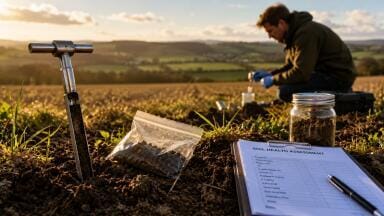
For monitoring professionals, the message is straightforward. Soil health is becoming less of a vague environmental aspiration and more of a measurable, auditable and policy-relevant condition. That shift will depend heavily on the people who know how to turn a bag of soil into reliable environmental evidence.
IET 36.5 Sept/Oct 2026



 Product directory
















.jpg)