.jpg)
Soil testing
In the realm of environmental monitoring, few resources are more foundational, or more underused, than soil data.
Yet despite soils underpinning everything from food security to flood prevention, the most comprehensive record of England and Wales’ soils, the National Soil Inventory (NSI), remains locked behind restrictive licensing and access barriers.
That may be about to change.
In June 2025, a coalition of soil scientists, environmental advocates, and monitoring professionals issued a compelling letter to the Secretary of State.
Their request was unambiguous: make the National Soil Inventory fully, freely, and permanently accessible to all users.
Backed by the Sustainable Soils Alliance, ClientEarth, the Rivers Trust, and senior soil scientists from Aberdeen and the James Hutton Institute, the letter frames this as a litmus test of the government’s environmental ambition and its commitment to open, effective governance.
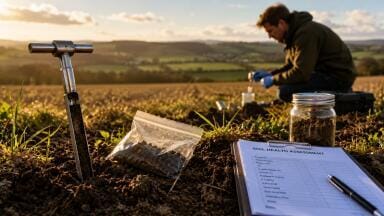
Created in the 1970s with public funding, the NSI provides geolocated, national-scale data on the physical, chemical, and biological properties of soils.
It’s vital for assessing degradation, designing nature-based solutions, and evaluating carbon storage potential.
In short, it’s the reference point for any serious attempt to understand or improve soil health.
Yet the dataset is controlled by Cranfield University under a licensing regime that is complex, restrictive, and expensive.
Responses to two FOI requests in 2024 revealed that only seven licences were granted to public bodies over a five-year period.
In contrast, more than 970 licences were issued to commercial or not-for-profit users, each paying for access to information that was originally funded by taxpayers.
This arrangement creates a paradox. Government departments and research institutions responsible for delivering public environmental goods are being asked to pay again for access to data they already financed.
While the total spend, about £3.4 million over five years, might seem small, the real cost is strategic. Every pound spent on licensing negotiations is a pound not spent on actual soil health improvements.
What gives this campaign fresh urgency is the convergence of political momentum, technical possibility, and ecological pressure.
On the policy front, England’s long-delayed Land Use Framework is finally approaching publication, and soil is climbing up the agenda.
DEFRA’s environmental targets depend on soil recovery but without open access to baseline data, aligning policy with practice becomes harder and slower.
Meanwhile, soil monitoring technologies are evolving rapidly.
Fibre-optic sensors, satellite-linked moisture tracking, and AI-driven carbon estimators promise near real-time data flows. But without historical baselines like the NSI, these technologies lack context.
The tools are ready, but the foundation remains locked away.
England’s approach to soil data also raises questions of fairness and precedent.
Scotland made its equivalent dataset, the Scottish Soil Survey, freely accessible in 2011.
Since then, open access has enabled faster, clearer policy responses and greater uptake across sectors.
Dr Matthew Aitkenhead of the James Hutton Institute, a signatory to the letter, notes that Scotland’s open data approach has repeatedly proven its worth.
It has supported national policy goals and delivered commercial value to partners in energy and water.
While it might be tempting to see this as an academic licensing issue, the consequences reach far wider.
This is a structural problem affecting the entire environmental data ecosystem.
Local authorities struggle to assess soil vulnerability in nature recovery plans because they can’t afford access.
Start-ups working on soil sensors or modelling tools hesitate to use NSI-derived data for fear of breaching licensing terms.
Environmental NGOs conducting catchment restoration projects can’t align monitoring with interventions without access to field-level baselines.
Even farmers and land managers, encouraged to adopt regenerative practices, are left without the essential reference data they need to make informed decisions.
When foundational data is locked away, collaboration breaks down. Innovation stalls.
Resources are wasted on redundant efforts. In a system where interoperability is essential, keeping the NSI under lock and key holds everyone back.
Opening the NSI is not simply a matter of saving money, it’s about building coherence across the monitoring landscape.
With open access, a shared vocabulary becomes possible. Monitoring professionals could calibrate new sensors against validated baselines.
Researchers could publish models without redacting key inputs.
Developers could create tools that integrate field-level data seamlessly. And perhaps most importantly, it would unlock private investment.
Businesses are far more likely to build tools, platforms, or analytics products when they don’t need to negotiate data use on a case-by-case basis.
Imagine a national soil data environment where NSI records sit alongside live feeds from in-field sensors, satellite outputs, and citizen science observations.
It’s not a pipe dream: Europe’s Soil Mission is already building toward this reality. England and Wales risk being left behind, not because of technical limitations but because the foundational dataset is still behind a paywall.
The letter makes a single, specific demand: that all NSI data and maps be made freely and permanently available, with no licence restrictions, for any user. That means full access. No fragmentation. No bespoke permissions.
With DEFRA already in negotiations with Cranfield, the government has a clear opportunity to act.
Doing so would demonstrate evidence-led policymaking, eliminate unnecessary public spending, and catalyse innovation across the public and private sectors.
It would also help rebuild trust between government and researchers, between policy and delivery.
Soil health has rightly risen up the policy agenda. But ambition without access is just rhetoric.
Unlocking the NSI would be both a symbolic and material step toward serious, evidence-led environmental progress.
If soils are to underpin biodiversity recovery and food system resilience in the years ahead, we need to give monitoring professionals all of the available tools.
IET Guide 2026

 Product directory