Leak detection
A growing number of oil, gas, water and infrastructure operators are considering it as a practical monitoring strategy.
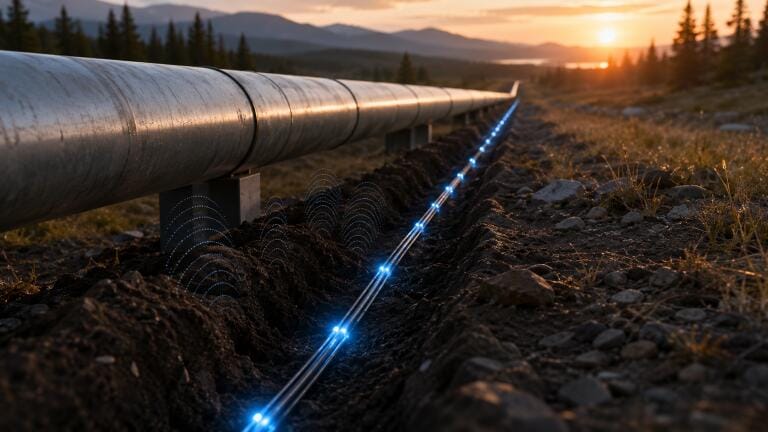
Distributed Acoustic Sensing, or DAS, uses fibre optic cable to detect vibration, strain and acoustic activity along long linear assets.
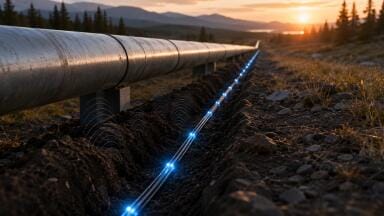
In pipeline applications, that means a cable running alongside, near, or in some cases inside the pipeline can act as thousands of listening points distributed along the route.
Instead of relying only on pressure changes, flow imbalance, periodic inspection or manual patrols, operators can continuously monitor the acoustic behaviour of the line itself.

For leak detection, the appeal is obvious. A small leak does not always create an immediate, dramatic pressure drop. It may not be visible from the surface.
It may occur in a remote location, under water, under soil, in a sensitive habitat or in a congested industrial site where background process noise makes conventional detection difficult.
But when pressurised gas or liquid escapes from a pipe, it creates vibration and acoustic energy. DAS is designed to detect those kinds of changes.
The technology works by sending laser pulses through a fibre optic cable and analysing the tiny fraction of light that is scattered back. When the fibre is disturbed by vibration, ground movement, flow noise or acoustic energy from a leak, the backscattered signal changes.
By measuring those changes along the length of the fibre, the system can identify where an event has occurred and how its acoustic signature differs from normal background activity.
A conventional detector measures what happens at one location. A pressure transmitter, flowmeter, hydrophone or gas detector may be highly valuable, but it only sees the system from its own installed position. DAS offers a distributed view. In effect, the pipeline route becomes a continuous monitoring zone.
For environmental and process monitoring professionals, that is a major shift. Leak detection has often been treated as a question of alarms after something has gone wrong. DAS pushes the field closer to continuous surveillance of asset integrity.
It does not simply ask whether a leak has already become obvious. It asks whether the acoustic behaviour of the pipeline has changed in a way that could indicate an emerging problem.
This matters because many of the most damaging leaks are not dramatic ruptures. They are small, persistent failures that remain unnoticed until contamination, product loss, pressure instability or environmental damage has already occurred.
Pinhole leaks, corrosion-related defects, poor joints, damaged coatings and third-party interference can all create problems before they become visible incidents.
In those cases, earlier detection is not just a technical improvement. It can be the difference between a manageable maintenance event and a costly environmental response.
Recent research is helping to move DAS and acoustic leak detection from signal collection toward intelligent interpretation. Machine learning models are increasingly being trained to recognise the acoustic and vibration signatures associated with different leak scenarios.
This is important because pipelines are noisy environments. Pumps, valves, road traffic, ground movement, animals, weather, maintenance activity and normal process variation can all produce signals that may look significant to a simple threshold-based alarm system.
By training models on known leak signatures, systems can begin to distinguish genuine events from background noise and routine operational activity.
In controlled studies, researchers have shown that acoustic emission and fibre optic approaches can detect small leaks that may be difficult for conventional monitoring methods to identify, especially where the pressure or flow change is too subtle to trigger a clear alarm.
For operators, this could help address one of the persistent weaknesses of leak detection: false alarms. A system that alarms too often quickly loses credibility with control room staff.
If every event requires a field team to investigate a harmless vibration or routine valve operation, the system becomes burdensome. But if the system can classify events more intelligently, prioritise higher-risk signals and provide a more precise location, it becomes a practical decision-support tool rather than just another source of noise.
The localisation capability is one of the strongest arguments for DAS. In a long-distance pipeline, knowing that something has happened is only half the problem.
Operators also need to know where to send a response team. DAS can often narrow the location of an acoustic event to a relatively short section of pipeline, depending on the fibre layout, coupling, signal quality and system configuration.
That can reduce search time, shorten response windows and help maintenance teams move from general investigation to targeted intervention.
This is especially relevant for buried, offshore or remote pipelines. In these environments, visual confirmation may be slow, expensive or impossible without specialist equipment.
Aerial surveys, drones, satellite methane detection, pressure analysis and computational pipeline monitoring all have roles to play, but they may not provide precise subsurface localisation on their own.
DAS can complement those methods by adding a continuous acoustic layer close to the asset.
A useful way to think about the future of leak detection is not as a competition between one technology and another, but as a layered monitoring architecture.
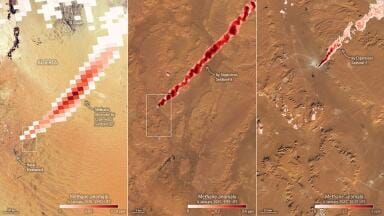
Satellites can identify large-scale methane anomalies or broad environmental signals. Drones and aircraft can inspect corridors and provide targeted imaging or gas measurements. Pressure and flow systems can track hydraulic behaviour inside the pipeline. DAS can listen continuously along the route and localise acoustic events.
Ground teams and laboratory analysis can then confirm what has happened and assess any environmental impact.
For monitoring professionals, that layered model is where the real value lies. No single system will solve leak detection in every context. DAS is powerful but it is not magic.
It depends on fibre placement, fibre condition, coupling to the pipeline or surrounding medium, signal processing, calibration and interpretation.
A poorly installed or poorly understood DAS system can generate confusing data. A well-integrated system can become a major part of an operator’s integrity and environmental protection strategy.
This is why the technology creates opportunities not only for fibre optic sensing companies, but also for instrumentation specialists, environmental consultants, data analysts, system integrators and service providers.
Operators will need help designing the monitoring architecture, deciding where DAS is appropriate, integrating it with existing SCADA and alarm systems, and building workflows that turn acoustic data into operational decisions.
The data challenge should not be underestimated.
DAS systems can generate very large volumes of information. For a pipeline operator, the issue is not simply whether the system can detect vibration.
It is whether the data can be processed fast enough, interpreted reliably and presented in a form that control room teams can use.
That means alarm logic, event classification, historical baselining, data storage, cybersecurity and reporting all become part of the monitoring conversation.
Earlier leak detection can reduce the scale of contamination, lower the volume of lost product and improve the chances of containing an incident before it spreads through soil, groundwater, rivers, wetlands or coastal waters.
In that sense, DAS should be seen as an environmental risk reduction technology.
It may also change expectations around evidence. Regulators, insurers and stakeholders increasingly want to know not only how operators respond to incidents, but how they monitor for them in the first place.
A pipeline fitted with continuous distributed sensing can produce a much richer record of normal operation, abnormal events and response times. That can support compliance, incident investigation and risk assessment, but it also raises the bar for data management.
If continuous monitoring exists, operators need to be able to explain what it showed, when it showed it and how they responded.
For instrument suppliers, this creates a more sophisticated market. The question is no longer simply whether a leak detector can detect a leak under ideal test conditions.
Buyers will want to know how the system performs across different soil types, burial depths, pipe materials, flow regimes, fluids, pressures and noise environments.
They will also want to know how easily the data can be integrated with existing control systems, how false alarms are managed and what level of expertise is required to maintain the system over time.

DAS is also likely to become more relevant as pipeline networks diversify.
Oil and gas operators are not the only potential users. Hydrogen pipelines, carbon dioxide transport networks, water mains, district heating systems and chemical pipelines all face leak detection challenges.
Some of these networks will carry fluids or gases with unfamiliar acoustic behaviour, different safety risks and different environmental consequences. As those markets develop, distributed fibre optic sensing could become part of the standard monitoring toolkit.
The human point is simple. Leak detection is a practical question of whether they can see trouble early enough to act.
It affects control room operators deciding whether an alarm is real, field engineers sent to investigate remote sections of pipeline, environmental teams trying to limit damage, and suppliers asked to provide systems that work outside controlled demonstrations.
Distributed Acoustic Sensing will not replace every existing method, and it should not be presented as a universal solution. But it is changing what operators can reasonably expect from pipeline monitoring.
Instead of waiting for leaks to become visible, measurable at a pressure station or obvious in the environment, DAS allows the pipeline corridor itself to become part of the monitoring system.
For environmental and process monitoring professionals, that is the real significance. The future of leak detection is not just more sensors. It is more continuous, more spatially detailed and more integrated evidence about how critical infrastructure is behaving. DAS is helping to make that future operational.
IET Guide 2026

 Product directory