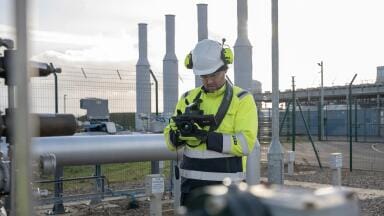
Environmental laboratory
Instead of operating through dispersed programmes and sector-led initiatives, the new plan creates a unified statutory, cross-government system intended to drive measurable environmental outcomes between now and 2043.
For environmental monitoring professionals, the plan establishes new responsibilities and data expectations between land, water and air.
It also introduces more prescriptive timelines and enforcement structures than previous environmental strategies.
The EIP’s purpose is to transition England from broad environmental aspirations to defined delivery actions.
It reorganises policy around ten long-term goals, ranging from air and water quality to chemicals, resources, hazards, climate resilience and access to nature.
Each goal contains a set of commitments and interim statutory targets.
Annual progress reporting will be tied directly to these metrics, creating clearer expectations for regulators, local authorities, water companies, land managers, consultants and monitoring organisations.
A central feature of the EIP is the integration of legally binding targets from the Environment Act 2021 into every relevant chapter.
This ensures that environmental monitoring is no longer optional or ad hoc; it becomes the primary means of tracking compliance.
Many targets have interim milestones for 2030 or earlier, which creates immediate demand for consistent, high-resolution datasets.
The plan’s targets include halting species decline, reducing population exposure to harmful air pollutants, restoring freshwater habitats, increasing tree cover, improving soil health and reducing the risks posed by hazardous chemicals.
In practice, meeting these goals will depend on the quality and reliability of environmental data.
The plan emphasises that monitoring networks must improve, become more consistent and integrate across sectors so that environmental conditions can be assessed at national scale.
The chemicals and pollution chapter is one of the most relevant sections for environmental monitoring professionals.
It establishes a clear expectation that chemical releases must be identified (by quantity) and reduced at source.
The goal is to create a safer chemicals regime supported by more dynamic monitoring, smarter regulation and updated safety standards.
This chapter encompasses a wide array of substances, including regulated industrial chemicals, pesticides, hazardous waste components and persistent pollutants.
The plan highlights the need for up-to-date exposure data and improved technical guidance on analytical techniques.
PFAS sits within this broader chemicals framework, but the plan also references the need to keep pace with emerging pollutants and evolving risk-assessment methods.
A significant structural change in EIP 2025 is the formalisation of Local Nature Recovery Strategies (LNRS).
These will cover the entire country and form the basis for spatial prioritisation of habitat creation, water improvements, land management decisions and investment routing.
LNRSs will rely on monitoring data to determine where environmental interventions are most needed and whether they are delivering measurable improvements.
Environmental monitoring organisations will engage with LNRSs in several ways: through baseline assessments, targeted surveys, remote sensing data, hydrological monitoring, ecological condition assessments and long-term trend analysis.
LNRSs will also guide planning decisions, meaning that environmental datasets will increasingly be required in routine development processes.
EIP 2025 links water quality, land use, climate resilience and natural capital into a single policy framework.
For monitoring specialists, this integration changes the nature of environmental assessment.
Water-body condition, flood risk, soil quality, nutrient status, carbon storage, drought risk and ecological health will be assessed in relation to one another, rather than as separate regulatory domains.
The plan directs £104 billion of investment into the water sector over the next five years, which will significantly increase demand for real-time and high-frequency monitoring.
It also embeds nature-based solutions into water and flood-management planning.
This will require new types of monitoring, including hydrological behaviour of restored wetlands, sediment transport in river corridors, evapotranspiration from new woodland areas and the water-quality impacts of habitat creation.
A cross-government Environmental Improvement Plan Board will oversee delivery of the plan.
This is intended to remove ambiguity about responsibilities and ensure that departments act consistently.
For environmental monitoring professionals, this means regulatory expectations will become more unified and predictable across sectors.
The Corry Review, published alongside the EIP, has prompted commitments to reform and modernise environmental regulation.
This includes the use of digital tools, improved data flows between regulators and operators, streamlined permitting processes and clearer outcome-based guidance.
Monitoring professionals should expect greater scrutiny of data quality, improved transparency requirements and wider use of telemetry and automated reporting.
EIP 2025 signals long-term growth in the demand for environmental data.
Water companies will need to expand monitoring networks to demonstrate delivery of investment plans.
Local authorities will require detailed environmental baselines for planning decisions.
Land managers engaged in agri-environment schemes will need monitoring to evidence compliance.
Industrial operators will face more frequent inspections and automated reporting requirements.
The plan also highlights the importance of green skills and technical training.
Increased investment in apprenticeships, qualifications and workforce planning reflects an expectation that monitoring roles will expand across water, agriculture, forestry, waste and chemicals regulation.
EIP 2025 is not simply another government strategy; it is a statutory framework that defines how environmental progress will be delivered and measured for at least two decades.
For environmental monitoring professionals, it sets out a predictable long-term operating environment based on robust data, formalised reporting requirements and cross-sector coordination.
Its targets, governance structures and investment commitments all reinforce the central role of monitoring in environmental protection.
As the plan moves from publication to implementation, monitoring organisations will play a critical role in ensuring that environmental improvements are not only promised but evidenced.
IET Guide 2026

 Product directory