Water monitoring
While sewage overflows dominate headlines, runoff from the nation’s roads is quietly undermining decades of progress in water quality.
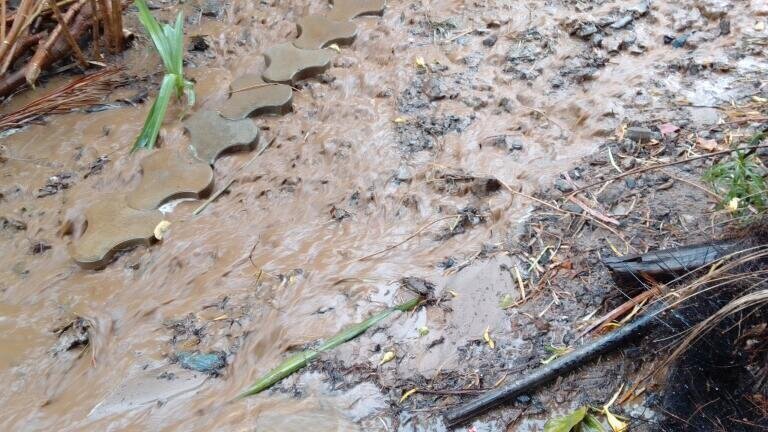
Recently, at the Environmental Audit Committee, MPs heard that 25,000 highway outfalls regularly discharge heavy-metal-laden, microplastic-rich water directly into rivers, with no permits and no continuous monitoring.
The Environment Agency’s (EA) own data suggest this road runoff accounts for roughly 18% of the reasons England’s rivers fail to achieve good ecological and chemical status.
The regulatory vacuum is remarkable. Sewage outfalls are monitored and, at least nominally, controlled through the EA’s systems.
But laden with particles from tyre and brake wear, hydrocarbons and heavy metals like zinc, copper, and lead, road runoff are not (yet) under the same scrutiny.
There are currently no permits for highway discharges in England.
That means the very contaminants most likely to accumulate over time in sediments and biota are the least understood.
The toxicity profiles of these outflows vary dramatically depending on rainfall, traffic density, and local geology, making them precisely the kind of diffuse source pollution that requires continuous, event-based monitoring to characterise.
Without that monitoring, the true scale and chemistry of this pollution remain conjectural.
The Environment Agency has acknowledged that runoff from highways and urban areas is a serious issue, but admits it does not routinely monitor it.
From an instrumentation perspective, road runoff is an engineering challenge that environmental monitoring technology is already equipped to tackle—but policy has lagged behind capability.
The tools exist, but the devil's in applying them correctly.
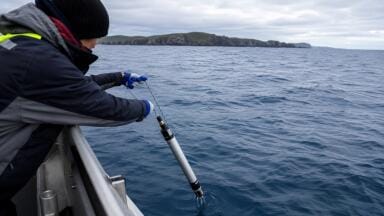
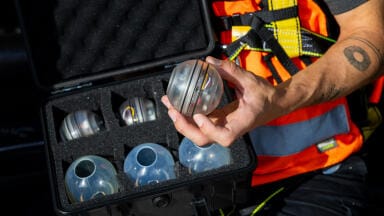
Automated samplers triggered by rainfall events could capture representative pollutant loads.
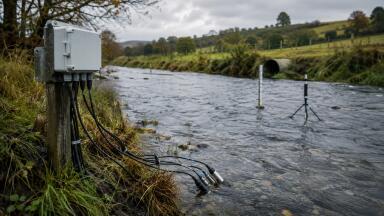
In-situ turbidity, TOC and heavy metal probes could track concentrations in real time.
Microplastic sensors and optical particle counters could provide new insights into transport and degradation dynamics.
Machine-learning models fed by catchment-scale sensor networks could predict pollution spikes and identify high-risk discharge points.
Yet none of this is being deployed systematically. Monitoring remains confined to pilot projects by researchers and consultancies, rather than a national framework.
The Environmental Audit Committee heard that National Highways has identified 126 high-risk sites requiring mitigation by 2030—but this covers only a fraction of the 25,000 known outfalls.
Nick Harris, the agency’s chief executive, said work had been completed at just 40 so far.
The delay reflects not just funding constraints but a structural gap in how the UK’s environmental institutions assign responsibility.
Highway pollution sits awkwardly between the EA’s regulatory duties, Defra’s policy remit, and the operational domain of National Highways.
The recently published Cunliffe review of the water sector barely mentions road runoff at all, despite its significance for river health.
This means that, unlike water company discharges, which are visible through the EA’s public datasets and pollution alerts, the nation’s road runoff problem is essentially data-dark.
Pressure is now building for inclusion of road runoff in the government’s upcoming water white paper, with experts arguing that the next phase of water policy must address diffuse and non-sewage pollutants.
If that happens, demand for monitoring technologies capable of operating in highly variable, sediment-rich flows will surge.
We could soon see all sorts of innovative infrastructure.
For instance, roadside monitoring stations could be integrated into smart drainage systems and event-based sensors could feed into digital twins for catchment management.
Cross-sector partnerships between Highways England, local authorities, and sensor manufacturers.
The shift would also align with Stormwater Management Plans under the Flood and Water Management Act and help meet Water Framework Directive objectives still embedded in UK law.
If sewage monitoring has become the poster child for environmental accountability, road runoff is its neglected twin—just as toxic, but invisible.
For the environmental monitoring sector, the implications are clear: the next major regulatory and technological frontier in water quality is not underground, but on the tarmac.
Every rainfall event is a live experiment in toxic chemistry. It’s time we started measuring it.
IET 36.5 Sept/Oct 2026



 Product directory




.jpg)













.jpg)