River water monitoring
With less water to dilute effluent and diffuse inputs, solutes and particulates build up in the remaining flow.
EPA guidance notes that “during a low-flow event… there is less water available to dilute effluent loadings, resulting in higher in-stream concentration of pollutants”.
Similarly, UK studies of drought impacts report that “as water availability is reduced, concentrations of dissolved nutrients and pollutants may increase”.
In other words, nutrient, metal and organic contaminant levels tend to spike as summer dry periods and drought shrink rivers.
Many Europe-wide assessments (e.g. WFD reporting) flag low-flow or river abstraction as a pressure that exacerbates nutrient enrichment and chemical pollution.
In practice, river monitoring shows that the effect of low flow can outstrip even point-source control: a major US study found that in hundreds of small streams, wastewater effluent dominated summer flow and caused endocrine-disruptor concentrations to exceed safety thresholds.
Rice and Westerhoff (2017) mapped dilution factors in >14,000 U.S. streams and found that effluent often constitutes most of the flow in headwater reaches.
In over 900 streams surveyed, treated sewage made up >50% of streamflow.
Crucially, during exceptional low-flow (drought) events the dilution fell so far that one or more endocrine chemicals exceeded chronic safety limits in many cases.
This illustrates how low-order reaches with WWTP inputs can become “effluent-dominated” when flows drop.
In practical terms, monitoring has found that sewage-derived contaminants (pharmaceuticals, pathogens, organic load) become highly concentrated in summer baseflows.
Similar USGS data have shown that hormone mimics and other micropollutants accumulate in low flows because the treated wastewater provides most of the water.
These findings underscore that even well-treated sewage is a pollutant source: at low flow it can overwhelm small streams.
Many pollutant types respond to low flow. Nutrients (nitrogen, phosphorus) typically build up when summer rains fail.
For example, European models predict that reduced river flow under climate change will raise nutrient concentrations and eutrophication risk, since there is less dilution of fertilisers and wastewater.
In one UK catchment, phosphate and nitrate loads were observed to concentrate in low-flow summer periods (since agricultural run-off is limited and uptake slows).
However, biological processes can modulate this: in some rivers, algal uptake and denitrification may lower nitrate in very low flows, whereas phosphorus often remains elevated (phosphate binds to settled sediments).
Monitoring programmes must therefore sample carefully – an unusually high nutrient reading in summer may reflect lack of flow more than new pollution.
Heavy metals often show striking flow-dependent patterns.
In mining-impacted streams, dissolved metals rise as flow falls. For instance, USGS studies at a former mining site in Idaho found arsenic in groundwater leaching into creeks.
Arsenic concentrations increased downstream (8.9 µg/L at an upstream site vs 56.5 µg/L further downstream) and peaked in late summer low flows.
In fact, at all sampling points arsenic was inversely correlated with discharge.
This implies that baseflow (groundwater) dominates the chemistry in drought: as rain declines, the same arsenic load is borne by fewer cubic metres of water, so concentration spikes.
By contrast, some metals bound to particles behave oppositely.
The Idaho study showed mercury (mostly particulate) peaking during spring flood flows (April–June) and dropping in summer.
Thus, heavy-metal responses depend on speciation: dissolved forms often rise in drought, whereas sediment-bound metals may stay trapped at low flow and only surge during floods.
In general, low flows push rivers toward groundwater and pollution sources that vary less with rain (e.g. aquifers, septic systems), concentrating what remains in the stream.
Detecting these concentration shifts requires appropriate instrumentation and sampling strategies.
Traditional grab samples (monthly/weekly sampling) may miss transient dry-season spikes, so modern programmes often use automated or high-frequency methods.
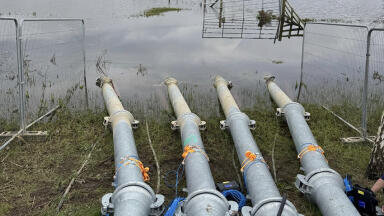
For example, autosamplers can be programmed to collect composite samples during critical low-flow periods.
In-situ sensors (multi-parameter sondes) now measure conductivity, turbidity or nitrate continuously; these can act as surrogates for pollutant loads.
USGS researchers routinely deploy probes (water-level, specific conductance, temperature) and develop regression models to estimate contaminants in real time.
In one study of Idaho streams, a surrogate model used continuous conductivity and discharge data to predict dissolved arsenic and antimony levels.
These models allow flow-driven extrapolation from occasional lab samples, yielding near-real-time concentration curves.
Other techniques include passive samplers (e.g. polar organic chemical integrative samplers, POCIS) that accumulate micropollutants over weeks, useful when low flows give limited sampling volumes.
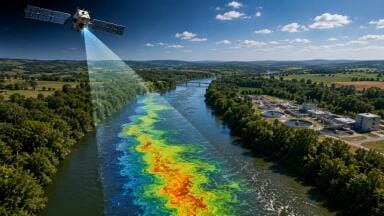
Remote monitoring (satellite, in-situ fluorometry) is emerging for proxies like algal blooms or turbidity.
Crucially, agencies integrate flow measurements with chemistry: large monitoring networks (such as the UK’s Harmonised Monitoring Scheme) combine flow gauges and water samples at mainstem sites.
The UK HMS, for instance, has 135 long-term sites (many near tidal limits) measuring nutrients, BOD and metals (As, Cd, Cr, Cu, Pb, Ni, Zn) over decades.
Such datasets allow analysis of concentration vs flow trends across seasons.
Several factors can complicate the simple picture of “low flow = high concentration.”
Sedimentation plays a big role: slow-moving water in dry seasons often causes fine sediments (and particle-bound pollutants) to settle in bed and banks.
This can temporarily lower suspended-particle concentrations even as dissolved fractions climb.
Conversely, a rain event after a drought can scour those deposits and flush a pulse of pollutants downstream (as happened in the Potomac after a 2002 drought–flood cycle).
Groundwater inflows can either dilute or concentrate depending on context.
In some catchments, cooling base-flow may dilute runoff pollution, but in others (mineralised areas) the groundwater itself carries contaminants (as for arsenic above).
Rainfall and runoff can both dilute (adding clean rain) or mobilise pollutants (washing fertilisers or flushing sewers).
For example, summer thunderstorms may briefly reduce concentration by adding water, whereas a single heavy downpour can entrain nutrients and metals from soils.
Human interventions also matter.
Wastewater upgrades are reducing loads of certain pollutants (e.g. ammonia, P, some organics) – meaning low-flow concentration spikes may be smaller than decades ago.
Abstraction and reservoir operations can alter flows: dam releases may maintain constant discharge (blunting low-flow effects downstream) or hold back water (exacerbating natural drought).
Some riparian wetlands or hyporheic zones may buffer pollutant peaks via filtration or denitrification.
Monitoring teams must account for these variables: for instance, a steady low flow during summer may actually result from upstream flow augmentation, masking what would otherwise be an extreme concentration scenario.
For monitoring professionals, interpreting low-flow sampling requires care.
First, always consider flow context when evaluating concentrations.
A high concentration on a drought day might represent a normal or even reduced pollutant mass load; the spike may simply reflect lack of dilution.
Wherever possible, analysts calculate loads (concentration×flow) or use flow-normalised metrics (e.g. flow-weighted mean concentrations) to distinguish genuine pollution trends from hydrologic variability.
For example, many agencies adopt “critical low-flow” designations: setting permit limits (TMDLs) based on extreme low-flow scenarios so that criteria are still met under worst-case dilution.
However, sampling during very low flows also has challenges: very low volumes may be hard to grab, and some sensors (e.g. for turbidity) become noisier at near-zero flow.
It is advisable to supplement point samples with continuous loggers and to compare multiple events.
Professionals should also remember that many regulations apply to concentration thresholds.
Under the EU Water Framework Directive and Environmental Quality Standards, it is the pollutant concentration that matters for ecological status.
Thus a modest pollutant load can fail a river if the water volume is small.
Field teams should flag unusually high concentration readings in low flow as potentially requiring action (e.g. investigating sewage leaks or illicit discharges), even if raw loads haven’t spiked.
In sum, trend analyses must always pair chemistry with hydrology; neglecting flow leads to misinterpretation of whether a river is truly worsening or just running dryer.
Recent studies confirm that climate-driven droughts are already degrading water quality.
A global review of ~1000 case studies found that in 68% of drought/heatwave events, river water quality worsened.
Many authors note that “low-flow years” tend to concentrate contaminants because “there’s less water to dilute them”.
Projections suggest such episodes will become more frequent: USGS scientists warn that “exceptionally low river flows are predicted to become more frequent and severe… as a consequence of climate change”.
Their modelling of a Colorado mountain watershed shows that under future drought, up to 66% of streamflow may come from metal-rich groundwater (vs 25% at median flow), potentially raising trace metal levels.
At the same time, lower pH and cooler flows at drought may increase sorption onto sediments, meaning dissolved concentrations may not rise as much as expected.
Globally, researchers anticipate more drastic “concentration–discharge” extremes – longer zero-flow spells and sharper pollution pulses – as rainfall becomes more erratic.
The concentration spikes during low flows have important implications.
Regulators may need to reassess standards and monitoring frequencies.
For example, the upcoming EU Urban Wastewater Treatment Directive recast recognises that effluent dilution is limiting: it explicitly calls for treating nutrient removal upgrades in areas “at risk” based on the river’s dilution capacity.
Some jurisdictions already set stricter effluent standards for small or ephemeral rivers: e.g. Hungary requires total-P limits of 5 mg/L for discharges to ephemeral streams (versus 10 mg/L in larger waters).
This acknowledges that dry streams can’t tolerate typical pollutant loads.
Higher concentrations also raise human and ecological risks.
Some drought-season spikes are to regulated micropollutants: as noted, endocrine-disrupting chemicals have exceeded safe levels in low-flow US streams.
Excess nutrients during low water can trigger algal blooms and oxygen depletion (dry-season blooms can persist when summer flows are low).
The University of Maryland review warns that nitrogen stored in dry soils may be flushed in toxic pulses when rains return, threatening drinking water and fisheries.
Heavy metals concentrated in low flows could briefly exceed drinking-water limits if abstracted.
Monitoring agencies should thus gear up for extremes: higher-frequency sampling in low-water seasons, use of continuous sensors, and integration of hydrologic data into assessments.
Understanding how sedimentation, groundwater, and human interventions modify low-flow chemistry is crucial for setting realistic WFD status targets and water quality standards.
Overall, the evidence is clear: “dilution is the solution to pollution” only when flows are ample.
In drier futures, we must anticipate that natural dilution will fail, and field practices should reflect that concentrations – not just loads – will often rise in the river’s lowest reaches.
IET 36.5 Sept/Oct 2026


 Product directory




.jpg)















.jpg)






.jpg)